

Three ascendancies, one class — and the wrong pick costs you dozens of hours before you can respec. This guide doesn’t just list Lich, Blood Mage, and Infernalist as options. It explains the mechanics behind each: why Lich’s Unholy Might underperforms in hybrid builds, why Blood Mage’s Gore Spike scales directly from a life pool number, and why Infernalist’s Infernal Flame system punishes stopping just as much as it punishes reckless casting.
Both patches 0.5.0 and 0.5.1 shifted the meta. Blood Mage leech doubled to 20% in 0.5.0, and Lich’s Eternal Life passive lost its reservation restriction in 0.5.1. Those changes affect which builds are viable and at what investment level. Everything below is verified against GGG’s official patch notes for both updates.
Quick Start: Choose Your Witch Ascendancy in 60 Seconds
If you’re in Act 2 choosing your first ascendancy and don’t want the full breakdown yet, this table routes you to the right pick. Read the deep dives below to verify the choice before committing.
| What you want | Pick | Why |
|---|---|---|
| First Witch, campaign forgiveness | Infernalist | Demon Form covers campaign bosses; Hellhound tanks melee |
| Minion-focused build | Infernalist | Beidat’s Will converts life to Spirit for more minion slots |
| Chaos damage over time, curse control | Lich | Necromantic Conduit + Incessant Cacophony is the strongest curse loop |
| High-burst spell crits | Blood Mage | Gore Spike + Sunder the Flesh is the most direct crit path on Witch |
| Group / party play | Lich | Blasphemy Cursebot can double group DPS through debuff auras |
| Solo endgame with gear investment | Lich | Highest damage ceiling; Eternal Life ES buffer handles spike damage |
Lich: The Chaos Scaling Engine
Lich has the highest endgame ceiling of the three Witch ascendancies. It also has the steepest gear requirement. The system runs on a dual-resource loop: Energy Shield acts simultaneously as your defense, your life buffer, and the cost of your highest-damage passive node. Understand that triangle before building anything else.
The Unholy Might Math Most Guides Skip
Necromantic Conduit grants Unholy Might — 30% of all your damage as extra Chaos — while you stay above 30% Mana, at a continuous cost of 5% maximum Mana per second. The number every hybrid Lich build gets wrong: your primary damage type’s increased modifiers do not apply to the Chaos bonus.
Exact math: if you deal 100 Lightning damage and have 80% increased Lightning, your hit becomes 180 Lightning + 30 Chaos — not 54 Chaos. The 80% increased Lightning multiplies only the Lightning portion. Chaos-specific modifiers are the only way to push the Chaos bonus higher. This is why pure Chaos builds — with Chaos damage rolls on rings, amulet, and passive tree — outperform hybrid builds even with equivalent gear budgets. Every “increased Chaos Damage” roll on a ring scales the bonus directly; every “increased Lightning Damage” roll does not touch it at all.
Blackened Heart compounds this: the node adds 4% Unholy Might magnitude per 100 maximum Mana. At 1,000 maximum Mana, Unholy Might becomes 40% of damage as Chaos instead of 30% — a 33% relative gain just from Mana investment. At 1,500 Mana, it reaches 46%. Scaling Mana on Lich is not just sustaining Necromantic Conduit — it is directly increasing your damage bonus.
Eternal Life and the Energy Shield Defense Layer
Eternal Life prevents your life pool from changing while you have any Energy Shield remaining. Your ES absorbs hits first; your life is untouchable until ES drops to zero. Soulless Form regenerates Mana at 6% of maximum Life per second, which keeps Necromantic Conduit fueled as long as ES holds. The result: ES functions as defense, mana sustain, and life protection simultaneously.
Patch 0.5.1 removed the restriction that prevented Eternal Life from coexisting with Life Reservation. Previously, any life-reservation aura interacted directly with your life pool, bypassing the Eternal Life protection. That block is gone — you can now run reservation buffs alongside Eternal Life without penalty, opening reservation-stacking builds that weren’t viable before.
Eldritch Empowerment adds 30% more damage to non-channeling spells at a cost of 3% maximum ES per cast. This is the sustainability trade-off: high-damage bursts cost ES, reducing your life buffer. Without ES recovery, sustained heavy casting drains your defensive layer. The node is powerful, but it requires ES regeneration investment to be safe under pressure.
Rupture the Soul: Why Clear Speed Snowballs
Cursed enemies killed have a 33% chance to explode, dealing 25% of their maximum Life as Chaos damage. Incessant Cacophony makes your curses permanent — once cursed, an enemy stays cursed until death, no reapplication needed. In a dense map, the first kill in a pack triggers chain explosions through Rupture the Soul. You’re not hitting each enemy; you’re triggering the first explosion and letting the physics engine clear the rest.
In group play, this scales further. The Blasphemy Cursebot build converts curses to auras via Blasphemy, applying them to every enemy in range passively. Combined with Rupture the Soul’s chain explosions and Necromantic Conduit’s Unholy Might aura, a Lich support can double or more the group’s effective DPS output against cursed targets without dealing direct damage themselves.
When NOT to play Lich: If you’re building your first Witch and haven’t managed ES gear before, the dual management of ES and Mana simultaneously is punishing when gear is weak. Lich underperforms harder than the other two ascendancies on budget gear. Start Infernalist for your first campaign run; come back to Lich with a planned gear path.
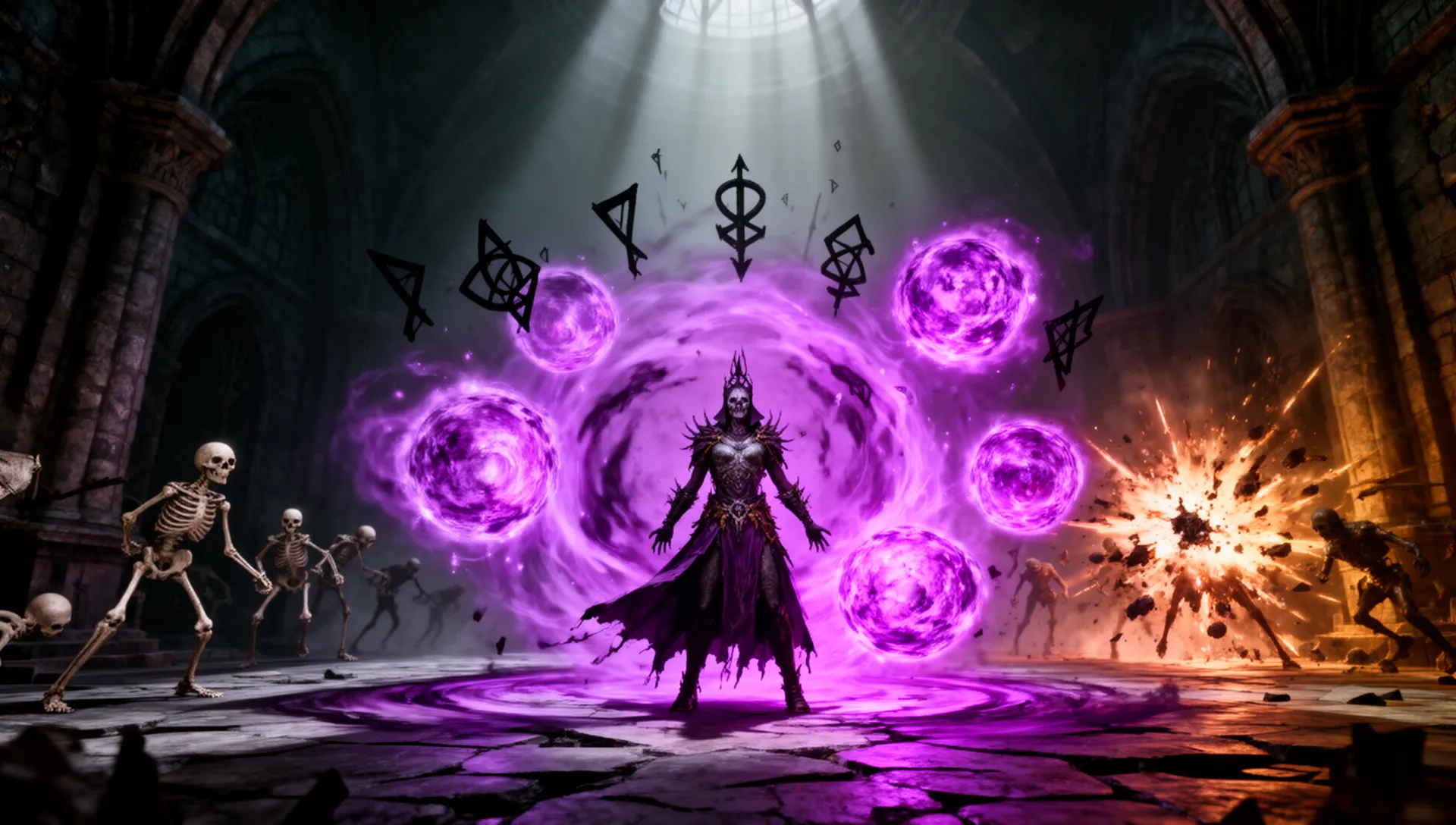
Blood Mage: Life-Cost DPS Explained
Blood Mage turns the question “how much damage can I deal?” into “how much damage can I absorb while dealing damage?” The ascendancy’s entire architecture links your life pool to your damage output — and then charges that life pool as a spell cost. The loop is powerful in the right content; it breaks in the wrong situations.
The Gore Spike Formula
Gore Spike grants 1% increased Critical Damage Bonus per 50 maximum Life. At 4,000 maximum Life — achievable mid-campaign with solid rare gear — that is 80% bonus Critical Damage Bonus applied to every critical hit. Stack Crimson Power (converts body armour Energy Shield to additional maximum Life) and you push that pool higher through a gear slot that doesn’t normally scale life.
Sunder the Flesh provides 15% base spell critical chance. Combined with tree nodes, reaching reliable crit strike rates doesn’t require specialized crit jewelry — the ascendancy provides the baseline. The full damage loop runs like this: cast a spell (costs Life via Sanguimancy), critical hit fires, Gore Spike applies bonus crit damage scaled to your life pool, Vitality Siphon returns 20% of spell damage as Life leech. The loop sustains itself when you’re hitting consistently.
The Leech Ceiling
Vitality Siphon was buffed in patch 0.5.0 from 10% to 20% leech — double the theoretical recovery on paper. The ceiling problem: since 0.5.0, only one leech instance per resource is active at a time, and the leech calculation caps at 40,000 per hit. For builds dealing well above 40,000 per hit, additional leech investment beyond Vitality Siphon returns no extra recovery. The percentage looks higher on paper than it delivers in practice at high investment levels.
AoE content compounds this. Distributed damage across many small hits generates less total leech than one large hit. Blood Mage sustains better in single-target content where each hit is large enough to generate meaningful leech. Ritual and Breach — both of which cluster enemies for simultaneous hits — are this ascendancy’s strongest content types.
The Life Remnant Problem
Sanguimancy converts your spell’s mana cost to a life cost and drops Life Remnant orbs on kills. Those orbs trigger recovery — but only when you physically collect them by walking over them. For melee builds staying inside packs, this is natural. For ranged casters, it means moving toward danger after every kill wave to collect recovery, directly against the instinct to maintain distance.
This mechanical friction is Blood Mage’s biggest weakness. Grasping Wounds delays 25% of incoming hit damage over 4 seconds, which masks how much damage you’re actually taking in real time. You feel safer than you are, then collect Life Remnants late, and the 25% delayed damage arrives while your life is already low. Playing Blood Mage correctly requires actively monitoring your life bar — not a passive survival loop like Lich’s ES buffer or Infernalist’s recoup heal.
The Detonate Dead build sidesteps the ranged Life Remnant problem by using corpse explosions instead of direct projectiles. Skeletal Brutes — the highest-health minions — are sacrificed via the Sacrifice skill, creating large AoE explosions that clear packs at range while the player stays near the corpse clusters. It works particularly well in Ritual, Breach, Expedition, and Trial of Chaos where enemies cluster on spawn.
When NOT to play Blood Mage: Aggressive players who take hits frequently will find the life-cost mechanic compounds fast under pressure. Players who prefer ranged playstyle will fight the Life Remnant collection mechanic constantly. First-time Witch players should skip it — the feedback loop of cast → lose life → scramble for recovery orbs is punishing during learning.
Infernalist: Managing Infernal Flame
Infernalist solves resource management by making the resource itself dangerous. Infernal Flame replaces Mana entirely — and when you let it cap, it takes your life and Energy Shield as fire damage. The ascendancy then gives you a survival loop that converts that damage into healing. Understanding this loop is the difference between Infernalist feeling infinite and feeling suicidal.
Pyromantic Pact: The Resource System
Pyromantic Pact replaces maximum Mana with maximum Infernal Flame at twice your mana value. If you had 1,000 Mana, you now have 2,000 maximum Infernal Flame. Skills cost Infernal Flame instead of Mana, removing traditional Mana management entirely. A new timing pressure replaces it: Infernal Flame decays at 25% per second if you stop gaining it for 2 consecutive seconds. Stop casting for more than 2 seconds, and your resource begins draining.
The overflow mechanic: when Infernal Flame hits maximum, you immediately take your maximum Life plus maximum Energy Shield as Fire damage, and the gauge resets to zero. This sounds like a death sentence. In practice, it’s the engine of the Recoup survival loop.
The Recoup Survival Loop
The belt affix “Recoup Fire damage as Life” converts the overflow damage back into healing. The larger the overflow hit, the larger the recoup heal. Energy Shield amplifies the overflow hit — because the overflow deals maximum Life plus maximum ES as damage, stacking ES directly scales how much you recoup. The counterintuitive build goal: maximize Energy Shield not to absorb hits, but to make your overflow hits larger, which makes your recoup heals larger.
Grinning Immolation adds a crit layer to this: any critical hit triggers a self-ignite at 15% Life and ES per second, but grants 50% more Critical Damage Bonus multiplicatively. For fire crit builds, Grinning Immolation is a free 50% crit damage multiplier funded by a burn you’re already healing through the recoup loop. The ignite damage and the recoup heal run simultaneously.
Beidat’s Reserve System
Three nodes each reserve 25% of your maximum Life in exchange for a stat conversion: Beidat’s Gaze gives +1 maximum Mana per 6 maximum Life (relevant for builds that still use Mana-based skills); Beidat’s Will gives +1 maximum Spirit per 25 maximum Life (the minion slot engine); Beidat’s Hand gives +1 maximum Energy Shield per 8 maximum Life (amplifying the recoup loop). These nodes are modular — pure fire casters skip Beidat’s Will entirely; minion Infernalists max it to stack Spirit for simultaneous minion counts.
Loyal Hellhound and Bringer of Flame
The Loyal Hellhound ignites enemies within a 2.5m radius passively. For hybrid fire and minion builds, this means consistent ignite uptime in melee range without active casting. The companion absorbs a portion of damage the Infernalist takes, acting as a permanent tanking buffer during campaign content and early maps.
Bringer of Flame extends ignite contribution to allies within 4m of the Infernalist: all ally damage in that radius contributes to ignite chance and magnitude. In group content, an Infernalist converts the entire group’s damage into fire ignite stacking — a passive team buff that scales with group size and damage output. The 4m radius is small enough to require positioning but large enough to cover most coordinated group configurations.
When NOT to play Infernalist: Builds relying on Mana-based skills or supports lose their resource entirely when Pyromantic Pact activates — check your gem costs before committing. Any build that needs consistent stop-casting windows (for repositioning, reading the room, waiting on cooldowns) will see Infernal Flame decay and require restart, losing casting momentum on every engagement.
All Three Compared: Endgame Performance Table
| Lich | Blood Mage | Infernalist | |
|---|---|---|---|
| Primary resource | Energy Shield + Mana | Life | Infernal Flame |
| Main damage type | Chaos (best as pure Chaos) | Physical / Spell Crit | Fire + Ignite |
| Best endgame content | All maps, group play | Ritual, Breach, Expedition | Maps, minion scaling |
| Defensive layer | Eternal Life (ES buffer) | Grasping Wounds (damage delay) | Recoup loop |
| Gear dependency | High (ES gear required) | Medium (life stacking) | Medium (unique belt) |
| New player difficulty | High | High | Medium |
| Group value | Best (Blasphemy Cursebot) | Solo-focused | Good (Bringer of Flame) |
| 0.5.x patch change | 0.5.1: Eternal Life unrestricted | 0.5.0: Leech buffed to 20% | No major changes |
Which Ascendancy Should You Pick? (Decision Tree)
Run through these questions in order. Stop at the first match.
Do you want to play minions with a companion?
Pick Infernalist. Beidat’s Will scales Spirit from Life, giving you more active minion slots than any other Witch path. Loyal Hellhound provides passive ignite cover in melee range, and Demon Form gives burst windows for campaign bosses. See our PoE2 league starter builds guide for an Infernalist minion setup to follow from Act 1.
Do you want chaos damage over time with curse control?
Pick Lich. Necromantic Conduit + Incessant Cacophony + Rupture the Soul is the strongest curse-and-explode loop in the game. Essence Drain pairs naturally — it applies Contagion spread and Chaos DoT simultaneously, both boosted by Unholy Might. Pure Chaos gear investment compounds every node in the ascendancy.
Do you want high-burst spell crits and don’t mind life risk?
Pick Blood Mage. Gore Spike + Sunder the Flesh is the most direct critical damage path on Witch without requiring crit jewelry. Works best in content that clusters enemies or spawns corpses (Ritual, Breach) where Detonate Dead or clustered hits maximize leech efficiency.
Are you playing in a party?
Pick Lich. Blasphemy Cursebot applies infinite-duration debuffs to everything in range passively and can double or more the group’s effective damage output against cursed targets. It’s the only Witch build that is specifically stronger in group content than it is solo. Check our PoE2 ascendancy guide for how Lich Cursebot fits into a full party composition.
Is this your first Witch run through the campaign?
Pick Infernalist. Demon Form provides burst for campaign bosses, the Hellhound tanks in melee range while you cast from behind it, and the Recoup loop — while complex at endgame — is forgiving in the campaign because Infernal Flame doesn’t hit max quickly at low skill costs. You can learn the resource system without being punished hard by it until maps.
FAQ: PoE2 Witch Build Questions Answered
Is Lich or Blood Mage better for solo endgame?
Lich, by a wider margin than most build sites suggest. The Eternal Life + ES defense removes the “spike hit kills you” vulnerability that Blood Mage has without deep defensive layers. Grasping Wounds delays 25% of incoming damage, which helps Blood Mage, but it masks real incoming damage and creates deferred death scenarios in endgame content with multiple overlapping hits. Lich’s ES absorbs the spike and buys time to react. Blood Mage rewards precise positioning and life monitoring; Lich is more forgiving once ES gear is in place.
Does Unholy Might apply to minion damage?
Yes. Necromantic Conduit grants Unholy Might to you and all allies in your presence — including your minions. They inherit the 30% of damage as extra Chaos bonus (scaling further with Blackened Heart if your Mana is high). This is why Lich minion builds compete with Infernalist minion builds despite Infernalist having dedicated minion nodes — Lich gives minions a damage bonus Infernalist doesn’t.
What’s the hardest Witch ascendancy to play correctly?
Blood Mage. Life Remnant collection requires active repositioning after kills. Grasping Wounds delays damage in a way that hides how much pressure you’re actually under. The leech ceiling (40,000 per hit cap, one instance per resource) means high-investment builds stop gaining proportional recovery past a certain gear threshold. Lich’s complexity is mechanical — manage two resources and ES. Blood Mage’s complexity is situational — read damage you’re taking in real time under deferred conditions.
Can Infernalist work without Pyromantic Pact?
Yes. The minion route — Beidat’s Will stacking, Loyal Hellhound, Bringer of Flame — doesn’t require Pyromantic Pact. You play a standard Mana-using summoner with fire aura support, skip Infernal Flame entirely, and use the passive points on Beidat’s nodes instead. Pyromantic Pact is specifically the fire caster’s path. Minion Infernalist is a separate build that shares the ascendancy.
When do I pick my ascendancy in PoE2?
Ascendancy points are awarded after completing Trials of Ascendancy in Act 2. You receive your first two ascendancy points at that point. Respeccing ascendancy costs Divine Vessels and scales up with subsequent respecs — plan your ascendancy before starting rather than mid-campaign. If you’re unsure, Infernalist is the safest pick to learn Witch mechanics on, with the option to respec into Lich or Blood Mage once you understand the resource loops.
Conclusion
Three ascendancies, three risk profiles. Lich rewards gear investment with the highest chaos damage ceiling in the game and the only Witch support build that meaningfully multiplies group output. Blood Mage gives you the most direct critical spell damage path at the cost of active life management and Life Remnant collection. Infernalist makes your resource dangerous on purpose, then gives you a recoup loop that turns overflow damage into healing — the most mechanically interesting of the three once the system clicks.
New players: Infernalist. Endgame chaos theorists: Lich. Precision crit players: Blood Mage. For the full Path of Exile 2 class overview and starting class comparison, see our Path of Exile 2 Beginner’s Guide. For passive tree planning across all classes, see our PoE2 passive tree guide.
Sources
- Witch — Path of Exile 2 Wiki, Fextralife
- Lich — Path of Exile 2 Wiki, Fextralife (linked inline above)
- Blood Mage — Path of Exile 2 Wiki, Fextralife
- Infernalist — Path of Exile 2 Wiki, Fextralife
- Content Update 0.5.0 Patch Notes, GGG Official (linked inline above)
- Patch 0.5.1 Preview Notes, GGG Official
- Blasphemy Cursebot Lich Endgame Build Guide, Maxroll.gg
- Detonate Dead Blood Mage Build Guide, Maxroll.gg
- Witch Ascendancies and Class Guide, Game8
- Best Witch Build in Path of Exile 2, Insider Gaming
- How Does Unholy Might Work in PoE2, Game Rant
- Infernalist Ascendancy Overview, Maxroll.gg

I've been playing video games for over 20 years, spanning everything from early PC titles to modern open-world games. I started Switchblade Gaming to publish the kind of accurate, well-researched guides I always wanted to find — built on primary sources, tested in-game, and kept up to date after patches. I currently focus on Minecraft and Pokémon GO.