

The Path of Exile 2 passive skill tree holds over 1,800 nodes. Your character will allocate roughly 120 of them by endgame. The problem most players run into is not a shortage of options — it is that nothing in the game tells you which twelve to grab first.
Every competitor guide explains what the nodes do. This one applies a Pareto filter: 20% of the nodes deliver 80% of your build’s power. Identify those nodes, path to them efficiently from your class start, and you’ll clear the campaign without respeccing a single point. Everything else is optimisation.
For broader build context, see our Path of Exile 2 beginner’s guide. This guide covers the passive tree specifically — cluster navigation, priority node selection, and keystone decisions for every starting class.
Verified against patch 0.2.0, which added 13 new clusters and significantly changed four major keystones. See Section 4 for the updated keystone breakdown.
Quick Start Checklist
Seven actions to take the moment you open the passive tree for the first time:
- Zoom in on your class starting zone and identify the two closest Notable passives — the larger, named nodes.
- Open the tree’s search function (Ctrl+F on PC) and type your primary damage type. Highlights show every relevant Notable on the tree.
- Locate the nearest Jewel Socket to your starting point. Prioritise reaching it early — Jewel Sockets function as customisable Notables and deliver Notable-tier power.
- Pick your target Keystone before leaving the character creation screen. You won’t reach it until Act 2 or 3, but it determines your entire routing plan.
- Count the small passives between your start and your first target Notable. If the number exceeds four, there is likely a closer Notable you should hit first.
- Open the Maxroll PoE2 passive tree planner alongside the game and pre-plot your first 20 nodes before spending a single point.
- If you imported a build guide written before patch 0.2.0, check your keystones against the changes in Section 4 — Giant’s Blood, Acrobatics, and Eldritch Battery all changed meaningfully.
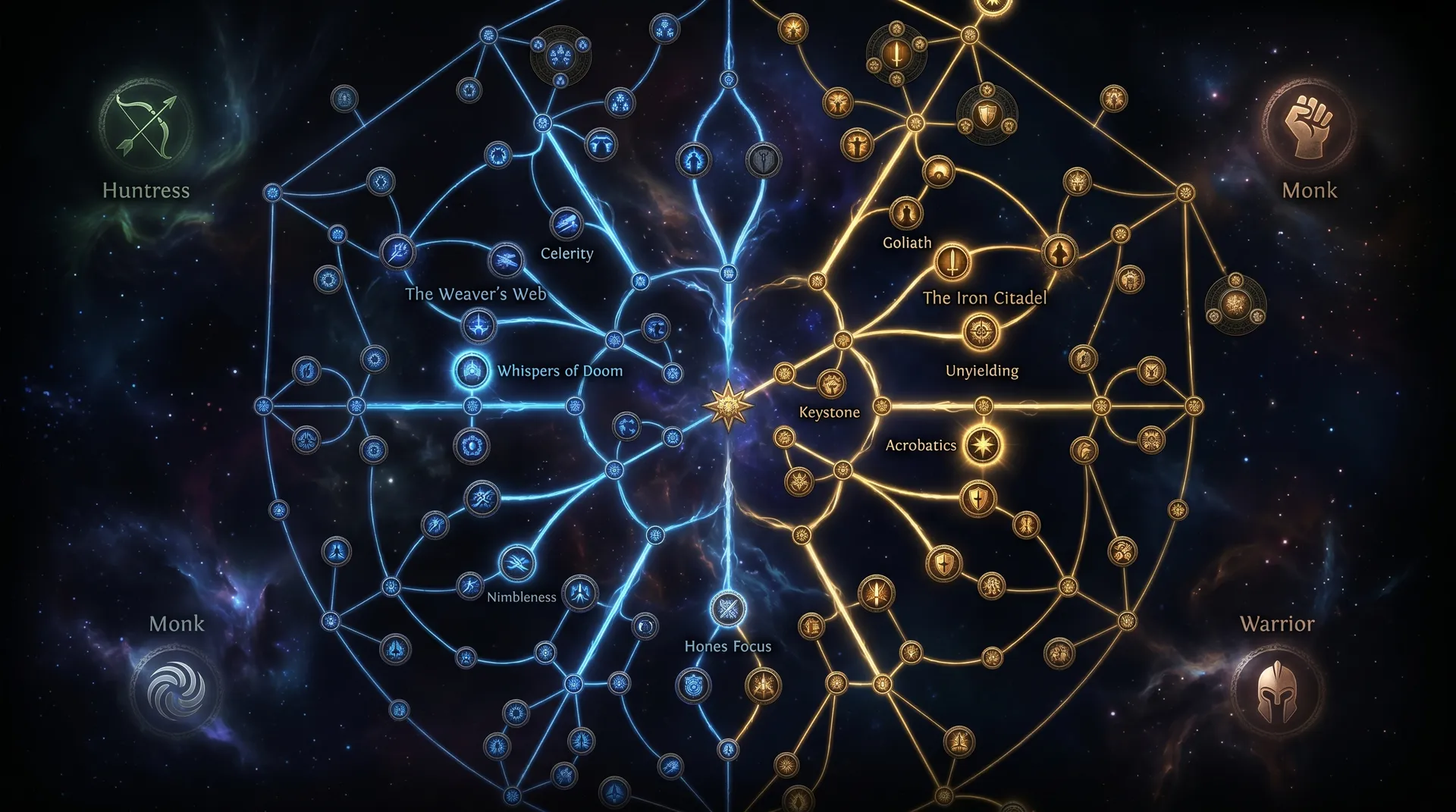
The tree contains four node types, and only two are worth treating as destinations [3]:
Small passives (1,800+): Minor stat boosts. These are toll roads. You cross them to reach Notables and Keystones. Never detour more than two small passives off your planned route to reach one.
Notable passives (500+): The mid-tier power targets. Each delivers a meaningful chunk of power — Skullcrusher’s 40% more damage against stunned enemies, Essence Infusion’s energy shield recharge acceleration, Wild Storm’s 15% increase to maximum lightning damage [4]. Build your entire route around Notables as waypoints.
Keystones (18 total as of patch 0.2.0): Build-defining. A single Keystone fundamentally rewrites your combat model. Mind Over Matter routes all damage through mana before life, with 50% reduced mana recovery as the trade-off. Blood Magic removes your mana pool entirely and pays skill costs from life [3]. Most builds want one Keystone as their anchor.
Jewel Sockets: Slotted into fixed tree positions, these are customisable Notables — similar power, varied stats depending on the Jewel inserted. Patch 0.2.0 removed 12 Jewel Sockets from the tree. If you are following an older build plan and your Sockets are missing, use the in-game command /reclaimjewels to recover displaced gems [5].
The single navigation rule: Always path toward your next Notable, not toward individual small passives. A two-small-passive detour to grab a minor percentage boost costs a point that could have moved you closer to the cluster anchoring your build.
Tree geography follows attribute alignment: Intelligence governs the upper portion (spells, energy shield, mana), Dexterity runs centre-right (evasion, projectiles, cold), and Strength dominates the lower-left (melee, fire, life). Hybrid positions sit at each juncture [1].
Class Starting Zones: Where You Are and What Is Close
Six starting points, each pinned to an attribute quadrant [1]. Your first 15 to 20 nodes should stay local — the starting area for every class is deliberately populated with Notables that suit that archetype.
| Class Pair | Attribute | Nearest Keystones | Best Early Notables |
|---|---|---|---|
| Warrior / Marauder | Strength | Giant’s Blood, Vaal Pact | Skullcrusher, Savoured Blood, Made to Last |
| Mercenary / Duelist | Str / Dex | Glancing Blows, Bulwark | Apocalypse, Cull the Hordes, Lay Siege |
| Ranger / Huntress | Dexterity | Acrobatics, Heartstopper, Oasis | Low Tolerance, Falcon Technique, Stacking Toxins |
| Monk / Shadow | Int / Dex | Whispers of Doom | Siphon, Energise, Manifold Method |
| Sorceress / Witch | Intelligence | Chaos Inoculation, Eldritch Battery | Essence Infusion, Endless Blizzard, Psychic Fragmentation |
| Druid / Templar | Str / Int | Mind Over Matter, Zealot’s Oath | Ancestral Bond, Bolstering Presence, Restless Dead |
The Act 3 boundary is a hard rule: stay within two or three cluster-widths of your starting zone until you reach Act 3. The most common pathing mistake is crossing three attribute quadrants to reach one appealing Keystone — that journey costs eight to twelve small passive toll nodes and leaves you under-powered for the mid-campaign difficulty spike [2].
Hybrid classes — Mercenary/Duelist between Str and Dex, Monk/Shadow between Int and Dex, Druid/Templar between Str and Int — benefit from wider early routing. Their starting position gives access to two quadrants’ worth of Notables from the start. Spend your first ten points in the quadrant aligned with your primary weapon, then branch into the second quadrant after your first cluster is complete.
The 12 Priority Nodes: A Pareto Framework for Passive Points
PoE2’s passive tree is not designed to be completed — it is designed to reward focus. The most efficient campaign builds allocate 10 to 15 high-value Notables, path through small passives as necessary, and anchor around a single Keystone. The first 12 to 15 allocated nodes determine roughly 75 to 80% of your passive tree’s total power contribution [2][4].
Priority framework by tier:
Tier 1 — Universal (nodes 1 to 3):
- Your class’s first major damage Notable, within three small passives of your start
- Your class’s first life or energy shield Notable
- The nearest Jewel Socket within four to five nodes of start — socket a matching Jewel immediately
Tier 2 — First cluster anchor (nodes 4 to 8):
- The damage cluster’s central Notable for your class: Skullcrusher for Warrior, Wild Storm for Monk, Essence Infusion for Sorceress/Witch, Falcon Technique for Ranger [4]
- The defensive Notable matching your survival type: Savoured Blood for leech builds, Essence Infusion for energy shield, Heatproofing for armour-and-fire Warrior builds
- A second Jewel Socket if accessible without a detour of more than two small passives
Tier 3 — Keystone pathing (nodes 9 to 15):
- Path toward your chosen Keystone using Notables as waypoints along the route
- Pick up any Notable within one small passive of your Keystone route — these are free power on the way
- The Keystone itself
- Three Notables immediately adjacent to the Keystone in its cluster
Damage-first rule: Take damage Notables before defensive ones through Acts 1 and 2. Enemy damage spikes in Act 3 — that is the correct moment to shift points toward defensive Notables and life or ES scaling [2].
Keystone Decision Tree: Which One Defines Your Build
Identify your target Keystone at character creation, not at level 40. Keystones sit at the outer reaches of the tree — knowing which one you are pathing toward determines every routing decision along the way [6].
The five highest-impact Keystones as of patch 0.2.0:
| Keystone | Tree Zone | Core Trade-off | Build It If… |
|---|---|---|---|
| Mind Over Matter | Upper-middle | Damage hits mana before life; 50% less mana recovery | Sorceress / Templar with a large mana pool investment |
| Giant’s Blood | Str (left) | Two-handers in one hand; triples attribute requirements (0.2.0 nerf) | Warrior / Marauder at very high Strength — verify attribute totals first |
| Chaos Inoculation | Intelligence | Maximum life set to 1; full chaos damage immunity | Pure Energy Shield builds only — requires ES as your sole defensive layer |
| Whispers of Doom | Top-middle | One additional curse; double curse activation delay | Curse-stacking Witch / Shadow builds with multiple curse skills |
| Vaal Pact | Bottom-left | Instant life leech; life flasks disabled | Leech-dependent melee builds with a reliable high hit rate |
Patch 0.2.0 changes to verify before committing [5]:
- Giant’s Blood: Attribute requirements for martial weapons now tripled (previously doubled). Run the numbers on your Strength investment before spending twelve nodes to reach it.
- Acrobatics: Evasion penalty increased to 75% (was 70%). Still strong for Ranger/Shadow, but the defensive trade-off is more severe.
- Eldritch Battery: Now doubles all mana costs in addition to converting Energy Shield to Mana. Viable, but requires significant mana cost reduction investment.
- Unwavering Stance: Changed from doubled stun threshold to immunity to light stuns. Verify whether your build relied on the old threshold scaling.
Decision rule: If reaching your target Keystone requires more than 12 small-passive toll nodes, path through an intermediate Notable cluster first and defer the Keystone to Act 2 or early Act 3. Keystones are not so powerful that they justify a 12-node detour at level 15.
Player-Type Guide: Different Priorities for Different Goals
| Player Type | First 15 Nodes | Keystone Strategy | Respecs? |
|---|---|---|---|
| New Player | Two damage Notables and one defensive Notable from your starting zone only. Ignore everything beyond your starting quadrant. | Don’t commit to a Keystone until Act 2. Try the playstyle before locking in a build-altering trade-off. | Yes. Respec freely via gold in Act 1. Cost scales with level but stays affordable throughout the campaign. |
| Casual | Take the three Tier 1 universals, then follow a community build path. Use the Maxroll planner to pre-route. | Commit by Act 1 final boss. Pick a mainstream Keystone: Mind Over Matter or Chaos Inoculation for casters, Vaal Pact for leech melee. | One respec in Acts 1 to 2 to correct early mistakes, then commit. |
| Optimizer | Apply Tier 1/2/3 priority framework exactly. Map all Jewel Socket positions before spending your first point. Count toll-node costs per route. | Identify Keystone at character creation. Calculate the toll-node cost to reach it from your start. | Zero if planned correctly. Use /reclaimjewels if patch 0.2.0 removed your planned Sockets [5]. |
| Completionist | Follow Optimizer route for the campaign. Map remaining Notables in reverse-priority order after Act 3. | Consider Keystone adjacency — some builds support two Keystones if they share a cluster (e.g. Zealot’s Oath alongside an Energy Shield path). | One endgame respec to finalise Keystone adjacency and complete the notable cluster map. |
Weapon Specialisation: The 24 Hidden Passive Points
The passive tree gives you one point per level plus quest rewards. There is also a separate pool of 24 passive points earned through campaign quests that applies exclusively to your active weapon set [1].
These weapon-set passives activate only when that weapon set is equipped and switch off on weapon swap. The practical effect: you can double-invest in one damage cluster without sacrificing your general defensive tree.
Invest weapon-set points into the same damage-type cluster as your primary weapon’s Notables. Do not use weapon-set points to path toward distant Keystones — the Keystone’s effect does not transfer across weapon sets [1].
For builds that actively swap weapons (Mercenary running crossbow-to-melee, Druid switching between a totem staff and melee): split your 24 weapon-set points 12 per set, concentrating on each weapon’s primary damage Notables. Single-weapon builds should put all 24 points into deepening the same cluster.
In-game search (Ctrl+F on PC): Type a stat keyword and the tree highlights every matching node. Use this before routing to confirm your target Notable is not stranded on the opposite side of the tree.
Path cost preview: Hover over any distant Notable and the tree draws the cheapest path, displaying a node count. If the toll exceeds five small passives to reach a single Notable, the route is probably inefficient unless that Notable sits on your Keystone path.
Maxroll passive tree planner: Free, browser-based, and updated for patch 0.2.0. Lets you simulate full builds, calculate exact point costs to each cluster, and share build plans via URL. Essential for Optimizer and Completionist players plotting 80-plus-node routes before spending their first in-game point.
Frequently Asked Questions
Can I respec my Keystone after taking it?
Yes — respeccing costs gold, scaling with your character level. The cost is not punishing enough to prevent Keystone changes during the campaign. In endgame, reconfiguring a Keystone is more expensive but still feasible. The real cost is the toll-node investment required to re-route to a different Keystone position.
Do the 13 new clusters from patch 0.2.0 change the priority framework?
The 13 new clusters — Blind, Volatility, Ranged, Melee, Hazards, Companion, Presence Radius, Aura, Parry, Banner, Bleeding, Thorns, and Quiver — primarily expand options for specific archetypes such as pet builds, bleed builds, and parry-focused melee. The Tier 1/2/3 priority framework remains valid. If your build focuses on one of these archetypes, check whether the relevant cluster sits within efficient pathing range of your starting zone [5].
Key Takeaways
The passive tree rewards focus over breadth. Twelve well-chosen nodes — three Tier 1 universal picks, three cluster anchors, and six on your Keystone path — deliver the foundation of your passive power.
- Start local: stay within your class’s starting quadrant for the first 15 nodes
- Damage Notables first, defensive Notables from Act 3 onward
- Choose your Keystone at character creation — it determines every routing decision
- Weapon-set points are a separate pool; invest them into your primary weapon’s damage cluster
- Verify Giant’s Blood, Acrobatics, and Eldritch Battery against patch 0.2.0 changes before building around them
- Use the in-game search and the Maxroll planner before spending points, not after
Sources
- PoE 2 Passive Tree and Weapon Specialisation — Maxroll.gg
- Path of Exile 2 Passive Tree Guide — Vulkk.com
- Passive Skills — Path of Exile 2 Wiki (Fextralife)
- PoE 2 Best Passive Skill Tree Notables for Each Class — AOEAH
- PoE2 0.2.0 Patch Note: Passive Skill Tree Changes — MMOJugg
- PoE 2 Passive Skill Tree Keystones Tier List — AOEAH
- Path of Exile 2 Passive Skill Tree Explained — PCGamesN

I've been playing video games for over 20 years, spanning everything from early PC titles to modern open-world games. I started Switchblade Gaming to publish the kind of accurate, well-researched guides I always wanted to find — built on primary sources, tested in-game, and kept up to date after patches. I currently focus on Minecraft and Pokémon GO.