

Hades 2 is the sequel that somehow lives up to one of the most critically acclaimed roguelikes ever made. Supergiant Games took everything that worked in the 2020 Game of the Year winner and rebuilt it around a new protagonist, new mechanics and a fresh slice of Greek mythology. Whether you are picking up the franchise for the first time or rolling over from hundreds of Zagreus runs, this guide covers every system you need to understand before your first clear—and well beyond it.
The game launched in Early Access in May 2024 and reached its full 1.0 release in 2025, with continued balance updates rolling into 2026. Combined franchise sales have passed 20 million copies, and the active community on Reddit and Discord remains one of the most helpful in the roguelike genre. If you enjoy the loop here, you will also want to check out our picks for the best roguelike games in 2026.
What Is Hades 2 and How Does It Differ from Hades 1?
Hades 2 puts you in control of Melinoe, the sister of Zagreus and daughter of Hades. Instead of escaping the Underworld from the bottom up, Melinoe fights her way down through a different region of the realm, seeking to confront Chronos—the Titan of Time—who has seized control of the House of Hades.
The core gameplay loop is identical to the first game. You start a run, fight through a series of randomly generated chambers, collect boons from Olympian gods, and eventually face a boss. When you die, you return to a hub area, spend resources on permanent upgrades, and try again. Each attempt makes you a little stronger, and the story unfolds through dialogue that changes based on how far you have progressed and which characters you have interacted with.
Where the sequel diverges is in how Melinoe plays compared to Zagreus. Three headline differences define the new experience:
- Arcana Cards replace Keepsakes for passive bonuses. Zagreus equipped a single keepsake before each run. Melinoe slots multiple Arcana Cards into a limited-point grid, giving you far more control over your passive build before you even enter the first chamber.
- The Hex ability slot adds a powerful charged spell. On top of your standard attack, special, cast and dash, Melinoe has access to a Hex—a high-damage ability that charges over time during combat. Hexes are granted by gods and can completely change how you approach tough rooms.
- Six weapon options at launch. Hades 1 also launched with six Infernal Arms, but Melinoe’s weapons feel mechanically distinct. Each one pairs differently with the Hex system and benefits from different boon types, creating more build diversity from the start.
The Boon System Explained
Boons are the heart of every Hades 2 run. Olympian gods offer you temporary power-ups after clearing certain chambers, and each god’s boons modify a different aspect of your kit. Understanding how boons interact is the single most important skill in the game.
How Boons Work
After clearing a combat room, you typically choose one boon from a selection of three. Each boon is tied to a specific god and modifies one of your core abilities:
- Attack boons modify your standard melee or ranged attack.
- Special boons modify your weapon’s secondary ability.
- Cast boons change or enhance your ranged cast projectile.
- Dash boons add effects to your defensive dash.
- Hex boons replace or upgrade your charged Hex ability.
Gods each have a gameplay identity. Apollo boons deal bonus damage and create daze effects — see our full Apollo boon breakdown for the exact Daze math and per-weapon priority. Hephaestus boons add massive single-hit damage spikes — see our full Hephaestus boon breakdown for the current armor-break numbers and per-weapon priority. Aphrodite boons weaken enemies so they deal less damage to you. Learning which god synergises with your weapon is the key to building strong runs.
Stacking Boons and Duo Boons
The real power comes from stacking. Taking multiple boons from the same god unlocks their legendary boon—a powerful capstone that can define an entire run. Taking boons from two specific gods can unlock a Duo boon, which combines their effects into something greater than the sum of its parts.
For your first several runs, follow this priority order when choosing boons:
- Always take a boon for your main damage source first. If you are using Sister Blades, prioritise attack boons. If you are using Umbral Flames, prioritise special boons. Getting your primary damage online early makes every subsequent chamber easier.
- Pick up a dash boon early. Defensive utility from your dash keeps you alive through mistakes. Poseidon’s dash boon is particularly forgiving because it knocks enemies away from you.
- Build toward a Duo if the option appears. Duo boons are rare but transformative. If you already have two boons from Apollo and one from Hephaestus, a Duo may be available—always check.
- Avoid spreading too thin. Taking one boon from every god gives you nothing powerful. Commit to two or three gods per run.
Weapons Overview for Beginners
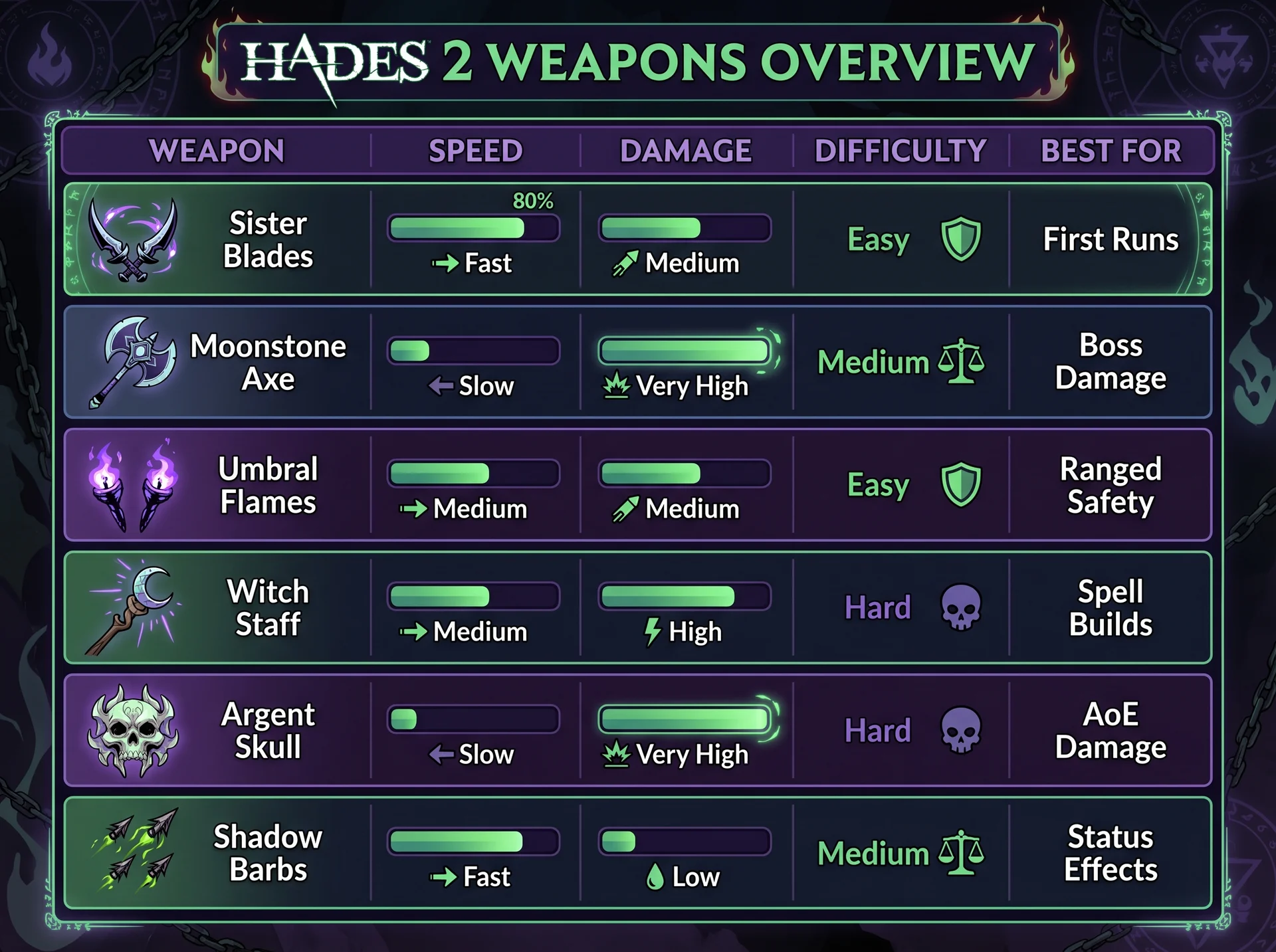
Hades 2 gives you six weapons to choose from. Each one changes your attack speed, range, damage style and which boons benefit you most. Here is a breakdown of all six, ranked by how forgiving they are for newer players.
Sister Blades — Best for Your First Run
The Sister Blades are fast, mobile twin daggers that let you weave in and out of combat quickly. Their attack speed means you proc boon effects frequently, making attack boons from any god effective. The low damage per hit is compensated by sheer volume. If you are not sure what to pick on your first attempt, pick these.
Best paired with: Aphrodite or Apollo attack boons. The rapid hits stack status effects almost instantly.
Moonstone Axe — High Risk, High Reward
The Moonstone Axe hits like a truck but swings slowly. Each attack has a significant wind-up, so you need to learn enemy patterns well enough to commit to swings without getting punished. Against bosses with long recovery windows, the Axe can end fights faster than any other weapon.
Best paired with: Hephaestus boons. His damage spikes trigger on individual hits, and the Axe’s high base damage amplifies this.
Umbral Flames — Most Forgiving for New Players
Umbral Flames are a ranged weapon that lets you maintain distance from enemies while dealing consistent damage. The playstyle is inherently safer because you spend less time in melee range. New players who struggle with dodge timing will find these much more comfortable than blades or axe.
Best paired with: Demeter or Zeus boons. Area-of-effect enhancements turn your flames into room-clearing tools.
Witch Staff — For Spell-Heavy Builds
The Witch Staff emphasises your cast and Hex abilities over raw melee damage. Attacks are moderate in speed and damage, but the staff’s real strength is how it enhances your magical abilities. This is the weapon to pick when you want your build to revolve around a specific god’s cast boon.
Argent Skull — Explosive Area Damage
The Argent Skull throws a slow, heavy projectile that detonates on impact. It excels at clearing groups of enemies but struggles in one-on-one boss fights where you need consistent DPS. The learning curve is steep because misses are punished heavily.
Shadow Barbs — Status Effect Specialist
Shadow Barbs hit fast and apply status effects efficiently. The damage per hit is the lowest of all six weapons, but the status stacking potential is the highest. Experienced players pair these with gods whose boons apply percentage-based debuffs to turn enemies against themselves.
Whatever weapon you pick, Daedalus Hammers shape how it plays mid-run. These one-run artifacts modify your attack patterns, add damage multipliers or rewire the weapon entirely. See the Hades 2 Hammer Upgrades Guide for per-weapon tier rankings and which two-hammer combinations compound best with your boons.
Arcana Cards: Your Pre-Run Power Budget
Arcana Cards are one of the biggest new systems in Hades 2. Before each run, you slot cards into a grid. Each card costs a certain number of points (called Grasp), and you have a limited Grasp budget. Cards provide passive bonuses that last the entire run—things like increased damage, more health, better boon rarity or faster Hex charging.
How to Unlock and Upgrade Cards
Cards are unlocked using Psyche, a resource you earn between runs by completing objectives and progressing the story. Early on, Psyche is scarce, so your unlock order matters. Follow this priority:
- Damage cards first. Cards that increase your attack damage or boon effectiveness give you the biggest immediate power spike. The Fates and Strength are both excellent early unlocks.
- Survival cards second. A card that gives you an extra Death Defiance (the game’s extra life system) is worth more than any small damage increase once you are consistently reaching bosses.
- Utility cards last. Cards that improve gold generation, shop prices or room rewards are nice but do nothing to help you survive the chamber you are currently in.
Budget Your Grasp
You cannot slot every card at once. Your Grasp starts limited and grows as you progress. This means you need to choose between raw power and breadth. For your first few clears, run three to four high-impact damage cards rather than spreading across six mediocre ones. Quality over quantity applies here just as much as it does with boons.
How to Beat Hecate: The First Boss
Hecate is the gatekeeper of the first major zone, and she will likely be the wall that stops your initial runs cold. She is fast, aggressive, and punishes passive play. Here is everything you need to know to take her down.
Phase 1: Standard Attacks
Hecate opens the fight with a combination of melee swipes and projectile spells. Her melee attacks have a clear wind-up animation—she raises her staff before each swing. Dash behind her during this animation, land two to three hits, then back off. Do not get greedy. Two hits and a dodge is always safer than four hits and a face full of damage.
Her projectile attack sends three green orbs in a fan pattern. These are telegraphed by a brief flash at her staff’s tip. Dash diagonally through the gap between orbs rather than trying to outrun them laterally.
Phase 2: Summons and Area Denial
At roughly 60% health, Hecate begins summoning additional enemies and casting area-denial spells. Glowing circles appear on the ground before exploding—move out of these immediately. The summoned enemies are weak but distracting. Kill them quickly to avoid getting overwhelmed while Hecate continues attacking.
The priority here shifts: clear adds first, then re-engage the boss. Trying to ignore the adds while fighting Hecate is the number one cause of failed attempts at this stage.
Phase 3: Empowered Hecate
Below 30% health, Hecate becomes significantly more aggressive. Her attacks come faster, and she gains a spinning staff attack that covers a wide area. The tell for this move is a brief pause where she pulls her staff back—dash away immediately when you see it.
This phase is a DPS check. If your boon build is strong enough, you can burn her down quickly. If not, play extremely defensively, punish only her longest recovery animations, and be patient.
Best Boons Against Hecate
- Aphrodite attack boons weaken Hecate’s damage output, giving you a much larger margin for error.
- Poseidon dash boons create distance whenever you dodge through her, buying you safe repositioning time.
- Apollo cast boons let you deal damage from a safe distance during her area-denial phases.
If you are still struggling with Hecate, consider switching to Umbral Flames for the range advantage. Staying at mid-range and dashing through her projectiles is significantly easier than trying to weave melee attacks between her swipes.
Resource Priority for Meta-Progression
Between runs, you spend resources on permanent upgrades. Knowing what to prioritise saves you hours of inefficient grinding.
- Psyche (highest priority). Unlocks Arcana Cards. Every card you unlock makes every future run stronger. Spend Psyche as soon as you earn enough for the next card in your priority list.
- Gold Apples. Used to unlock facility upgrades in the hub area. These provide convenience features and access to new mechanics. Prioritise the garden plot (grows resources between runs) and the training dummy (lets you test weapons without starting a run).
- Bones. Spent at the Wretched Broker for consumable items and specific boon unlocks. Bones are useful but less impactful than Psyche. Trade them for keys or darkness equivalents when available, but do not chase them over other resources.
Do not hoard resources between runs. Every upgrade you defer is a run where you were weaker than you needed to be. Spend early, spend often.
Tips for Faster Progression
Beyond the core systems, these general tips will accelerate your path to consistent clears:
- Talk to every NPC between runs. Dialogue unlocks story progression, which gates access to new weapons, cards and gods. Skipping conversations slows your unlock rate significantly.
- Use the garden between every run. Plant resources before you start, harvest when you return. This passive income adds up quickly over a session.
- Experiment with weapons even after you find a favourite. Different weapons teach you different enemy patterns. Skills learned with the Axe (reading wind-up timings) directly improve your Blades play (knowing when to commit).
- Prioritise mini-boss rooms for rare boons. These rooms are harder but guarantee higher-rarity boons. One epic boon from a mini-boss is worth three common boons from regular chambers.
Hades 2 rewards persistence and experimentation equally. The best runs come from players who understand every system deeply enough to adapt on the fly. If deck-building roguelikes are your thing, our Slay the Spire 2 guide covers similar strategic depth, and our Balatro guide breaks down another system-mastery roguelike that pairs perfectly with Hades sessions.
Frequently Asked Questions
Do you need to play Hades 1 before playing Hades 2?
No. Hades 2 features a new protagonist and a self-contained story. You will catch some returning character references and lore callbacks, but every major plot point is explained within the game itself. New players will not feel lost.
Is Hades 2 finished?
Yes. The game left Early Access and received its full 1.0 release in 2025. Supergiant continues to release balance patches and minor content updates, but the complete story, all weapons, and all major systems are available now.
How long is a single run in Hades 2?
A successful run from start to final boss takes approximately 30 to 45 minutes depending on your build and how quickly you clear rooms. Failed runs end earlier. The game is designed around short, repeatable sessions, making it ideal for quick play sessions or extended marathons.
What is the best weapon for your first clear?
The Sister Blades or Umbral Flames are the safest choices for a first clear. The Blades offer speed and mobility, letting you dodge-cancel out of attack animations. The Flames offer range, keeping you away from melee threats. Choose whichever playstyle feels more natural to you—both are viable all the way through the final boss.
For a complete step-by-step walkthrough, see every Hades 2 boss weak point, attack pattern, and best counter boon.
For a complete step-by-step walkthrough, see Aphrodite boon guide.
For a complete step-by-step walkthrough, see sister blades build guide covering the dash-timing rhythm and Artemis vs. Athena boons.
For a complete step-by-step walkthrough, see our full 2026 god boon tier list, updated for the April Ares rework.
For a complete step-by-step walkthrough, see how Gold Crowns and Obol Points actually work.
For a complete step-by-step walkthrough, see Poseidon boon guide, including the wall-slam knockback mechanic and best chamber setups.
For a complete step-by-step walkthrough, see our Demeter boon guide, with the exact freeze-duration math and the Demeter vs. Hestia DoT verdict.
For a complete step-by-step walkthrough, see Hermes Boon Guide.
For a complete step-by-step walkthrough, see Hestia boon guide (Scorch cap math and best weapon).
For a complete step-by-step walkthrough, see our Ares boon guide, covering all 5 April-patch reworks and which builds still survive them.
For a complete step-by-step walkthrough, see Eris fight breakdown, her phase-buff mechanic, and the Blessing of Strife debuff explained.
For a complete step-by-step walkthrough, see Hecate boss guide with her full 3-phase attack pattern and the most consistent weapon pick.
For a complete step-by-step walkthrough, see beating Prometheus and his 3-move fire chain.
For a complete step-by-step walkthrough, see farming Darkness and Ashes efficiently to grow your Grasp meter.
For a complete step-by-step walkthrough, see Melinoe character guide.
For a complete step-by-step walkthrough, see Grasp allocation for DPS vs. survival builds.
For a complete step-by-step walkthrough, see the Polyphemus boss guide.
For a complete step-by-step walkthrough, see our Chronos boss guide, with his exact HP thresholds, the 0-HP time rewind, and why time-manipulation Boons are switched off against him.
For a complete step-by-step walkthrough, see how to unlock all 5 Familiars and what their passive bonuses do.
For a complete step-by-step walkthrough, see cauldron incantation priority order and full ingredient list.
For a complete step-by-step walkthrough, see harvesting guide.
For a complete step-by-step walkthrough, see fishing guide.
For a complete step-by-step walkthrough, see Argent Skull Medea aspect build.
For a complete step-by-step walkthrough, see Fated List achievement guide.
For a complete step-by-step walkthrough, see 5 best builds ranked for the current patch.
For a complete step-by-step walkthrough, see sub-20-minute Any Fear speedrun route.
For a complete step-by-step walkthrough, see our full progression guide covering the exact resource-to-unlock milestone path from your first run to Chronos.
For a complete step-by-step walkthrough, see how Hades 2 compares to Dead Cells.
Sources
- Hades II on Steam — Official store page with game details and system requirements
- Hades Wiki — Hades II — Community-maintained wiki with detailed mechanics data
- r/HadesTheGame — Active community discussion on builds, strategies and patch changes
- Where Hades 2 Saves Your Game: AppData Path, Steam Cloud Sync, and How to Restore Lost Progress
- Hades 2 Best Weapon Builds Tier List 2026: All 6 Weapons Ranked
- Best Hades 2 Boon Combos
- Hades 2 Arcana Cards guide
- Hades 2 Keepsakes Guide: The Swap Schedule That Guarantees Your Target Boon
- Hades 2 Zeus Boons Ranked 2026: The Exact Chain Lightning Proc Conditions for Every Weapon
- Hades 2 Weapon Aspects Ranked 2026: Unlock Costs, Priority Order, and Which Actually Win Runs
- Hades 2 Chaos Gates Guide 2026: Curse Tier List and the 3 Blessings That Break Runs
- Hades 2 vs Hades 1: Deeper Systems, Tighter Story — Which to Start With in 2026
- Skip the Bad Picks: Every Hades 2 Daedalus Hammer Upgrade Ranked by Weapon (2026)
- Skip the Duds: 15 Games Like Hades 2 With the Build Variety That Actually Holds Up in 2026
- 8 Best Indie Games of April 2026: Vampire Crawlers Leads, Replaced Splits Critics

I've been playing video games for over 20 years, spanning everything from early PC titles to modern open-world games. I started Switchblade Gaming to publish the kind of accurate, well-researched guides I always wanted to find — built on primary sources, tested in-game, and kept up to date after patches. I currently focus on Minecraft and Pokémon GO.