
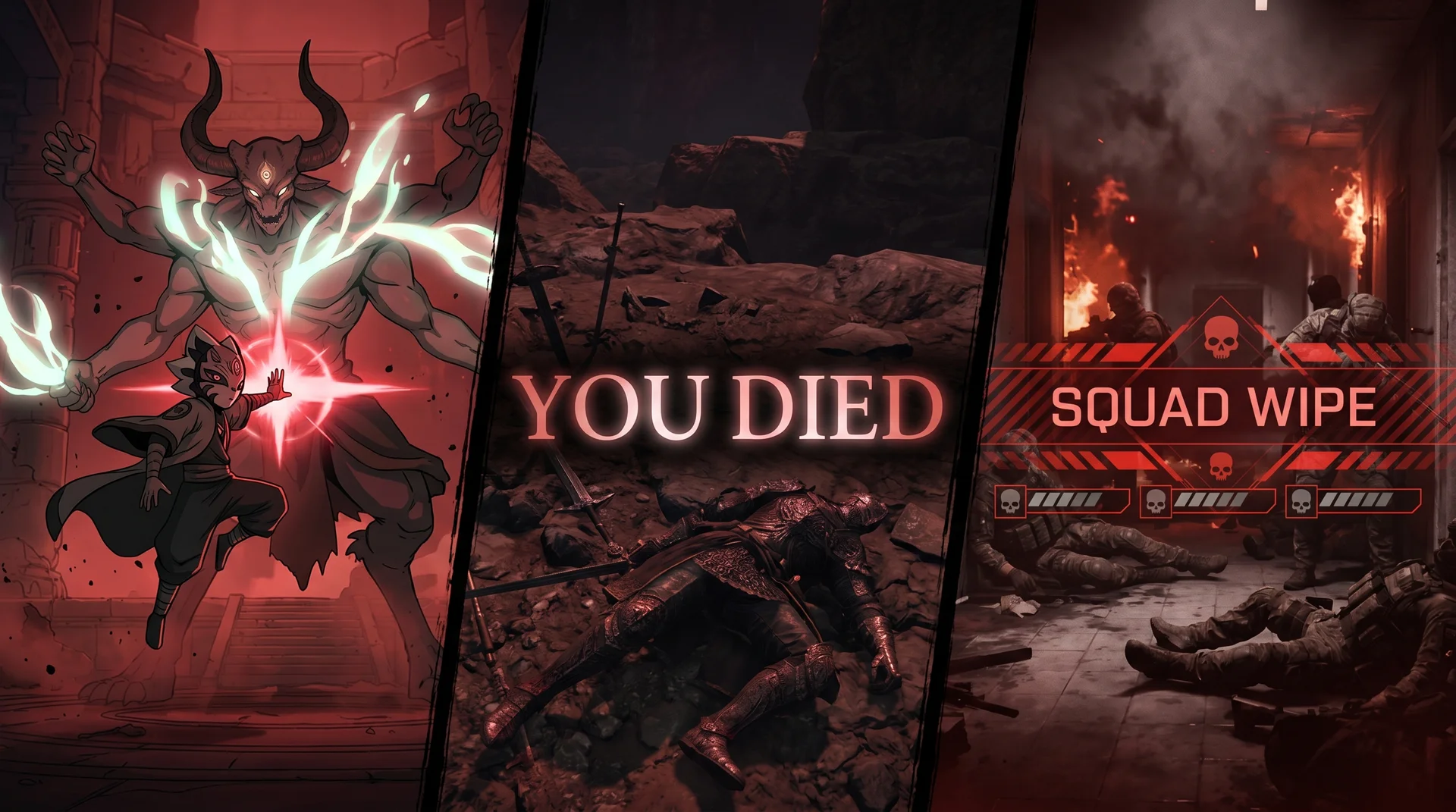
Most "hardest games" lists measure difficulty by boss HP and respawn timers. This one uses a different metric: skill ceiling — the gap between surviving your first session and playing the game at genuine competency. A game where grinding or over-levelling closes the gap has a low ceiling regardless of how brutal the first hour feels. A game where mastery permanently transforms your performance has a high one.
2025 and early 2026 delivered the strongest run of skill-ceiling games in years. Elden Ring Nightreign rewrote the Soulslike loop with roguelite time pressure. Hades II launched its 1.0 to 95 on Metacritic. Nioh 3 arrived in February 2026 as Team Ninja’s most polished work. Nine Sols, released June 2024, still demands parry discipline that rivals Sekiro at its most punishing.
Below, 15 games ranked across three tiers by skill ceiling: how long from first attempt to genuine competency, how wide the gap is between decent and expert play, and whether that gap is driven by deep design rather than arbitrary punishments. Three tiers — Entry-Level Hardcore, Mid-Tier Masochism, and Expert-Only Territory — help you find where your current patience meets its match.
How We Define Skill Ceiling
Difficulty and skill ceiling are different measurements. Dark Souls III is difficult. Once you understand stamina management and weapon poise values, the performance ceiling is relatively modest. Sekiro’s ceiling, by contrast, is nearly vertical: the posture system actively punishes rolling and backing away until you’ve internalized each boss’s full attack vocabulary.
For this ranking, skill ceiling means the distance between “can progress” and “playing the game at its best.” Time to competency, mechanical depth, and whether that depth rewards long-term investment are the three variables. Any game that lets you brute-force hard content by over-levelling fails this test regardless of how punishing early encounters feel.
All 15 Games at a Glance
| Game | Year | Skill Ceiling | Time to Competency | Best For |
|---|---|---|---|---|
| Black Myth: Wukong | 2024 | Medium | 20–25h | Soulslike newcomers |
| DOOM: The Dark Ages | 2025 | Medium | 15–20h | FPS veterans |
| Wuchang: Fallen Feathers | 2025 | Medium–High | 25–35h | Nioh-style fans |
| Monster Hunter Wilds | 2025 | High | 50–80h | System mastery seekers |
| Hades II | 2025 | High | 30–50h | Build theorycrafters |
| Hollow Knight: Silksong | 2025 | High | 25–40h | HK veterans only |
| First Berserker: Khazan | 2025 | High | 40–60h | Patient learners |
| Nioh 3 | 2026 | High | 50–80h | Nioh veterans |
| Elden Ring Nightreign | 2025 | High | 40–70h | ER fans who want pressure |
| Returnal | 2023 (PC) | Very High | 60–100h | Masochists with patience |
| Ninja Gaiden 4 | 2025 | Very High | 50–80h | Stylish combat fans |
| Lies of P | 2023 | Very High | 40–60h | Solo challenge seekers |
| Sifu | 2022 | Very High | 30–60h | Precision-oriented players |
| Nine Sols | 2024 | Extreme | 60–100h | Sekiro veterans |
| Sekiro: Shadows Die Twice | 2019 | Extreme | 50–80h | Pure mastery seekers |

Tier 1: Entry-Level Hardcore
These four games will punish you regularly, but the lessons are learnable within days. They reward pattern recognition and aggression without the full moveset memorization that Tier 2 and 3 demand. Start here if you’re building toward harder territory.
1. Black Myth: Wukong (2024)
The most accessible game on this list is still harder than most action RPGs at maximum difficulty. Black Myth removes Soulslike stamina anxiety from standard dodges and leans instead on boss pattern learning across 72 encounters drawn from the Journey to the West. Skill expression lives in staff stance switching — Smash, Pillar, and Thrust counter different enemy archetypes — plus transformation timing and Spirit absorption. On New Game+, the gap between a player who understands stance counters and one who doesn’t is measurable in boss attempts per encounter.
Skip if: You want sustained mechanical depth. Black Myth’s ceiling is its variety, not any single system’s depth.
2. DOOM: The Dark Ages (2025)
The Dark Ages added a shield bash and directional parry to DOOM’s kinetic combat, making defense an active offensive tool. On standard difficulty, skill expression centres on enemy prioritisation and resource economy — which rooms warrant a Berserk rune, when glory kill chains create dangerous exposure. Ultra-Nightmare, the permadeath tier, transforms those same decisions into permanent-consequence reads. GamingBolt [8] noted that Dark Ages demands “tactical enemy engagement on harder difficulties” — an understatement for what permadeath does to moment-to-moment decision density.
Skip if: Slow, methodical FPS movement is your default. The Dark Ages rewards aggressive momentum over positioning and cover play.
3. Wuchang: Fallen Feathers (August 2025)
Wuchang released August 2025 as one of the most mechanically interesting non-FromSoftware Soulslikes of the year. Its Skyborn Might system — charges earned from timed dodges or successful attack chains — powers skills and spells, creating a loop where skilled play immediately enables more skilled play [7]. Irrational Passions placed its complexity “somewhere between Dark Souls and Nioh” [7], which is accurate. Free skill respeccing at shrines removes all build experimentation cost. The flaw: bosses spike dramatically in difficulty after hours 8–10 [7], crossing from mechanical escalation into stat inflation.
Skip if: Difficulty spikes driven by designer decisions rather than your own failure break your motivation.
4. Monster Hunter Wilds (February 2025)
Monster Hunter Wilds doesn’t kill you in the first hour — typically. The skill ceiling here is horizontal rather than vertical: 14 weapons, each a separate combat grammar. The Charge Blade has Guard Points embedded in offensive moves — parry windows that punish players who don’t know they exist. The Hunting Horn requires real-time melody composition mid-combat. An August 2025 update added Tempered monster variants specifically targeting veterans who found base-game endgame too forgiving. A player 200 hours into one weapon reads a Tempered fight completely differently from one on their fifth hunt.
Our Monster Hunter Wilds tips guide covers the core weapon systems for clearing the early learning wall faster.
Skip if: You want to feel competent within the first 10 hours. Monster Hunter’s investment window is long and deliberately opaque.
Tier 2: Mid-Tier Masochism
These five games require weeks before failure stops dominating and reward starts emerging. Each has a specific mechanical click — a moment where a system that felt impenetrable becomes readable. Expect to fail at content that looks manageable, then feel the mechanism unlock.
5. Hades II (September 2025)
Hades II launched 1.0 on September 25, 2025, earning a 95 Metacritic score [5]. The skill ceiling isn’t reaction time — it’s build recognition. Six weapons with aspects intersect with eight Olympian Boon trees containing tier-3 synergies that only activate under specific conditions. A player who reads the first two rooms of a run and identifies a viable synergy path will clear faster than one who takes the strongest-looking individual Boon each room. God Mode exists (20% damage reduction, scaling by 2% per failed run to 80%) — honest accessibility design that leaves the challenge ceiling untouched.
Our Hades II complete guide breaks down the Arcana Card system and weapon aspects in full.
Skip if: Roguelite run structure — dozens of attempts with gradual incremental unlocks — doesn’t match your patience model.
6. Hollow Knight: Silksong (September 2025)
Team Cherry’s sequel arrived in September 2025 and immediately generated difficulty debate. The short read: Silksong was tuned assuming the player has already finished Hollow Knight. Where the original reserved two-damage hits for standout boss moments, Silksong’s standard enemies deal two damage routinely [8]. Hornet’s expanded mobility — faster and more acrobatic than the Knight — raises the ceiling on boss encounters by adding tools that each demand their own muscle memory. Optional late-game bosses compare in intensity to anything in the genre.
Skip if: You haven’t finished the original Hollow Knight. Silksong’s difficulty assumes that baseline as given.
7. The First Berserker: Khazan (March 2025)
Khazan released March 28, 2025, earning a 7/10 from Shacknews for being “demanding and exhilarating” [4]. The dual combat system is the core design idea: each enemy attack requires reading whether parry or dodge is correct. Both consume zero stamina on perfect execution — the payoff for correct reads is that resource conservation functionally disappears, turning conservation into pure offensive output [4]. Boss pattern complexity rivals the best FromSoftware work. Khazan’s parry window is more generous than Sekiro’s or Nine Sols’, making it more accessible but placing a slightly lower ceiling on ultimate mastery depth.
Skip if: Genre variety within a session matters. Khazan is consistent Soulslike structure with no tonal variation between zones.
8. Nioh 3 (February 2026)
Nioh 3 launched February 6, 2026 across PC and PS5. Tom’s Guide called it “the first must-play game of 2026” [2], and the review arc behind that verdict is instructive: early hours felt frustratingly overtuned, then transformed into obsession as the deep combat system’s approach variety became clear [2]. The Crucible — a high-difficulty area with a Life Corrosion mechanic reducing maximum HP mid-encounter — forces faster, cleaner kills rather than attrition. Fourteen weapon types with independent skill trees and dual Samurai/Ninja stance switching mid-combo create a ceiling most players won’t reach in a single playthrough.
Skip if: You found Nioh 1 or 2’s late-game loot chase more exhausting than rewarding.
9. Elden Ring Nightreign (May 2025)
Elden Ring Nightreign removes deliberate Soulsborne exploration and replaces it with a two-night timer. Build preparation for a specific encounter is structurally impossible — loot variance makes adaptability the skill. Solo play is significantly harder than the intended three-player format; Nightlord scaling doesn’t reduce proportionally for one player. The Deep of Night update on September 11, 2025 added Depths 1–5 [3]: defeats demote you to easier tiers, while Depths 4–5 deliver “endless battle for those seeking even greater thrills” with randomised Nightlords and detrimental Relics alongside powerful ones [3].
Skip if: You prefer deliberate Soulslike preparation and build planning over improvisation under time pressure.
Tier 3: Expert-Only Territory
These six games will take months to master. Some require weeks before first clear. All have ceilings most players never reach — that’s intentional. If Tier 2 feels manageable, move here.
10. Returnal (PC, May 2023)
Returnal’s difficulty reputation preceded its PC port in May 2023. The game is a third-person bullet hell roguelite: biomes randomise on each run, there’s no persistent mid-run save, and failing after 45 minutes returns you to the start. First-clear times range from 20 to 80 hours. Skill expression isn’t purely reaction-based — weapon trait identification (passive traits that stack with use), malignant item risk management, and earned biome shortcut knowledge all contribute to the gap between a player on their third cycle and one on their thirtieth. That gap widens considerably in the game’s back half.
Skip if: Extended session failures without progress markers erode motivation. Returnal requires accepting long failure loops as the learning mechanism itself.
11. Ninja Gaiden 4 (October 2025)
Ninja Gaiden 4 launched October 21, 2025, earning a 9/10 from TheSixthAxis [6] for blending PlatinumGames’ high-octane style with the series’ mechanical depth. The Bloodbind Gauge punishes passive play by requiring offensive engagement. The parry system works through attacking rather than a dedicated defensive input, and Bloodraven interrupts break enemy stances mid-combo when timed correctly [6]. The TheSixthAxis review described the ideal combat state as “a dance where every tool in your arsenal is a piece of offensive art, all looping together” [6]. That loop takes hours to feel natural, and the Hard difficulty ceiling with Yakumo’s full moveset is deep enough that most players won’t exhaust it.
Skip if: Stylistic expressiveness is less rewarding than strategic positioning. NG4’s payoff is in how the combat flows, not just survival.
12. Lies of P (September 2023)
Lies of P earned its reputation as the best non-FromSoftware Soulslike through one design decision: the Perfect Guard system. Blocking with precise timing absorbs chip damage entirely rather than draining a guard bar, making timed blocks more efficient than dodging in many scenarios — a complete inversion of how most Soulslikes train defensive instincts. The weapon assembly system mixes handles and blades across categories, adding build variety without muddying the mechanical focus. There is no co-op, and this is intentional: boss phase 2 transitions consistently increase aggression rather than just adding a health gate, keeping earned phase 1 familiarity from generalising too cleanly.
Skip if: Co-op support is part of your regular Soulslike approach. Lies of P deliberately removes the option.
13. Sifu (2022)
Sifu’s difficulty system is the most original on this list. You don’t die — you age. Each death adds years, reducing maximum HP while increasing damage output. Eventually you hit an age cap and face actual game over. A no-death run through a single location requires near-perfect play across multi-enemy fights. The skill ceiling isn’t reaching the final boss — it’s reaching it aged 25 instead of 45, carrying minimal debt from every preceding location. The gap between those two outcomes represents dozens of hours of combat reading. Restarts are instant; the feedback loop is fast; the mastery requirement is deep.
Skip if: Repeated 3–5 minute losses don’t give you the next-run pull. Sifu rewards players who thrive on fast iteration.
14. Nine Sols (June 2024)
Nine Sols has the highest parry-system skill ceiling of any game currently available. When an enemy prepares to attack, a white flash appears — parry to that flash [1]. Parry too early: minor damage that regenerates. Parry too late: full damage. Red-glowing attacks cannot be parried at all and require a dodge read [1]. The margin between a useful parry and a punished one is measured in animation frames.
What separates Nine Sols from every other parry game is the Qi-Talisman loop. A successful parry charges Qi; spending Qi places a Talisman on the enemy; detonating the Talisman is your primary damage source [1]. Parrying and dealing damage are the same cycle, requiring simultaneous management of defensive reads and resource state. The hardest bosses take experienced players an hour or more per encounter before the system clicks.
Our Nine Sols complete guide covers the full parry system, Qi upgrade path, and boss-by-boss breakdowns.
Skip if: Managing three concurrent responsibilities — parry timing, Qi charge, Talisman detonation — sounds like stress rather than satisfaction.
15. Sekiro: Shadows Die Twice (2019)
Every game on this list was shaped, directly or indirectly, by Sekiro. The posture system remains the cleanest execution of aggressive parry philosophy: trading blows builds the enemy’s posture bar, and a full break triggers a deathblow regardless of remaining HP. Passive play — rolling, backing away, waiting — actively resets the mechanic you need to win. The game mechanically punishes the instinct to avoid confrontation rather than just failing to reward aggression.
There are no character builds. You cannot out-level Isshin, the Sword Saint. No Skill Points change a boss’s attack patterns. All progress is personal mechanical development, which is what makes Sekiro’s ceiling genuinely extreme.
Skip if: Build variety and character expression are how you engage with action RPGs. Sekiro offers none, and that is precisely its design.
Which Tier Fits You?
| Your Situation | Start Here | Why |
|---|---|---|
| New to hardcore, transitioning from Normal | Tier 1 | Punishing but teaches via clear feedback loops |
| Finished 2–3 Soulslikes and want more depth | Tier 2 | Deeper systems, weeks of genuine investment required |
| Sekiro or Returnal veteran seeking a new ceiling | Tier 3 | Months to mastery, won’t feel finished quickly |
| Completionist wanting the widest system depth | Monster Hunter Wilds | The most horizontal skill ceiling on the list |
Starter Pack: Three Games That Sequence Well
Building toward Tier 3 from scratch? This progression develops the right skills in order:
Step 1 — Monster Hunter Wilds: Trains monster telegraph reading and patience under low punishment. You’re learning to observe enemy behaviour before the death consequences become severe.
Step 2 — Hades II: Builds roguelite pattern recognition and build-optimisation instincts. Every failed run teaches you to read offerings and make decisions faster. The Hades II boon combos guide covers the synergy depth you’ll be identifying mid-run.
Step 3 — Nine Sols: Demands everything the previous two developed — observation, patience, decision-making under pressure — applied to a single, exacting parry framework. The muscle memory from MHW monster reading and Hades II run evaluation transfers directly.
FAQ
Are there hardcore games releasing in late 2026?
Phantom Blade Zero is confirmed for September 9, 2026 on PC and PS5. Its hardest difficulty settings modify enemy AI into reactive, fighting-game-like behaviour rather than scripted patterns. An Extreme Mode unlocks after beating the game. It’s the most interesting new difficulty design announced for 2026 — and it hasn’t been tested by the community yet.
Does Elden Ring Nightreign require a three-player group?
No, but solo play pushes it into Tier 3 territory. Nightreign is designed around three-player co-op runs, and Nightlord scaling doesn’t reduce proportionally for one player. Solo clears are a recognised challenge sub-category in the community — treated as a harder mode, not the intended default.
Which game has the most accessible entry point?
Black Myth: Wukong, by a significant margin. No stamina gauge for standard dodges, checkpoints generous by Soulslike standards, and clear system communication throughout. It will still kill you repeatedly — but the death-to-lesson loop is faster and less punishing than anything else on this list.
Is Nine Sols harder than Sekiro?
Steam community consensus places them at roughly equivalent overall difficulty, with Nine Sols’ hardest optional encounters matching Sekiro’s Sword Saint in time investment. The parry mechanics differ enough that Sekiro veterans report a meaningful adjustment period before Nine Sols’ system clicks — muscle memory doesn’t transfer cleanly between them despite both being parry-centred games.
Sources
- Nine Sols Parrying Mechanic Explained — GINX TV
- Nioh 3 Review — Tom’s Guide
- Elden Ring Nightreign Deep of Night Mode — NME
- The First Berserker: Khazan Review — Shacknews
- Hades II — Metacritic (metacritic.com/game/hades-ii/)
- Ninja Gaiden 4 Review — TheSixthAxis
- Wuchang: Fallen Feathers Review — Irrational Passions
- 15 Hardest Games of 2025 — GamingBolt

I've been playing video games for over 20 years, spanning everything from early PC titles to modern open-world games. I started Switchblade Gaming to publish the kind of accurate, well-researched guides I always wanted to find — built on primary sources, tested in-game, and kept up to date after patches. I currently focus on Minecraft and Pokémon GO.