
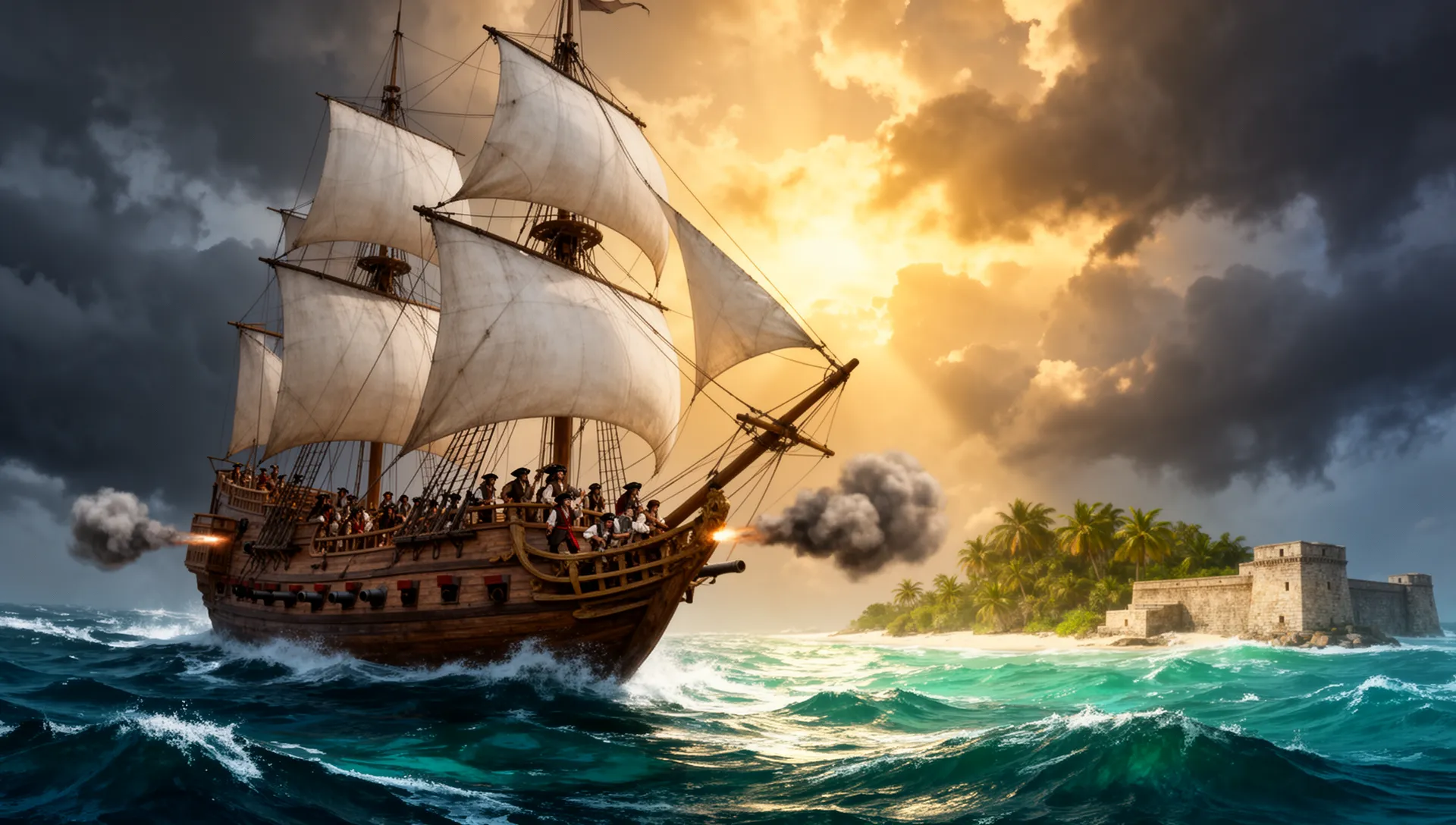
Early Access Notice: Windrose is in active development. Mechanics, balance, and content are subject to change. This guide reflects patch v0.10.04 and later (May 2026). Check the Steam patch notes for changes after that date.
In April 2026, a pirate survival game nobody had finished playing yet hit 222,134 concurrent Steam players — briefly displacing Rust from its long-held position at the top of the survival genre charts [2][3]. Windrose sold 1 million copies in under a week. It carries 87/100 Very Positive from more than 26,000 reviews on Steam [1]. And as of May 2026, no established guide hub exists for it anywhere.
This guide covers everything a new player needs: what Windrose is and how it differs from Rust, the full survival loop, ship construction fundamentals, resource priority for your opening 30 minutes, the four-faction reputation system, co-op setup, and — critically — the Early Access limitations you should know before buying.
Quick Start: Your First Session in Windrose
Before anything else, ten steps that save you the mistakes most first-session players make:
- Pick your difficulty before creating your save — you cannot change it mid-game. Calm Waters for first-timers, High Seas for survival genre veterans, Storm’s Edge only if you want a harsh experience from the first hour [5].
- Craft the Torn Sailcloth Bag immediately (2 Coarse Fabrics + 1 Rope at a Workbench). Without this, your inventory fills before you’ve gathered enough to build anything [5].
- Stack two food buffs before every fight. Kill crabs, pick bananas. Both are available on the first island and both give different buffs — you can run two simultaneously, and they matter more than raw stat differences in early combat [5].
- Place a Bonfire and Tent within the first 15 minutes. Both structures refund their full material cost when dismantled, so there is no penalty for placing and moving them later [5].
- Follow main quests for XP — kills give you nothing. Windrose awards zero XP for combat. Every level comes from quests [5].
- Build a Fast Travel Bell as soon as you have the materials. Register up to 10 bells as waypoints — death recovery becomes dramatically faster once you have them spread across islands.
- Put your first five stat points into Vitality. Stamina governs attacking, dodging, and gathering. It matters more than damage output in the opening hours [5].
- Talk to every NPC in Tortuga on your first visit. This opens faction reputation paths — you cannot earn reputation with factions you have not met yet [6].
- Build your ship upgrade station (the Wharf) near a shoreline — it will not function inland [4].
- Target Brethren of the Coast faction first if your goal is the Frigate. It is gated behind Brethren rank, not behind a tech tree [6].
What Is Windrose (and Why It Is Not Pirate Rust)
Windrose is a pirate survival crafting game from publisher Kraken Express, set in an alternate Age of Piracy. It blends the open-ocean exploration of Sea of Thieves with the base-building depth of survival games like Enshrouded, built around a structured 50–70 hour main story campaign rather than a pure sandbox [1][3].
The comparison to Rust is accurate in genre but misleading about design philosophy. Four structural differences separate the games:
No base raiding. Rust is architecturally built around scarcity as a social weapon — other players can demolish what you build, steal everything, and force a restart. That threat defines the game’s entire social architecture. Windrose removes it. There is no base-raiding mechanic, no PvP griefing system. What you build stays yours. The conflict moves from land to sea, and from player-vs-player to player-vs-world [3].
Story-driven progression. Rust’s progression is flat: survive or get wiped. Windrose has a narrative arc. You play as a captain challenging Blackbeard through a campaign that scales through biomes and faction conflicts. Quests are the only source of XP — kills give nothing — which means progression feels structured rather than chaotic [1][5].
Soulslike combat system. Rust’s combat is basic ballistics. Windrose uses stamina management, perfect-block timing, dodge rolls (CTRL), block charges, and revenge mechanics that restore health on counter [5]. The skill ceiling is meaningfully higher in melee, and it rewards the same read-and-react discipline that soulslike players recognise.
Naval-first design. Rust is fundamentally a land game with water as a hazard. Windrose inverts this — your ship is your primary weapon, your base at sea, and the main progression axis. For players who found Rust’s land-only endgame repetitive, the naval combat system opens a different kind of mastery. See our best survival crafting games of 2026 guide for how Windrose fits alongside the genre’s top picks.
The Core Survival Loop: Gather, Build, Sail, Fight
Windrose’s loop runs across three environments: land islands for gathering, the Wharf for ship upgrades, and open water for naval combat.
On land: You gather wood, stone, fiber, and ore. Not all trees are equal — Ficus Tree clusters give significantly more material per swing than standard trees or isolated bushes. When you see a cluster, farm it rather than working individual specimens. For food, crabs and banana plants on the first island solve both early hunger and pre-fight buff stacking. Two food buffs can be active simultaneously, and each provides a different temporary stat increase [5].
The Rested buff from staying near a Bonfire boosts stamina regeneration substantially. Stamina governs combat output — dodging, attacking, and blocking all cost stamina — so leaving camp without the Rested buff active means entering fights at a structural disadvantage [5].
At the Wharf: All ship upgrades happen at this station, which must be placed near a shoreline. The Wharf is where your ship transitions from starter kit to combat platform — cannons, hull armor, sails, boarding equipment, and cosmetics (name, sail colour, flag) all managed here [4]. The upgrade priority is not cosmetic: cannons first, sails second, hull armor third, boarding equipment last.
On water: Naval combat rewards positioning over raw firepower. Most NPC vessels carry no rear-facing cannons, making the stern the safest attack vector [4]. Circle to their back, deliver broadsides, disengage before they can turn to return fire. Chain shot ammunition targets masts and sails directly, applying a speed debuff that forces enemy ships into static positioning while you dictate the engagement pace.

Ship Construction: Hull Types, Variants, and Cannon Placement
Three ship classes exist, each in two variants. Understanding the variant system is the most important mid-game decision point Windrose presents.
Ship classes by progression:
| Class | Stage | Role |
|---|---|---|
| Ketch | Early game | Fast, maneuverable, limited firepower |
| Brigantine (Brig) | Mid-game | Balanced broadside platform |
| Frigate | Late game | Maximum hull, maximum firepower, endurance-focused |
Variant system — Brethren vs Blackbeard:
| Variant | Hull HP | Speed | Cannon access |
|---|---|---|---|
| Brethren | Maximum for class | Below average | Standard calibers only |
| Blackbeard | Lowest for class | Highest for class | Heavier calibers unlocked |
The cannon caliber restrictions are the hardest gate in ship progression:
- 12-pounders: Available to all ships except the Boat
- 24-pounders: Blackbeard Ketch, Blackbeard Brig, or any Frigate variant
- 36-pounders: Blackbeard Frigate only [7]
The practical implication: if you want access to 24-pound cannons before reaching the Frigate tier, you must build the Blackbeard Brig, not the standard Brig. The standard Brig cannot mount them. This is the single most important ship-building decision in the mid-game, and most guides bury it in fine print.
Recommended upgrade sequence and gear choices [7]:
- Cannons (first): Perfectly Ordered Cannons for single-cannon ships — the reload-speed passive triggers consistently and compounds over a fight. Devastating Cannons for Frigates running dual cannon mounts, where their debuffs stack to maximum effect faster.
- Sails (second): Better positioning means more broadsides from safety. Speed determines whether you can dictate engagement range.
- Hull — Keelhold (third): At Epic rarity, this modification extends repair kit duration by 30%. Naval fights that run long are won by the ship that sustains repairs more efficiently.
- Naval Tactics III — Stretch The Supply: Adds 30% repair kit duration plus enhanced Grog effectiveness. Pairs directly with the Keelhold modification for double repair extension.
- Boarding equipment (last): Only becomes relevant once your ship can win the initial exchange and close to boarding range safely.
Resource Priority: Your First 30 Minutes
Minutes 0–5: Do not leave the starting area until you have at least 30 wood and 15 coarse fiber. Craft the Torn Sailcloth Bag immediately (2 Coarse Fabrics + 1 Rope) — without it, your inventory fills before you have gathered enough to build the structures that make the next phase possible [5].
Minutes 5–15: Locate Ficus Tree clusters rather than farming individual standard trees. The per-swing material yield difference is significant enough to change how quickly you reach the building threshold. Gather from dense clusters, not isolated specimens. Simultaneously: kill crabs and pick bananas from palm trees for your pre-fight food buffs. You want these available before the first combat encounter, not after.
Minutes 15–25: Place your Bonfire and Tent. Both refund full materials on dismantlement — there is no cost to placing and moving them as your base shifts. Build a Fast Travel Bell as soon as you have materials. The ability to fast-travel to a waypoint instead of running from spawn after death is the single largest quality-of-life improvement in the early game, and it costs resources most players deprioritize [5].
Stat points: First five points into Vitality. You can reset stats and talents for free at any time, so this is not a permanent commitment — it is the correct decision for the first session because early combat is entirely dependent on whether you can sustain stamina through fights [5].
First faction step: Visit Tortuga and talk to every NPC on your first trip. You cannot earn faction reputation before making contact. The earlier you open Brethren of the Coast reputation gain, the faster you unlock the Frigate.

How the Faction System Works
Four factions, four separate trade economies. They are not interchangeable — each accepts different wares and provides access to different goods. Reputation is built through trade, not combat [6].
Brethren of the Coast: The faction that gates the Frigate. Progress here by earning Pirate Insignias and trading them at the Tortuga hub. Reaching the required rank lets you purchase the Frigate hull from a Provisioner. For most players, this is the first faction to prioritize — the Frigate transition is the biggest power upgrade in the game, and delaying Brethren progression delays it proportionally [6].
Smugglers of Port Royal: Runs a contraband economy. Goods this faction deals in are not available through other factions. Valuable for players focused on trade-route income and cargo economics.
Rogue Buccaneers: Combat-oriented rewards. Better positioning for players who want to lean into naval warfare efficiency over trade income.
People of Tortuga: The starting-area faction, accessible immediately. Good early reputation gain through basic trade — use this faction to learn the reputation mechanic before committing resources to Brethren of the Coast runs.
Key mechanic to internalize: reputation requires deliberate trade runs, not grinding. You collect the wares a faction accepts, sail to their outpost, trade. There is no passive reputation growth, no kill-farming path. This is the mechanism that prevents the mindless grind loop that the survival genre often defaults to — and it is the reason planning your resource gathering around faction trade routes matters from the start.
Co-op Setup for 2–4 Players
Windrose supports up to 8 simultaneous players. The developers recommend 4 as the performance ceiling for stable sessions [5]. Above 4, netcode strain becomes visible: ships desyncing visually for crew members, players occasionally falling through ship decks, interaction prompts failing on chests and crafting stations.
Before your session starts: Enable Shared Quest Progress in co-op session settings. Without it, players advance through the main campaign on separate quest tracks — which means the player who finishes a story quest first moves forward while others have to catch up separately.
With Shared Quest Progress active and 4 players, expect 4–6 hours to reach level 15.
Crew division that works:
| Crew size | Suggested split |
|---|---|
| 2 players | One on resource runs and island clearing; one on helm and cannon management during naval fights |
| 4 players | Two on boarding, one on helm, one dedicated to cannons and chain-shot timing — this is the configuration Windrose’s naval combat appears designed around |
Active netcode issue workaround: If your ship appears in the wrong position for crew members (visual desync), have the host steer a short distance. This forces the game to redraw the vessel for all connected clients. Keep a basic backup vessel crafted at any Wharf — the resource cost is minimal, and it covers mid-session disconnection scenarios [10].
What to Know Before Buying: Honest Early Access Limitations
Windrose is a strong Early Access launch with a clear roadmap. These are the limitations that matter for your purchase decision, not reasons to dismiss the game.
Performance: Community reports place average frame rates around 40 FPS on high-end hardware in dense environments, regardless of settings adjustments [10]. Patch v0.10.04 (April 30) targeted CPU load specifically. The May 2026 update reduced disk space usage and included additional performance fixes [8]. The trajectory is improving, but the current state is not smooth for performance-sensitive players.
Missing resource — sulfur: Sulfur appears in crafting recipes but is not available on the current map. Limited quantities come from looting enemy ships and chests — you cannot farm it or independently craft gunpowder. The developers confirmed this is a deliberate design gate, not a bug. Sulfur access is locked behind map expansions not yet released [10].
Story completion: Approximately 50% of the planned story content is playable now. The full release roadmap includes new biomes — the Ashlands biome is the first major announced addition, planned roughly 6 months out — plus additional enemies, ships, and loot [8]. No specific full-release date has been committed to by the developers.
XP system confusion: New players consistently expect kill XP. The game awards none. Every XP point comes from quests. This is intentional design, not a bug — but it surprises players coming from Rust, Valheim, or ARK where combat farming is standard progression [5].
Multiplayer stability: Deck-collision bugs, visual desync, and chest interaction failures are active known issues as of May 2026. Multiple patches have addressed them iteratively. Sessions above 4 players should expect occasional disruption in the current version [10].
Who Should Play Windrose Right Now?
| Player type | Verdict | Reason |
|---|---|---|
| New to survival games | Play now — start on Calm Waters | Lower complexity than Rust; story gives clear direction; no threat of losing progress to other players |
| Rust veteran seeking something different | Strong yes | No-raid PvE is a genuine change of pace; Rust positioning instincts transfer to naval combat |
| Solo player | Cautious yes | Campaign is fully soloable; no content locked to multiplayer; longer to reach max level than with a crew |
| Co-op crew of 4 | Strong yes | Designed for this configuration; naval combat crew roles are genuinely fun |
| Hardcore PvP player | Wait or skip | No base raiding, no PvP emphasis — this is not Rust at sea |
| Performance-sensitive player | Wait | ~40 FPS average on high-end hardware is an active, improving issue |
Frequently Asked Questions
Can you play Windrose solo?
Yes. The main campaign scales for solo play. Expect 6–8 hours to reach level 15 solo versus the 4–6 hour estimate with a 4-player crew and Shared Quest Progress. No content is locked to multiplayer.
Is there PvP in Windrose?
Not in the traditional survival sense. There is no base raiding and no mechanism for another player to permanently destroy your structures. The game is PvE-focused. Whether dedicated PvP will appear in full release has not been confirmed by the developers [1].
How do I unlock the Frigate?
Progress through the Brethren of the Coast faction. Earn Pirate Insignias, trade them at Tortuga, reach the required rank, then purchase the Frigate hull from a Provisioner. Start this progression on your first Tortuga visit — the earlier you begin accumulating Pirate Insignias, the sooner you clear the faction gate [6].
Why am I not gaining XP from kills?
Kills give zero XP in Windrose. Every point comes from completing quests. Follow your main quest chain for fastest level progression; use side quests to fill gaps between story objectives [5].
What does the Blackbeard variant actually change?
Speed and cannon access. Blackbeard variants have lower hull HP than Brethren variants within the same ship class, but they move faster and can mount heavier cannon calibers. The Blackbeard Brig is the only mid-game ship that can mount 24-pound cannons. For most offensive-focused players, Blackbeard is the correct variant [7].
Is Windrose worth buying in Early Access?
For PvE survival fans who can accept current performance limitations and roughly 50% story content: yes. For anyone who needs polished multiplayer stability, the full story arc, or independent sulfur farming — wait approximately 6 months for the Ashlands biome update and the concurrent performance patches [8].
This is a hub guide for Windrose. As Early Access progresses, we will publish dedicated guides for naval combat builds, faction optimization, and the Ashlands biome when it releases. Verified on Windrose patch v0.10.04+, May 2026.
Sources
- Windrose on Steam — Steam Store, Valve
- Windrose sells 1 million copies in less than a week — GamesRadar
- Pirate game Windrose dethrones Steam’s survival champion — PCGamesN
- Windrose Naval Combat and Ship Customization Guide — Game Rant
- Windrose — 10 Beginner Tips to Help You Get Started — Keengamer
- Windrose factions guide — PC Gamer
- Best Ship Gear in Windrose — Method.gg
- Windrose roadmap and future updates — Dexerto
- Beginner tips and co-op session structure — GameSpot
- Co-op netcode issues and performance — Windrose Wiki (windrosewiki.wiki)

I've been playing video games for over 20 years, spanning everything from early PC titles to modern open-world games. I started Switchblade Gaming to publish the kind of accurate, well-researched guides I always wanted to find — built on primary sources, tested in-game, and kept up to date after patches. I currently focus on Minecraft and Pokémon GO.