
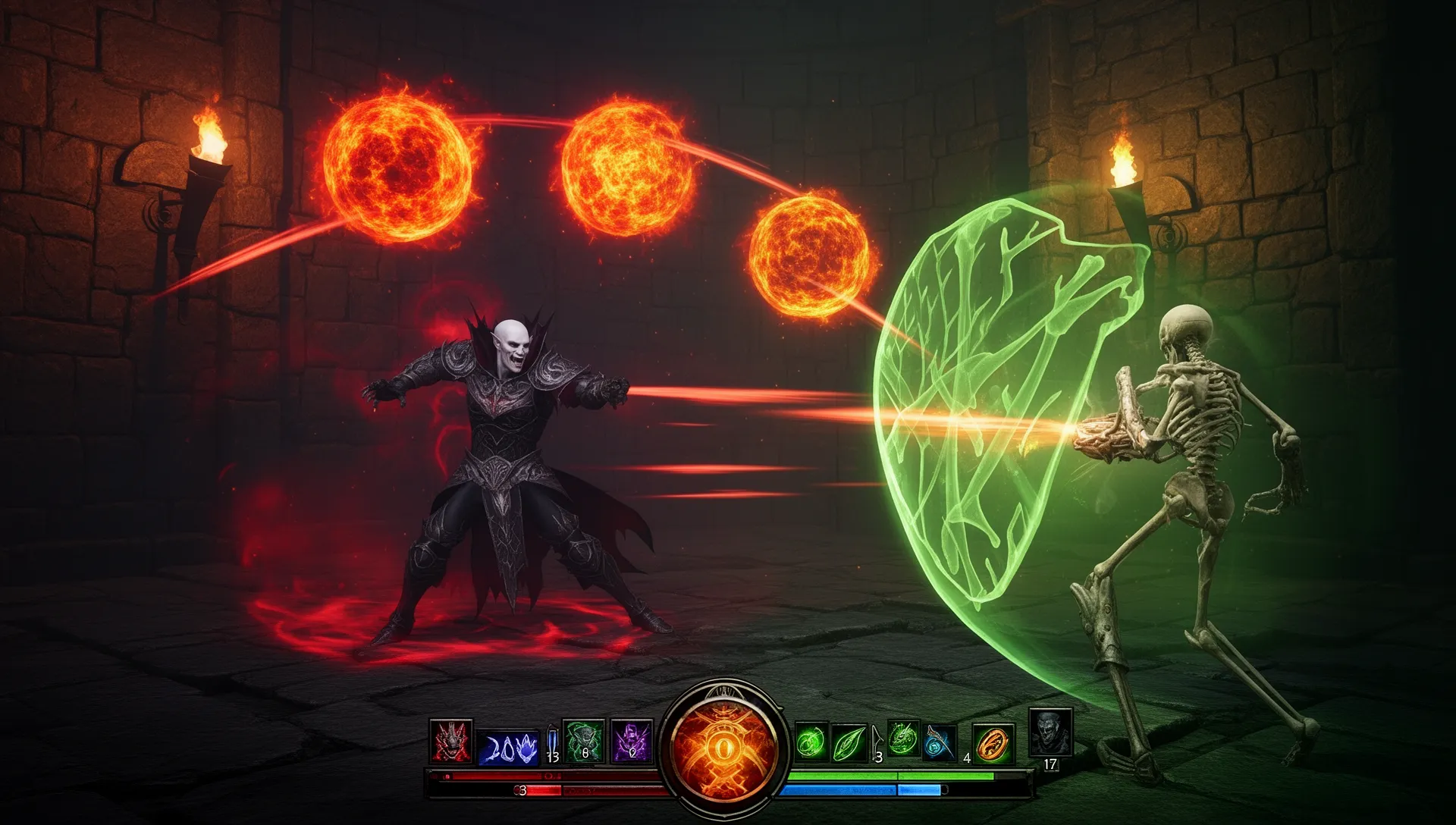
Most V Rising ability guides rank spells in order and call it done. Chaos Volley gets S-tier. Shadowbolt gets D. End of article. The problem is that you don’t fight bosses or raid players with one spell — you fight with a loadout. A B-tier ability slotted into the right combo beats an S-tier ability picked in isolation every time.
The three abilities that define the 1.0 and post-Oakveil meta — Veil of Blood, Chaos Volley, and Ward of the Damned — aren’t individually dominant. Ward of the Damned has no direct damage output. Veil of Blood doesn’t hit as hard as Veil of Chaos. Chaos Volley at 110% per bolt is outpaced by Void’s AoE in crowded fights. Together, they form the ranged shell: a sustain-through-leech, block-and-summon, reliable-DPS setup that covers every threat a solo vampire faces from early Farbane to late Oakveil Woodland bossing.
This tier list ranks individual abilities S through D — but the primary value is in what comes before: four complete loadouts for solo PvE, group PvE, duels, and raids, with the reasoning for each slot choice. Know why the combo works and you can adapt it as patches land.
Verified on V Rising Update 1.1 (Invaders of Oakveil), May 2026. Values may shift with future balance patches.
How the V Rising Ability Loadout System Works
Your combat setup runs five ability slots simultaneously, and understanding what each slot does changes how you evaluate individual spells.
- Weapon Q skill: Bound to your equipped weapon type and changes automatically when you swap. Each weapon has up to three distinct skills accessible via the Q key. Claws, Twinblade, and Throwing Daggers — added in 1.1 — each bring their own Q ability sets.
- Veil (Shift): Your dash and travel ability. Unlocked from V Blood Carriers, and every Veil carries secondary effects beyond the movement itself — sustain, illusions, shield generation, or offensive procs.
- Basic Spell 1 and 2: Two slots filled from your library of learned abilities. Roughly 60 are available at any given time, unlocked by defeating V Blood Carriers and through crafting research. These are the slots this tier list focuses on most.
- Ultimate: One slot on a 120-second cooldown. Soul Shards can optionally replace your equipped Ultimate — since 1.1, this replacement is no longer forced on you.
Each ability belongs to one of six magic schools: Blood, Chaos, Frost, Storm, Illusion, or Unholy. The Invaders of Oakveil update introduced a passive mastery system: as you learn more abilities within a school, you unlock passive bonuses tied to that school’s status effect. Each school also received one new spell in 1.1, and a reworked Spell Charges system now replaces older cooldown reset mechanics. You also have five passive slots available — Stygian Awakenings and standard passives — which stack on top of the active ability loadout but are outside the scope of this guide.
The 4 Meta Loadouts at a Glance
These are the four role-specific loadouts the meta supports in 2026. Weapon Q choices vary by weapon type and aren’t included — match your weapon to the build’s pace: fast weapons (Daggers, Swords, Claws) for Solo PvE and Duel builds; slower weapons (Reapers, Spears) for Support and Raid builds.
| Role | Veil | Basic 1 | Basic 2 | Ultimate |
|---|---|---|---|---|
| Solo PvE (Ranged Shell) | Veil of Blood | Ward of the Damned | Chaos Volley | Arctic Leap |
| Group PvE (Support) | Veil of Chaos | Lightning Curtain | Sanguine Coil | Raging Tempest |
| Duel (1v1 PvP) | Veil of Chaos | Void | Frost Barrier | Arctic Leap |
| Raid (Group PvP) | Veil of Illusion | Discharge | Ward of the Damned | Chaos Barrage |
Loadout 1: Solo PvE — The Ranged Shell
Veil of Blood + Ward of the Damned + Chaos Volley + Arctic Leap
This is the foundation shell that remains competitive into late Oakveil content. Veil of Blood provides a sustain dash: each use triggers the Blood school Leech passive, healing a percentage of damage dealt and keeping you healthy during extended boss pulls without constant potion use. It’s not the flashiest Veil in the game, but the sustain loop it enables — dash, Leech, heal, dash again — is self-contained in a way that Veil of Chaos’s illusions simply aren’t.
Ward of the Damned handles the defensive gap. When melee enemies reach you, activating Ward blocks the incoming attack and summons a skeleton swordsman that immediately redirects aggro. A fully-absorbed burst summons up to five skeletons, giving you a temporary tank line while you reposition and continue the Chaos Volley rotation. The skeletons persist long enough to keep a V Blood Carrier occupied through one to two additional ability casts. Unlocked from Nicholaus the Fallen (Level 37) at the Forgotten Cemetery.
Chaos Volley fills the DPS slot. Its two-bolt sequence — 110% magic damage per bolt, 0.6-second cast — applies Ignite twice in quick succession, triggering the Chaos school DoT passive even in a non-Chaos-committed school build. The Chaos Burn debuff also renders stealthed enemies visible, which matters in Oakveil’s cursed-forest sections where enemies use fade mechanics. Unlocked from Lidia the Chaos Archer (Level 26) in eastern Farbane Woods.
Arctic Leap closes the Ultimate slot: 250% magic damage on a 120-second cooldown with a 6-second freeze window. The freeze interrupts boss mechanics, mops up minion waves when the skeleton line collapses, and functions as an escape tool at range. The 0.2-second cast time means it’s almost never interrupted mid-channel. For tanky V Blood Carriers where the freeze is less useful than raw healing, swap Arctic Leap for Heart Strike — the Blood Ultimate adds 150% damage plus a 3.5-second self-heal that extends the sustain loop during long single-target fights.
Loadout 2: Group PvE — The Support Shell
Veil of Chaos + Lightning Curtain + Sanguine Coil + Raging Tempest
In group PvE your role changes from self-sufficient to enabler. The loadout is built around two questions: can you block the incoming burst that would otherwise wipe the group, and can you sustain your teammates through the phases you can’t block?
Veil of Chaos gives you two consecutive dashes and projects illusions that draw enemy AI targeting — useful for pulling aggro off a low-health teammate or repositioning after misplacing Lightning Curtain. The double dash is the mechanic here; the illusions are a bonus.
Lightning Curtain is the anchor of this build. A 2.5-second curtain that blocks incoming projectiles, applies Static on contact, and grants a 40% movement speed haste to allies in range. During a boss’s ranged damage phase, dropping the curtain between your team and the projectile barrage neutralizes the burst window entirely. The Storm school passive turns the Static application into passive zone damage — enemies hit take chain lightning procs at 50% spell power, converting a defensive cooldown into additional DPS while your group focuses the target.
Sanguine Coil’s three charges provide emergency heals throughout the fight. Each hit on a Leech-affected enemy heals the caster; each ally directly hit receives 120% spell power healing in return. Post-1.1, the self-heal component is 30% of spell power per proc (adjusted from earlier values), but the three charges make it a consistent heal source across an extended fight timeline. Raging Tempest closes the Ultimate slot with the highest damage output of any Ultimate in the game — 525% total magic damage split across a wide AoE. In a two- or three-person group stacked on a boss, it’s the DPS spike that ends phases.
Loadout 3: Duel — The Burst Control Shell
Veil of Chaos + Void + Frost Barrier + Arctic Leap
Duels in V Rising are decided in the freeze window. Arctic Leap freezes an enemy player for 2 seconds — shorter than its PvE application, but 2 seconds at full vampire movement speed is enough to deliver Void’s full damage burst plus a weapon Q combo before the freeze breaks. The key is sequencing: Void lands first, pulling the opponent toward the detonation point and applying Ignite, then Arctic Leap freezes them into the burn. Both hits land during the immobile window.
Void runs two charges at 90% magic damage each. Beyond raw damage, its pull mechanic removes the opponent’s ability to maintain range after a kite — it physically drags them toward the orb’s detonation point. Against a ranged opponent who’s been maintaining 20 meters of distance, Void closes that gap forcibly. Veil of Chaos’s illusions add deception: in open terrain they break visual tracking and create a 1-second window of uncertainty before the opponent identifies the real position.
Frost Barrier handles the defense slot. Unlike Ward of the Damned’s skeleton-based aggro management, Frost Barrier returns damage: each blocked hit deals 50% magic damage back to the attacker and applies Chill. A Chilled player caught by Arctic Leap freezes at the normal 2-second duration, but takes 25% extra damage while frozen due to the Frost school passive. Every hit you land during the freeze window gets that 25% bonus applied — so the difference between a Chilled and non-Chilled target entering the freeze is significant at high Spell Power values.
Counter note: opponents running Discharge become immaterial on activation, sidestepping Void’s pull entirely. Against a Discharge-user, replace Void with Power Surge. The +25% attack speed and +25% movement speed from Power Surge maintain offensive pressure during the Discharge’s immateriality window and keep the Ignite debuff ticking when they return to corporeality.
Loadout 4: Raid — The Zone Control Shell
Veil of Illusion + Discharge + Ward of the Damned + Chaos Barrage
Group PvP raids prioritize area denial and chaos over clean burst. The loadout creates a battlefield that favors discipline over firepower — your skeletons, your zone tool, your decoy, and your Ultimate all produce AoE effects that compound in dense enemy groups.
Veil of Illusion creates a phantom duplicate on each dash that persists long enough to confuse enemy targeting. Against multiple attackers, even a 1-second confusion window wastes their ability cooldowns. It’s the most utility-dense Veil in a raid specifically because the illusion is hardest to identify when multiple players are involved and attention is split.
Discharge provides two combat layers: immateriality during the dash absorbs the incoming burst that would otherwise kill you during a push, and the Static application on enemies passed through triggers chain lightning across multiple targets. Threading Discharge through a cluster of three or four attackers applies Static to all of them simultaneously, starting chain procs on the entire group before your team follows up. It’s the highest-utility single movement ability in group PvP.
Ward of the Damned returns from the solo PvE shell but in a different role: summoned skeletons attack multiple enemies simultaneously, spreading damage and drawing targeting away from your team’s squishier players. During a 5v5 raid, having five skeletons engaged with three enemy players creates a chaotic battlefield — one that favors the side that planned for it. Chaos Barrage is the raid Ultimate of choice: 200% direct magic damage plus 100% AoE damage across all four orbs, each applying Ignite independently. In a raid pile, a well-placed Chaos Barrage ignites every enemy in range and starts their DoT ticking before your team’s melee follow-up lands.

Individual Ability Tier List (S–D)
Rankings below reflect standalone utility. Abilities placed lower here can and do outperform higher-rated picks in specific loadout contexts — see the loadout sections above for the correct framing.
| Tier | Ability | School | Primary Reason |
|---|---|---|---|
| S | Void | Chaos | AoE pull + Ignite + 2 charges — highest offensive utility per slot in the game |
| S | Ward of the Damned | Unholy | Block + up to 5 skeleton summons — no other defensive spell provides aggro redirection |
| S | Lightning Curtain | Storm | Projectile denial + Static + 40% team haste — mandatory in any group PvE setup |
| S | Discharge | Storm / Illusion | Immateriality + CC + Static chain — best defensive-offensive crossover in the game |
| S | Mosquito | Illusion | 1.5-second fear + heavy AoE explosion after delay — best summon spell for mob clearing |
| A | Chaos Volley | Chaos | Reliable double-Ignite ranged DPS — drops to A as Void becomes available at higher GS |
| A | Frost Barrier | Frost | Returns 50% damage as Chill; synergizes with Freeze burst windows in PvP |
| A | Power Surge | Chaos | +25% attack/move speed — melee burst enabler; pairs with fast weapon Q skills |
| A | Sanguine Coil | Blood | 3-charge heal loop — best group heal available in a basic spell slot |
| A | Polarity Shift | Storm | Position swap + Static — underrated PvP tool for repositioning behind an opponent |
| A | Arctic Leap (Ultimate) | Frost | 250% dmg + 6s freeze — best PvE Ultimate and most reliable PvP opener |
| A | Heart Strike (Ultimate) | Blood | 150% dmg + 3.5s self-heal — top solo sustain Ultimate for long V Blood fights |
| A | Raging Tempest (Ultimate) | Storm | 525% total damage split — highest-damage group Ultimate in the game |
| B | Veil of Blood | Blood | Sustain dash — strong as part of the ranged shell, weak when evaluated in isolation |
| B | Veil of Chaos | Chaos | Double dash — strong in burst windows; illusions too brief to solo-carry PvP |
| B | Spectral Wolf | Illusion | Weaken + Phantasm stacking — strong Jewel Modifier platform, low raw damage output |
| B | Soulburn | Unholy | AoE life drain across 3 targets + 1.5s silence — good in multi-enemy PvE, redundant in raids |
| B | Death Knight | Unholy | Reliable single minion + Condemn — outclassed by Ward of the Damned’s summon volume |
| B | Ball Lightning | Storm | 180% over 3 seconds — effective with root/immobilize, loses value without setup |
| C | Ice Nova | Frost | 140% AoE Chill — consistent but inferior to Frost Barrier’s return damage utility |
| C | Corrupted Skull | Unholy | 80% x2 charges — single-target and outclassed by every other Unholy option |
| C | Cyclone | Storm | 90% pierce + good Static application — long cooldown kills its rotation viability |
| C | Bone Explosion | Unholy | 140% AoE opener — strong setup tool but too slow for sustained rotation use |
| D | Shadowbolt | Blood | 180% single target — solid damage but no utility beyond the hit itself; the starter spell |
| D | Frost Bat | Frost | Low damage, telegraphed projectile — Chill application only; superior Frost options exist at every GS |
School Passives: Which School to Commit To
In 1.1, specializing in a magic school unlocks passive bonuses as you learn more of its spells. This makes school selection a meaningful build decision, not just a cosmetic one. You don’t need all four spell slots in one school to access a passive — a two-Chaos, one-Blood loadout still triggers both schools’ basic passive tiers.
| School | Status Effect | Passive Bonus | Best for |
|---|---|---|---|
| Blood | Leech | Heal 10% of damage dealt to Leeched targets | Solo PvE sustain, hybrid melee builds |
| Chaos | Ignite | 50% of base spell damage as damage-over-time | Sustained DPS, PvP pressure, general use |
| Frost | Chill → Freeze | +25% damage dealt to Frozen enemies | Boss burst windows, PvP control builds |
| Storm | Static | Chain lightning at 50% Spell Power on Static targets | Group AoE, mob clearing, support builds |
| Illusion | Weaken + Phantasm | Free spell refund at 100 Phantasm stacks | Cooldown cycling, advanced combo builds |
| Unholy | Condemn | Damage amplification + skeleton conversion on enemy death | Minion summoner, group PvE support |
Blood and Chaos are the two most broadly useful schools for solo play. Blood’s Leech passive self-sustains without allied support — every Leeched target is a heal source as long as you’re dealing damage. Chaos’s Ignite passive turns every Chaos spell into a two-stage damage source: instant hit plus a burn that continues ticking while you reposition or block.
For PvP specifically, Chaos edges out Blood: Ignite remains on the target after they break your line of sight, while Leech requires you to stay in damage range to proc the heal. Frost is the best school for pure PvP burst: Chill into Freeze combined with the 25% damage bonus creates a window where every landed hit deals significantly more — the Arctic Leap opener becomes particularly punishing against a Chilled target compared to a non-Chilled one.
Jewel Slotting: How to Amplify Your Loadout
Jewels are socketable items that modify non-Ultimate abilities with passive effects. You can slot one Jewel per equipped ability, including Veil abilities, but not Ultimates. Jewels come in three relevant tiers: Tier 1 (single modifier), Tier 2 (two modifiers), and Tier 3 (three modifiers). Tier 1 drops begin around Gear Score 35; Tier 3 starts appearing reliably at GS 62 and above.
The modifiers that matter most for each loadout:
- Spell Lifesteal (8–12% range): Best on Chaos Volley and Void. Converts DPS into sustain without changing your loadout at all — every bolt proc returns health.
- Cooldown Reduction (6–10%): Best on Ward of the Damned and Frost Barrier. Reduces the gap between defensive windows in long fights.
- Explosion Damage (30–40%): Best on Mosquito. Increases the AoE burst after the fear window expires, which is where Mosquito delivers most of its damage.
- Cooldown on Kill: Best on mob-clearing abilities like Chaos Volley and Void. Each kill resets a portion of the cooldown, enabling rapid-fire use during dungeon runs and base defense scenarios.
- Spell Crit: Best on Void for PvP. Crit applies to both the direct hit and the AoE component, meaning a lucky proc effectively doubles the burst window’s damage output.
The strongest single Jewel upgrade in the solo PvE ranged shell is a Lifesteal Jewel on Chaos Volley. In a standard boss pull — roughly four casts per minute at typical fight duration — that’s four lifesteal procs returning 8–12% of Spell Power per hit. Stacked on the existing Blood Leech from Veil of Blood, the two sustain sources together effectively eliminate potion dependency on most non-elite V Blood Carriers. The synergy is why the ranged shell works at all content tiers rather than only early-game.
Oakveil 1.1: New Abilities by School
V Rising’s Invaders of Oakveil update added one new spell per school. Each addresses a gap in its school’s existing kit rather than simply adding redundant damage options.
| School | New Spell | Key Effect | Tier Assessment |
|---|---|---|---|
| Blood | Carrion Swarm | 4 blood bats pierce in a line, 50% each + Leech on all hits | C — Leech stacking across multiple enemies is its niche |
| Chaos | Rain of Chaos | 8 meteors over 3.2s, 380% total magic damage + Ignite | A — highest raw Chaos damage; channel time is the trade-off |
| Unholy | Chains of Death | Tether reduces speed 10–30%, 260% at max channel + Condemn | B — best new 1.1 addition for dedicated Unholy minion builds |
| Illusion | Curse | 5-wisp cone, applies Weaken + Curse to all targets hit | C — wide Weaken application but low direct output |
| Frost | Arctic Storm | Channeled AoE frost field, Chill on all targets in range | B — strong for base defense against raid incursions |
| Storm | Lightning Tendrils | Dynamic AoE control with Static application | B — situational AoE; competes with Lightning Curtain’s superior utility |
Of the six new spells, Rain of Chaos is the most immediately meta-relevant. At 380% total damage across 3.2 seconds, it outperforms Chaos Barrage in pure damage output — though Chaos Barrage’s direct knockback gives it situational PvP value that Rain of Chaos lacks. For extended boss fights against a frozen or otherwise controlled target, Rain of Chaos is the correct Chaos DPS choice. For standard rotations against mobile targets, the 3.2-second channel is too exposed to be safe.
Chains of Death adds a tether mechanic new to the Unholy school: it reduces enemy movement speed by 10–30% depending on tether distance, channels to 260% damage at completion, and applies Condemn throughout. The Condemn means enemy deaths during the channel proc skeleton conversions, making it the strongest 1.1 addition for players running a dedicated minion summoner build around Unholy.
When a B-Tier Veil Beats Every S-Tier Choice
Veil of Frost sits mid-table on almost every individual ranking. Its dash is straightforward, and the shield it generates — 70% of spell power after a dash followed by a primary attack — doesn’t match Veil of Chaos’s double dash or Veil of Blood’s sustain loop when evaluated on paper.
In one specific context, it’s the correct choice: tank-oriented solo builds against V Blood Carriers with heavy, sustained melee pressure phases. The shield absorbs the first hit of an enemy melee combo before your Leech proc or Barrier recast can activate — it cuts the effective incoming damage below the threshold where your healing rotation falls behind. At endgame Spell Power with a Tier 3 Jewel enhancing the shield value, Veil of Frost routinely absorbs 1,500–2,000 effective HP per use. Most healing rotations don’t return that much in the same window.
This is the correct framing for the entire tier list: don’t rank abilities in isolation. Rank them against the specific fight’s pressure profile and the loadout you’ve built around them.
Frequently Asked Questions
What is the single best ability in V Rising in 2026?
Ward of the Damned and Void both have legitimate claims. Ward of the Damned simultaneously protects the caster and generates allied damage sources — no other ability in the pool does both. Void’s AoE pull is the most reliable crowd control and DPS tool per slot. If you’re forced to choose one for general solo play, Ward of the Damned performs across more fight types because the defensive value applies at every progression tier while Void’s AoE advantage is most pronounced in late-game, multi-target scenarios.
Does Chaos Volley still hold up after Rain of Chaos was added in Oakveil?
Yes, for most situations. Rain of Chaos has higher total damage (380% vs Chaos Volley’s 220% per cast), but its 3.2-second channel leaves you completely exposed during the full duration — a risk only acceptable when the target is frozen or otherwise controlled. Chaos Volley fires both bolts in 0.6 seconds and gets you moving again immediately. For standard rotations against mobile targets, Chaos Volley remains the safer choice. For controlled boss phases where you have a freeze window, Rain of Chaos outperforms it.
How many abilities from one school do I need to unlock that school’s passive?
Magic School passives in 1.1 unlock progressively as you learn abilities. The first tier (general bonuses like reduced blood drain) activates early, after just one or two abilities learned. The school-specific damage passive — the Ignite DoT, the Leech heal, the Freeze bonus — unlocks at the second or third ability in the school. A two-Chaos, one-Blood loadout still triggers both schools’ first-tier passives, so you don’t need to commit all slots to one school to benefit.
Should I use a Soul Shard instead of my regular Ultimate?
Since 1.1, Soul Shards no longer forcibly replace your Ultimate — the replacement is optional. Standard Ultimates on 120-second cooldowns are consistently available throughout a boss fight; Soul Shard Ultimates are tied to endgame content access. For players progressing through mid-game content, standard Ultimates are the better pick. Endgame raid players with reliable Shard access should evaluate on a per-fight basis, since Shard Ultimates are more powerful but situational.
What’s the best ability loadout for a new V Rising player?
Start with the ranged shell: Veil of Blood, Ward of the Damned, Chaos Volley. Unlock them in roughly that order by defeating Nicholaus the Fallen for Ward and Lidia the Chaos Archer for Chaos Volley. Add Arctic Leap as soon as you can reach Terrorclaw the Ogre. This setup tolerates mistakes — Ward of the Damned’s skeleton summons buy time when positioning breaks down, and Veil of Blood’s sustain keeps you in the fight through errors that would otherwise require a retreat to your castle. Upgrade to Void and the duel build once you understand how the freeze-burst sequence works.
New to V Rising? Our V Rising Beginner’s Guide 2026 covers the full survival framework — blood types, Castle Heart placement, server selection, and the first three V Blood bosses in order.
Sources
- BisectHosting. Top 10 Best Spells in V Rising 1.0. BisectHosting Blog (2024)
- BisectHosting. V Rising: Best Spells in Update 1.1 Ranked. BisectHosting Blog (2025)
- GameSkinny. V Rising Spell Tier List. GameSkinny (2025)
- GameLeap. V Rising Best Spells Tier List. GameLeap (2024)
- High Ground Gaming. The Best Abilities in V Rising. High Ground Gaming (2025)
- Prima Games. Best Spells in V Rising Invaders of Oakveil 1.1. Prima Games (2025)
- Keen Gamer. V Rising Jewel Fusion & Passive Guide 1.1. Keen Gamer (2025)
- Game Rant. V Rising: Best Magic Types, Ranked. Game Rant (2025)

I've been playing video games for over 20 years, spanning everything from early PC titles to modern open-world games. I started Switchblade Gaming to publish the kind of accurate, well-researched guides I always wanted to find — built on primary sources, tested in-game, and kept up to date after patches. I currently focus on Minecraft and Pokémon GO.