
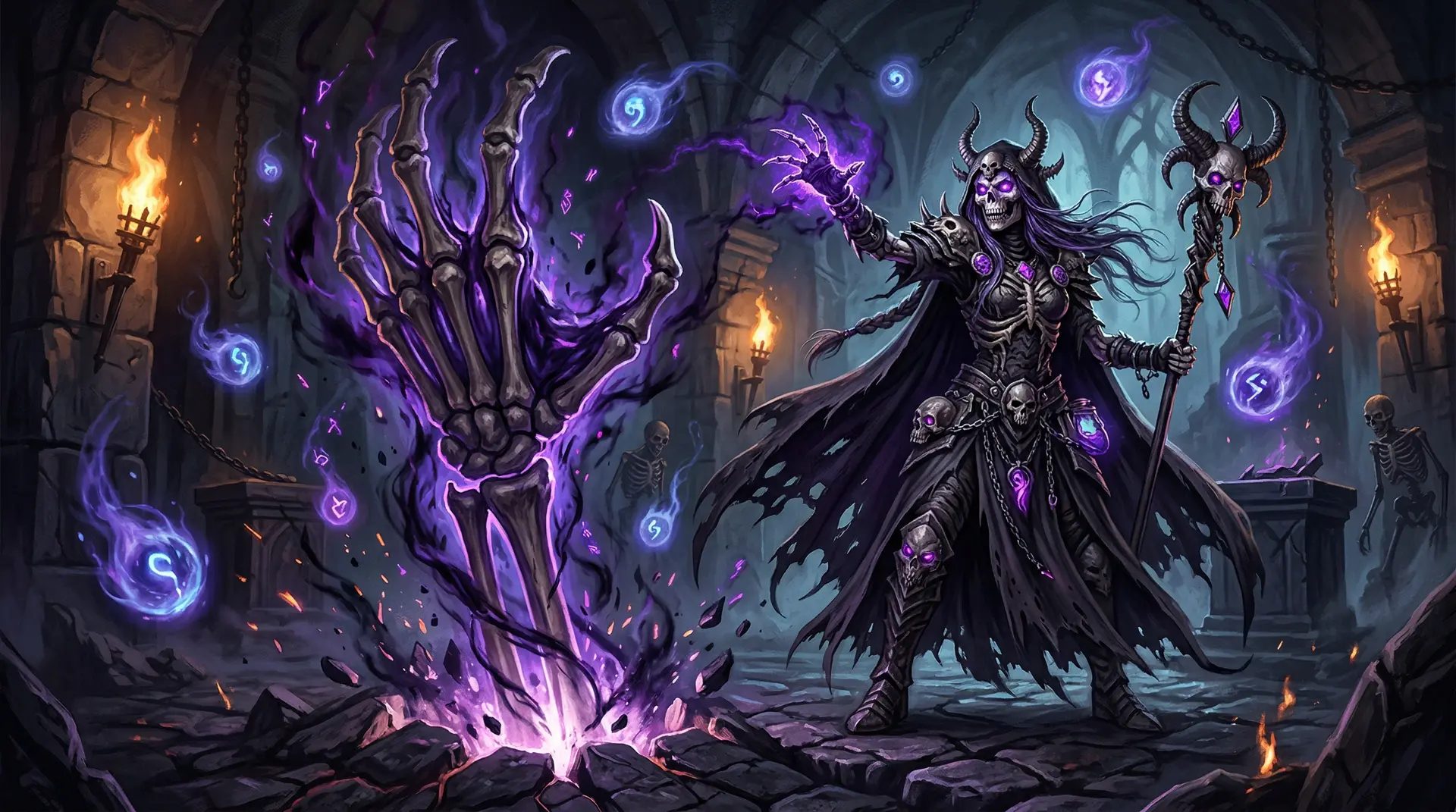
The Necrobinder enters every fight already at a disadvantage on paper — 66 HP is the lowest starting health of any character in Slay the Spire 2, dropping to 52 HP at Ascension 2. If you came straight off the Ironclad or the Regent, that number will feel alarming. It should. The Necrobinder trades raw survivability for three simultaneous win conditions that compound on each other in ways no STS1 character could manage.
She is the fourth playable character in STS2, unlocked after completing a run with the Regent. Her toolkit — a skeletal companion named Osty, an execution debuff called Doom, and a generated-card cycle engine called Souls — introduces mechanics with no direct precedent in the original game. The Early Access community has mapped out three primary archetypes with clear card and relic priorities. This guide covers all three, the relics that define each, and a decision framework for choosing based on your experience with the class. For a full breakdown of all STS2 mechanics and systems, see our complete STS2 guide.
Verified on Slay the Spire 2 Early Access, April 2026. Card values and mechanics may shift with patches — verify numbers in-game.
Necrobinder Quick Start
If this is your first Necrobinder run, follow these five steps before diving into archetype detail:
- Run Soul Cycle — it functions without unlocking high-rarity cards and has the clearest win condition of the three builds.
- Take Grave Warden and Capture Spirit in Act 1 — they generate Souls while providing Block, replacing Defend without losing defensive value.
- Draft Haunt as your primary damage source — multiple copies stack, so two Haunts means every Soul removes twice as much enemy HP.
- Buy Funerary Mask whenever it appears in a shop — it gives 3 free Souls per combat at no card slot cost and fires Haunt triggers from turn 1.
- Keep your deck under 15 cards — cycle speed is what generates Haunt triggers fast enough to matter against Elites and bosses.
What Makes the Necrobinder Different
No STS1 character provides a useful comparison point. The Ironclad hits things and accumulates Strength. The Silent poisons and evades. The Defect channels energy through orbs. All three returned to STS2 with years of community documentation behind them. The Necrobinder arrived with no equivalent foundation — three entirely new systems, no meta history, and a card pool that rewards committed archetype construction over flexible adaptation. For a side-by-side look at how she compares to every STS2 character, see our STS2 characters guide.
Osty is a reanimated skeletal hand that accompanies the Necrobinder into every fight. Her starting relic, Bound Phylactery, summons Osty at the start of each turn — she never begins a turn without her companion present. Osty has its own HP bar and intercepts incoming damage before it reaches the Necrobinder’s health pool. Certain cards deal damage proportional to Osty’s current HP, creating a genuine incentive to maintain companion health rather than using Osty as a passive buffer. [1]
Doom is an execution debuff applied to enemies via specific cards. It works as a convergence game: at the end of each enemy’s turn, if that enemy’s current HP is equal to or below their accumulated Doom stacks, they die instantly — bypassing block entirely. Doom stacks never decay, meaning an early application of 7 Doom still contributes to the execution threshold turns later. The timing caveat is critical: execution triggers at the end of the enemy’s turn. The enemy always gets one final action before the kill lands. [1]
Souls are zero-energy cards generated by specific skill cards. When played, they draw two cards and exhaust — functioning as a cycle engine that simultaneously fuels scaling payoff cards. Haunt removes HP from enemies each time you play a Soul; Soul Storm deals damage equal to the total Souls in your exhaust pile. Souls are not in the starting deck. You build toward them through generator cards like Grave Warden, Capture Spirit, and Dirge. [2]
Early Access note: A minority of community sources describe Souls as HP-cost spells that enter a separate Graveyard pile, retrievable via cards like Exhume and Lich King. The majority consensus across current community guides and the official wiki treats Souls as zero-energy exhausting cards. This likely reflects either an earlier patch version or a distinction between two related card types in the pool. Verify current behavior in-game on your patch version.
Her starting deck — four Strikes, four Defends, Bodyguard, and Unleash — produces less damage per turn than any other STS2 character at baseline. Her 82-card pool (20 common, 36 uncommon, 26 rare) compensates through high payoff density at rarity. She rewards committed archetype construction. [1] For ranked analysis of the strongest cards across all STS2 classes, see our STS2 best cards tier list.
Build 1 — Soul Cycle (Beginner-Recommended)
The Soul Cycle build is the recommended entry point for new Necrobinder players. It functions without deep card unlocks, has the clearest win condition of the three archetypes, and produces consistent results against Act 3 bosses when the engine assembles correctly.
How it works: Generate Souls using skill cards, flood your exhaust pile, then let Haunt and Soul Storm convert those Souls into damage. Every Soul you play triggers Haunt — and if you have two copies, each Soul triggers both simultaneously. Soul Storm’s damage scales directly off Souls in the exhaust pile, making it a high-ceiling finisher against tanky bosses when timed correctly.
Essential cards:
- Grave Warden (1 energy): Blocks 8 and generates a Soul simultaneously. It replaces Defend without losing defensive value and produces engine fuel at the same time. Draft early and often.
- Capture Spirit (1 energy): Creates 3 Souls for 1 energy — the highest raw generation rate available. A single Capture Spirit fires Haunt three times per turn with one copy in play.
- Dirge (variable X energy): Generates X Souls and increases Osty’s max HP. The Osty HP bonus adds a defensive buffer even in Soul-focused decks — you get it without dedicating a slot to Block.
- Haunt (Power): Forces a random enemy to lose HP each time you play a Soul. Multiple copies stack — two Haunts means every Soul removes HP twice. This is the build’s primary damage engine. Prioritize a second copy whenever it appears. [3]
- Soul Storm (Attack): Deals damage equal to Souls in your exhaust pile. Hold it until your exhaust count reaches 8 or more. Against a final boss, the difference between 5 and 12 Souls in exhaust is 40+ damage.
- Borrowed Time (1 energy): Applies 3 Doom, gains 1 Energy. The Doom is irrelevant in a Soul-focused build. The energy is net-free. Take it whenever it appears.
- Undeath (Power): Self-replicates in your deck, making it consistently searchable across multiple cycles. Reliable survivability card with no downside. [3]
Key relic — Funerary Mask: Starts every combat with 3 free Souls in your draw pile. This relic alone jumpstarts Haunt triggers from turn 1 without requiring energy or a card play. Treat it as a first-priority shop purchase. [3]
Deck target: 10–15 cards. Smaller decks cycle faster, directly increasing Haunt trigger frequency per fight. Use Seance or Dredge for thinning when available. Avoid adding filler cards at reward screens even when nothing looks immediately useful.
Build 2 — Osty Scaling (Intermediate)
The Osty build weaponizes Osty’s HP pool directly. Summon cards pour health into the companion, and scaling attacks convert that HP into burst damage. It is the most mechanically intuitive of the three archetypes — build a companion, attack through it — but the most fragile in practice without deliberate defensive support.
The pro tips are in slay spire defect build.
How it works: Summon-keyword cards grow Osty’s HP pool. Squeeze and Flatten then deal damage proportional to that HP. The Fetch + Flatten combination is the core loop: for 1 energy, Fetch cycles your hand while triggering an Osty attack, and Flatten fires for free as a follow-up. At scale, this combination hits for 15+ damage per mana — higher than most comparable attacks available to the class. [2]
Core cards:
- Pull Aggro (2 energy): Grants Summon 4 and 7 Block simultaneously. Grows Osty and defends in one card — the most efficient Summon source for survivability.
- Invoke (1 energy): Summon 2, gain 2 Energy. Net-neutral on energy while adding Summon. One of the better energy-generating cards in her pool.
- Fetch (1 energy): Cycles your hand while triggering an Osty attack. Direct pairing with Flatten. Multiple copies speed up the combat loop.
- Flatten (0 energy, after Osty attack): Free damage following any Osty attack in the same turn. The more Osty attacks per turn, the more Flatten copies fire.
- Squeeze (Attack): Deals damage scaled to Osty’s current HP. At Osty HP 20+, this hits harder than most cards available to the class. At low Osty HP after multi-hit damage, it barely registers. High-variance card — requires defensive setup to function reliably. [4]
- Rattle (Attack): Multi-hit attack that benefits from Osty damage modifiers. Scales naturally with companion health. Reliable filler that does not require specific synergy.
Key relic — Bone Flute: Generates 2 Block each time Osty attacks. At scale, with multiple Fetch/Flatten cycles per turn, this adds 10–20 passive Block per round without card plays. It makes an inherently fragile build meaningfully more survivable.
Glass cannon warning: Squeeze collapses if Osty’s HP drops. Multi-hit enemies, AoE attacks, and Elites targeting Osty repeatedly can crater your damage output for an entire fight. If you commit to Osty Scaling, carry at least 2 defensive cards — Borrowed Time, Dirge, or upgraded Defends — or expect the build to fail against any Elite with a multi-hit pattern. [4]
Build 3 — Doom Execution (Advanced)
The Doom build plays a deliberate two-number convergence game. Apply Doom stacks steadily while dealing direct damage — eventually the enemy’s HP drops to meet their Doom total, and they are executed at the end of their turn, bypassing all remaining block. It is the highest-ceiling archetype and the most demanding on card pool depth.
How it works: Heavy Doom applicators front-load stacks quickly. Shroud converts each Doom application into Block, solving the survivability gap during the accumulation phase. Undying Sigil halves incoming damage from any enemy whose Doom matches or exceeds their HP — a critical buffer between approaching the threshold and the actual execution trigger. [5]
Core cards:
- Deathbringer (2 energy): Applies 21 Doom and 1 Weak to all enemies. AoE Doom with a free debuff — in multi-enemy rooms, this single card sets up executions across the board.
- No Escape (1 energy): Applies 10 Doom, plus 5 additional Doom for every 10 Doom already on the target. Against an enemy with 30 accumulated Doom, one No Escape adds 25 more — exponential scaling that dramatically shortens convergence timelines.
- Negative Pulse (1 energy): 5 Block and 7 Doom to all enemies. Efficient, defensive, and useful in every act of the run.
- Shroud (Power, 1 energy): Gain 2 Block each time you apply Doom. With Deathbringer, Negative Pulse, and No Escape in one turn, Shroud generates 35–45 passive Block. This card is what makes Doom builds survive long enough to reach the execution threshold. [5]
- End of Days (3 energy): Applies 29 Doom to all enemies and immediately kills any target already at or below their Doom threshold. A room-cleaner and closer combined in one card.
- Time’s Up (2 energy): Deals damage equal to the target’s current Doom stacks. Use it during accumulation to deal real damage while waiting for convergence — bridges the gap between early Doom application and the eventual kill point. [4]
Key relics: Undying Sigil (enemies with Doom ≥ HP deal 50% reduced damage) and Book Repair Knife (heal 3 HP when a non-minion dies to Doom). Undying Sigil is the build-enabling relic — it creates a survivability window during the convergence phase that the build cannot function without at higher difficulty.
Prerequisite note: Deathbringer is uncommon and End of Days is rare. Neither appears in early card reward pools without sufficient unlock depth. On your first or second Necrobinder run, start with Soul Cycle and return to Doom once the high-rarity pool is accessible. The build underperforms without its core applicators. [5]

Which Build Should You Run?
Each archetype suits a different experience level and card reward type. Use the comparison table to understand where each build stands:
| Soul Cycle | Osty Scaling | Doom Execution | |
|---|---|---|---|
| Difficulty | Beginner | Intermediate | Advanced |
| Win condition | Haunt + Soul Storm | Squeeze/Flatten burst | Execution threshold |
| Key relic | Funerary Mask | Bone Flute | Undying Sigil |
| Fragility | Medium | High | Low (Sigil buffer) |
| Works without synergy? | Yes | No | No |
| Unlock depth required | Low | Medium | High |
Player-type routing:
| Your situation | Recommended build |
|---|---|
| First Necrobinder run | Soul Cycle |
| STS1 veteran, new to Necrobinder | Soul Cycle, pivot to Doom once familiar |
| Chasing highest ceiling | Doom Execution |
| Want early run reliability | Soul Cycle with Osty hybrid elements |
| Experienced, optimizing boss clears | Doom Execution or mixed Doom/Souls |
Best Relics Quick Reference
- Funerary Mask (Uncommon): 3 free Souls per combat start. Essential for Soul Cycle — highest priority shop relic. [3]
- Bone Flute (Common): 2 Block per Osty attack. Core defensive enabler for Osty builds — passive Block without spending card plays.
- Undying Sigil (Shop): Enemies with Doom ≥ HP deal 50% reduced damage. Build-enabling for Doom — creates the survivability window during convergence.
- Book Repair Knife (Uncommon): Heal 3 HP on non-minion Doom kill. Sustain for long Doom runs with multiple executions per fight.
- Pendulum: Extra draw on deck reshuffle. Universal — benefits every archetype by maintaining hand size through cycles.
- Dolly’s Mirror: Copies any card in your deck. Use to duplicate Haunt for Soul Cycle or Deathbringer for Doom builds. [3]
Tips for Every Experience Level
Beginner
- Grab attack cards immediately in Act 1. The Necrobinder has the weakest baseline damage of any STS2 character, and four Strikes alone will not carry you past the first Elite. [2]
- Let Osty absorb damage in every build — the companion intercepts hits before they reach your HP in any archetype. Never spend Block on damage Osty can eat for free.
- Prioritize Funerary Mask in shops over most relic choices. The 3 free Souls per combat translate to immediate Haunt triggers from the very first turn.
- Use Seance and Dredge for deck thinning when they appear. A 10-card Soul Cycle deck fires Haunt at least twice as frequently as a 20-card version of the same build.
Advanced
- Borrowed Time cross-build utility: the 3 Doom it applies activates Undying Sigil’s damage reduction once an enemy nears threshold. In a Soul Cycle run, 2 copies of Borrowed Time provide near-free energy plus a passive survivability buffer at negligible deck cost.
- Soul Storm timing: track your exhaust pile count actively. Against bosses with 100+ HP, hold Soul Storm until exhaust reaches 10+. Playing it at 3 Souls exhausted wastes most of the card’s damage ceiling.
- Squeeze commitment threshold: only draft Squeeze when Osty has a reliable path to sustaining 15+ HP through a full Elite fight. Against rooms with multi-hit attack patterns, evaluate whether Osty will survive two consecutive turns before adding it.
- Doom + Haunt hybrid: Borrowed Time’s 3 Doom accumulates across turns. In long boss fights, 4–6 Borrowed Time plays passively stack 12–18 Doom — enough for Undying Sigil’s damage reduction even in primarily Souls-focused decks. Not a primary win condition, but adds resilience at near-zero cost. [5]
Frequently Asked Questions
Is the Necrobinder good for beginners?
The Necrobinder is not the recommended first STS2 character. The Ironclad is simpler and more forgiving, and experienced STS1 players already understand his foundational mechanics. Once you have cleared Act 3 with the Ironclad and want significantly more complexity, the Necrobinder’s Soul Cycle build is the accessible entry point — clear win condition, lower unlock dependency, manageable cognitive load for a first run.
What is the best starting relic?
Bound Phylactery is the non-negotiable starting relic — it summons Osty at the start of every turn, meaning every run benefits from companion HP absorption regardless of build focus. For acquired relics: Funerary Mask is highest priority for Soul Cycle, Bone Flute for Osty builds, and Undying Sigil for Doom execution.
Can Doom and Souls be mixed in the same deck?
Yes. Borrowed Time is the natural bridge — 1 energy, applies 3 Doom, returns 1 Energy, making it effectively zero-cost Doom generation. Running 2 copies in a Soul Cycle deck passively accumulates Doom across a long fight, eventually triggering Undying Sigil’s damage reduction alongside your Haunt engine. This hybrid is not optimal compared to a full Doom build’s ceiling but adds resilience against tanky enemies at minimal investment.
Why does the Necrobinder have such low HP?
The 66 HP starting pool is the tradeoff for her power toolkit. Blood magic mechanics and HP-cost card effects are balanced against a lower base health ceiling than other characters. At higher Ascension levels this becomes a primary tension — how aggressively you use HP-based payoffs determines how much buffer remains for Act 3 Elites and the final boss. Managing that tension is most of what advanced Necrobinder play actually consists of.
Sources
- Necrobinder — Slay the Spire 2 Wiki: slaythespire.wiki.gg/wiki/Slay_the_Spire_2:Necrobinder
- Slay the Spire 2 Necrobinder guide — PCGamesN
- Best Build And Relics For The Necrobinder — TheGamer
- Best Cards for Necrobinder Runs — Game Rant
- Slay the Spire 2 Necrobinder Guide — Mobalytics

I've been playing video games for over 20 years, spanning everything from early PC titles to modern open-world games. I started Switchblade Gaming to publish the kind of accurate, well-researched guides I always wanted to find — built on primary sources, tested in-game, and kept up to date after patches. I currently focus on Minecraft and Pokémon GO.