
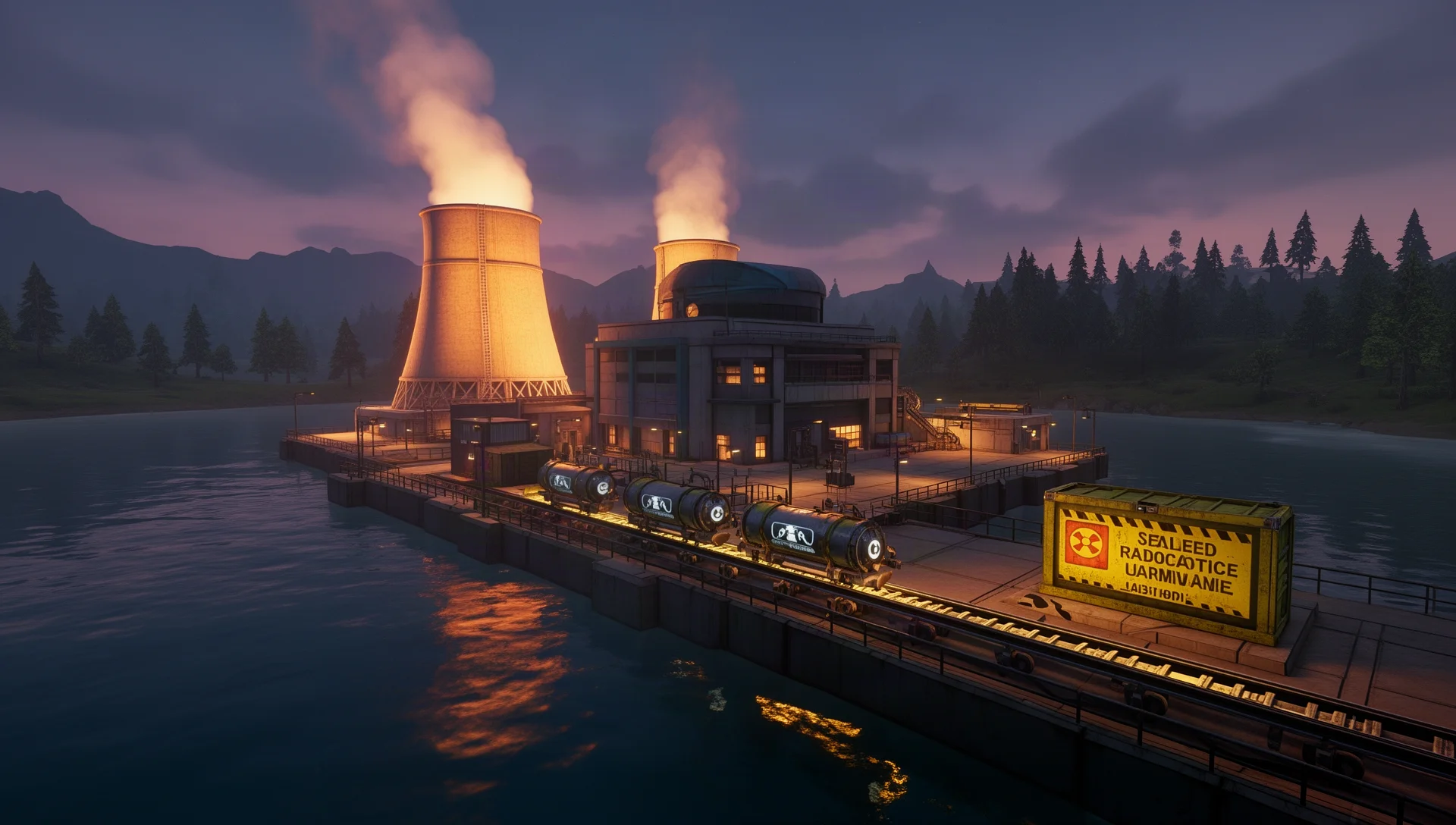
Your first Nuclear Power Plant produces 2,500 MW from a single building — more than four Fuel Generator rows combined — but it also draws 240 m³ of water every minute and produces radioactive waste the game will not let you delete[1]. Uranium Waste cannot go in the AWESOME Sink. It cannot be thrown away. FICSIT’s own tooltip says it outright: FICSIT does not waste[3]. Every pioneer who unlocks Tier 8 hits the same wall a few hours later — a storage yard full of glowing crates and no plan for what comes next.
This guide covers the full loop: the exact ratios for a single 2,500 MW plant, the water and radiation logistics that trip up new builds, and the three-stage chain — Uranium to Plutonium to Ficsonium — that’s the only way to actually clear that storage yard to zero[6][7].
Quick Start: The 6-Step Nuclear Loop
If you’re staring at an unlocked Nuclear Power Plant blueprint and don’t know where to start, do these in order.
- Build water extraction first — 240 m³/min per plant, from a lake or the ocean, before you pour a single foundation for the reactor itself.
- Run Uranium through Encased Uranium Cells into Uranium Fuel Rods — budget the full production chain, not just the final rod recipe.
- Build the plant and connect power distribution before you connect fuel — an unpowered plant with fuel queued will still consume rods once it comes online.
- Build a dedicated Storage Container run for Uranium Waste immediately, not after the first overflow warning — 10 Uranium Waste/min adds up in under an hour[3].
- Get a Hazmat Suit and Iodine-Infused Filters running before your waste yard passes a few hundred units — radiation intensity scales with proximity and total item count[8].
- Decide your endgame early: sink Plutonium Fuel Rods for points, or commit to the Particle Accelerator chain that ends in Ficsonium. Retrofitting later means re-piping water you’ve already committed elsewhere.
Skip step 4 and you’ll be doing an emergency waste-storage expansion right as your second plant comes online — it’s the single most common nuclear mistake we’ve watched new players make.
The Core Numbers: 2,500 MW, 240 m³ of Water a Minute, and What It Costs to Build
One Nuclear Power Plant outputs 2,500 MW at 100% clock speed, no matter which of the three fuel rods you feed it[1]. Water consumption is also fixed at 240 m³/min regardless of fuel type — that number doesn’t change whether you’re burning Uranium, Plutonium, or Ficsonium rods[1].
| Spec | Value |
|---|---|
| Power output | 2,500 MW at 100% clock speed |
| Water draw | 240 m³/min, fixed regardless of fuel type |
| Unlock | Tier 8 — Nuclear Power |
| Build cost | 10 Supercomputer, 25 Heavy Modular Frame, 100 Alclad Aluminum Sheet, 200 Cable, 250 Concrete |
To put 2,500 MW in perspective: matching it with Coal Generators, at 75 MW each, would take roughly 34 of them plus their own separate 45 m³/min water lines and a constant coal-belt supply[13]. One Nuclear Power Plant replaces that entire sector, which is exactly why the water and waste trade-offs below are worth planning around instead of avoiding.
The single biggest planning mistake is treating water as an afterthought: 240 m³/min per plant is a serious draw, and elevation changes between your extraction point and the reactor will need header pumps to keep pressure up — budget for that before you commit a build site, not after the plant is already placed.
Verified against the official Satisfactory wiki as of September 2026, current with Update 1.2 (promoted to Stable June 2, 2026)[10]. Nuclear Power’s core numbers have been unchanged since the Tier 8 rework — if you’re returning to an old save from before 1.0, re-check these values in-game before committing a factory layout.
Uranium Fuel Rods: What You’ll Actually Run First
A single Nuclear Power Plant burns 0.2 Uranium Fuel Rods per minute — one rod every 300 seconds — and each rod returns 50 Uranium Waste over that cycle, a steady 10 Uranium Waste/min per plant[1][3].
Encased Uranium Cell is its own sub-chain, not a raw-ore swap-in: a Blender turns 10 Uranium ore, 3 Concrete, and 8 Sulfuric Acid into 5 Encased Uranium Cells on a 12-second cycle (25/min)[14]. That Sulfuric Acid input is the part new players forget to scale — undersize it and your Uranium Fuel Rod line stalls at the Blender, not at the final Manufacturer step where the bottleneck looks obvious.
The rod itself comes from a Manufacturer: 50 Encased Uranium Cell, 3 Encased Industrial Beam, and 5 Electromagnetic Control Rod per rod, on a 150-second cycle (0.4 rods/min output)[2]. Build two Manufacturers on that recipe and you’re comfortably ahead of a single plant’s 0.2/min appetite, with slack banked for a second reactor later. The Uranium Fuel Unit alternate recipe trades in a Crystal Oscillator and a Rotor for a faster 0.6 rods/min per Manufacturer, if you’ve unlocked it — worth it once you’re running three or more plants and don’t want a wall of Manufacturers[2].
That low 0.2/min consumption rate is the entire appeal of Uranium over Fuel or Coal generators: one rod holds 750,000 MJ, so a plant sits at a flat 2,500 MW output for the full 300-second cycle on a trickle of input[1]. The trade is the waste stream you now have to manage for the rest of the save.
The Radiation Problem: Why the Waste Container Is a Timer, Not a Solution
Storing Uranium Waste is not a permanent fix — it’s radioactive, it stacks to only 500 per slot, and the game actively blocks you from getting rid of it: it can’t go in a trash slot, and it will clog the input if you try to route it into the AWESOME Sink[3][5].
| Item | Radiation (decay) value | Notes |
|---|---|---|
| Uranium (raw ore) | 15 | Deposits stay hot until you save and reload |
| Uranium Waste | 10 | Cannot Sink or trash |
| Plutonium Fuel Rod | 250 | Radioactive even before you burn it |
| Plutonium Waste | 200 | Highest radiation density per inventory slot[8] |
The takeaway: Plutonium Waste is far more dangerous per inventory slot than Uranium Waste, so a Plutonium-burning setup needs a stricter storage plan from day one — this isn’t something to retrofit after the fact.
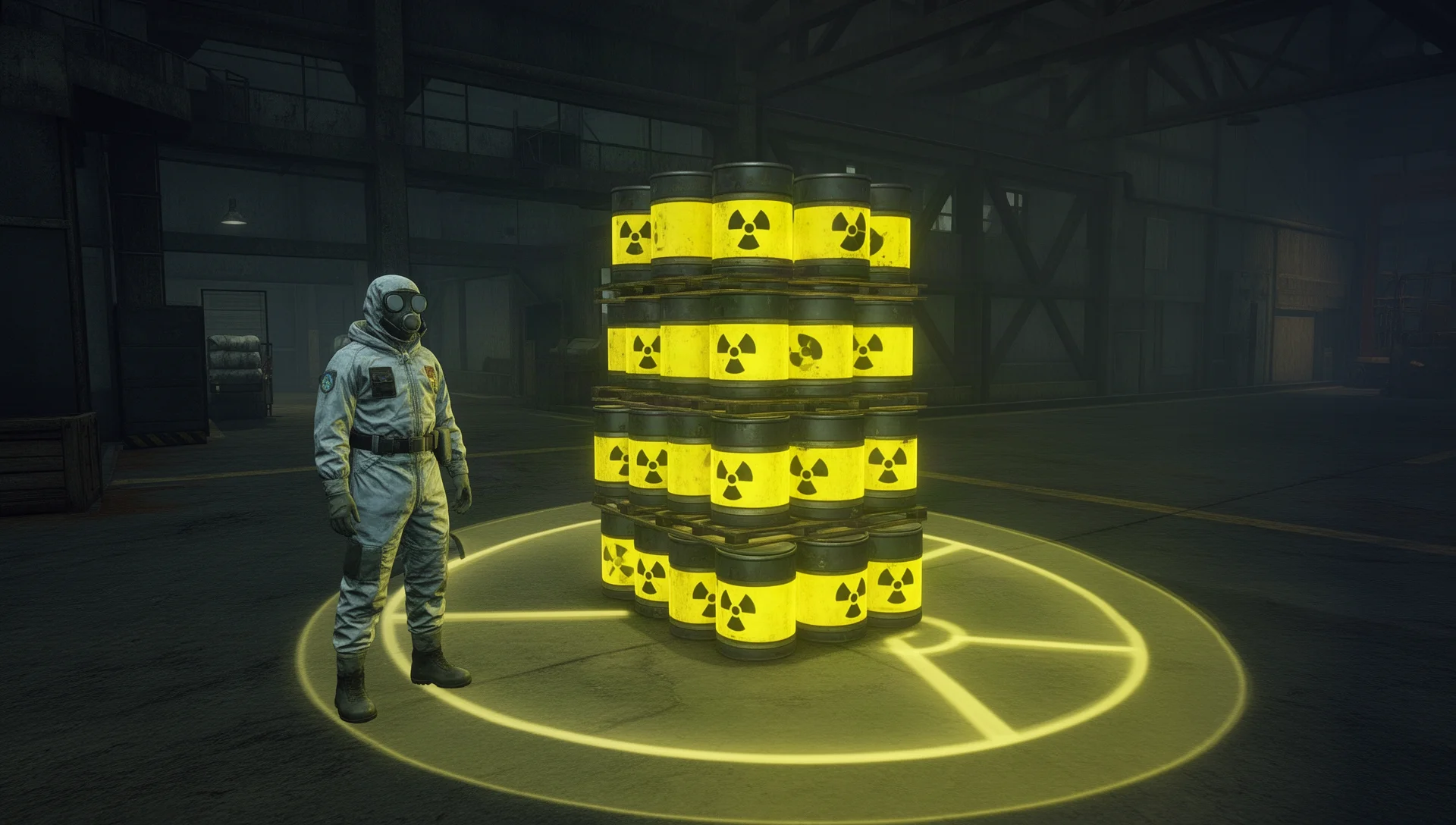
Radiation intensity scales with item count, proximity, and each item’s decay value, capped between 0.2 (0.44% damage) and 45 (100% damage)[8]. Get within half a meter of a large waste pile and the game treats you as if you were standing at that half-meter distance no matter how carefully you approached — there’s no way to tiptoe past a big stack. A Hazmat Suit with Iodine-Infused Filters, unlocked at Tier 7, is the only practical way to work near a waste yard without taking chip damage on every visit[8]. Stepping into any vehicle also blocks radiation damage outright, which is why most veteran bases route a truck path or hypertube past the waste yard instead of a walking one.
Player-Type Priorities: How Far Should You Actually Take This?
| Player type | What to actually build |
|---|---|
| New player | Stop at Uranium. Run one plant, dedicate a full outpost to waste storage, and don’t touch Plutonium until the rest of your factory is stable. The waste problem isn’t urgent in your first ten hours with nuclear. |
| Casual player | Burn Uranium, but sink the downstream Plutonium Fuel Rods for AWESOME Sink points instead of burning them. This avoids Plutonium Waste entirely and skips the Particle Accelerator chain. |
| Hardcore / optimiser | Build the full Uranium to Plutonium to Ficsonium loop. It’s the only setup with zero long-term waste accumulation, and past roughly 10,000 MW of total factory draw the Particle Accelerator investment pays for itself in storage space saved[9]. |
| Completionist | Build every fuel-rod tier at least once, including Ficsonium, even below the 10,000 MW threshold — the Quantum Encoder it requires feeds other Tier 9 chains you’ll likely want anyway. |
Closing the Loop: Uranium to Plutonium to Ficsonium
There are exactly two off-ramps from Uranium Waste, and only one of them reaches zero waste: convert it up the chain toward Ficsonium, or sink the intermediate fuel rods instead of burning them[3][6].
| Stage | Machine | Recipe | Output |
|---|---|---|---|
| Uranium Waste to Non-Fissile Uranium | Particle Accelerator | 15 Uranium Waste + 10 Silica + 6 Nitric Acid + 6 Sulfuric Acid (24s) | 20 Non-Fissile Uranium |
| Non-Fissile Uranium + Waste to Plutonium Pellet | Particle Accelerator | 100 Non-Fissile Uranium + 25 Uranium Waste (60s) | 30 Plutonium Pellet |
| Plutonium Pellet to Fuel Rod | Manufacturer | 30 Encased Plutonium Cell + 18 Steel Beam + 6 EM Control Rod + 10 Heat Sink (240s) | 1 Plutonium Fuel Rod |
| Plutonium Waste to Ficsonium | Particle Accelerator | 1 Plutonium Waste + 1 Singularity Cell + 20 Dark Matter Residue (6s) | 1 Ficsonium |
| Ficsonium to Fuel Rod | Quantum Encoder | 2 Ficsonium + 2 EM Control Rod + 40 Ficsite Trigon + 20 Excited Photonic Matter (24s) | 1 Ficsonium Fuel Rod |

Burn that final rod and the plant produces no waste output at all[7] — the only fuel type in the game where that’s true. It costs a Singularity Cell and Dark Matter Residue supply chain most players won’t have built before Tier 9, which is exactly why this isn’t a step-one recommendation.
Decision Tree: Is Ficsonium Actually Worth Building?
Ask these in order.
- Is your total base draw under 10,000 MW? If yes, stop — store Uranium Waste in a dedicated outpost and skip the Particle Accelerator chain for now. The infrastructure cost doesn’t pay back at small scale[9].
- Are you already sinking Plutonium Fuel Rods instead of burning them? If yes, you’re avoiding Plutonium Waste already — Ficsonium only becomes relevant once you switch to burning Plutonium rods for power.
- Do you have a stable Tier 9 Singularity Cell and Dark Matter Residue supply chain? If no, build that first — a Ficsonium line without a solid upstream supply just becomes a second waste-storage problem, one tier up.
- Answered yes to all three? The loop closes: build the Particle Accelerator to Quantum Encoder chain, and you’ve got the only nuclear setup in the game that doesn’t grow a storage yard over time[6][7].
If you’ve built nuclear power in Factorio before, the shape of the problem feels familiar and the numbers don’t transfer. Factorio’s benchmark ratio — one reactor, four heat exchangers, and seven steam turbines — is a heat-exchange chain built around fuel cells shared across paired reactors. Satisfactory skips the heat-exchanger step entirely: the Nuclear Power Plant converts fuel rods straight to MW at a fixed water cost, so the ratio math behind Factorio’s steam loop doesn’t carry over.
The waste problem is where the two games genuinely diverge. Factorio’s used-up uranium fuel cells can be reprocessed in a Centrifuge back into U-238[11] — a real recycling loop — and, as far as documented mechanics show, sitting near a pile of them doesn’t harm your character. Satisfactory’s waste is different in kind, not just degree: Uranium Waste and Plutonium Waste actively irradiate your pioneer on proximity, which is why this guide spends an entire section on Hazmat Suits and a Factorio nuclear build never needs to. The recycling instinct carries over between the two games — the safety instinct has to be learned fresh.
Automating Waste Overflow: What Satisfactory Can (and Can’t) Borrow From Circuit Logic
Satisfactory doesn’t have anything like Factorio’s circuit network — no combinators, no reading an inventory’s fill level, no wire that fires off a condition. If you’ve used Factorio’s circuit network to trigger an alarm or reroute production the moment a buffer chest fills, that specific trick has no Satisfactory equivalent — worth knowing going in, rather than hunting for a setting that isn’t there.
What Satisfactory does give you is the Programmable Splitter’s Overflow filter, which is narrower than it sounds: it can’t split items in exact ratios, but it can send items to an output only once every other output is full or has no matching rule[12]. Set your Particle Accelerator’s waste-input belt as the priority destination and your Storage Containers as the Overflow-only destination, and waste routes into reprocessing first, spilling into storage only once the reprocessing line can’t keep up. It’s not an alarm or a condition — it’s a hard-coded priority order — but it produces the same practical outcome: storage stays a buffer, not a growing pile.
Before You Build: FPS and the Particle Accelerator Problem
Particle Accelerators and Quantum Encoders are some of the heaviest buildings in the game to render, and a nuclear-adjacent factory sector is often where players first notice their frame rate drop. Tune your settings before you’re deep into this build, not after — our best Satisfactory PC settings guide covers the specific options worth adjusting for factory-heavy areas. A nuclear sector with two plants, a Particle Accelerator line, and a full waste-storage yard is a good stress test for whatever settings you land on — if it holds steady there, it’ll hold everywhere else on your save.
Frequently Asked Questions
Should I sink Plutonium Fuel Rods instead of burning them?
For most saves, yes. Sinking Plutonium Fuel Rods for AWESOME Sink points instead of burning them avoids Plutonium Waste entirely, and Plutonium Waste’s decay value (200) is twenty times higher than Uranium Waste’s (10)[5][8]. Burning them only makes sense once you’re committed to the full Ficsonium loop — otherwise you’re trading a Uranium Waste problem you can store for decades for a Plutonium Waste problem that’s far more dangerous per slot.
Do I need a Hazmat Suit for Uranium Waste, or just Plutonium?
Both, eventually. Uranium Waste has a lower decay value than Plutonium Waste, but it still damages you at close range once a storage yard grows past a few hundred units, and radiation scales with total item count, not just decay value[8]. The Hazmat Suit is a Tier 7 unlock, so if you’re building Tier 8 nuclear power, you already have access to it — there’s no reason to run an unprotected waste yard.
Is Ficsonium worth it if I’m not running a 10,000 MW factory?
Not on pure efficiency math. Community consensus, backed by the Particle Accelerator’s steep Singularity Cell and Dark Matter Residue inputs, is that the investment mainly pays off on factories in the five-digit MW range[9]. Build it anyway if you’re going for full milestone and tech-tree completion — the Quantum Encoder it requires unlocks other Tier 9 recipes you’ll likely want regardless.
Can Uranium Waste damage my base or nearby buildings?
No. Radiation in Satisfactory only affects your pioneer, not buildings or the terrain long-term, beyond the temporary visual radiation-zone marker itself[8]. The risk is entirely to you and anyone who walks near the pile unprotected, which is why routing waste storage away from walking paths — or reaching it only by vehicle, which blocks radiation damage outright — solves the problem without touching the waste itself.
Bottom Line
One plant, 2,500 MW, 240 m³/min of water — those numbers never change. What changes is how far you take the waste chain: store Uranium Waste and stop there if you’re under 10,000 MW, sink Plutonium Fuel Rods if you want to skip Plutonium Waste entirely, or build all the way to Ficsonium if you want a nuclear sector that never grows a storage yard at all. Pick the tier that matches your factory’s actual scale, not the one that looks most impressive on paper.
Sources
- Official Satisfactory Wiki. Nuclear Power Plant. wiki.gg
- Official Satisfactory Wiki. Uranium Fuel Rod. wiki.gg
- Official Satisfactory Wiki. Uranium Waste. wiki.gg
- Official Satisfactory Wiki. Plutonium Fuel Rod. wiki.gg
- Official Satisfactory Wiki. Plutonium Waste. wiki.gg
- Official Satisfactory Wiki. Ficsonium. wiki.gg
- Official Satisfactory Wiki. Ficsonium Fuel Rod. wiki.gg
- Official Satisfactory Wiki. Radiation. wiki.gg
- 4netplayers. Satisfactory Nuclear Power Guide: Reactors, Fuel Rods & 0% Waste. 4netplayers Blog
- XGamingServer. Satisfactory Roadmap 2026: Updates, 1.1 & 1.2. XGamingServer Blog
- Official Factorio Wiki. Used up uranium fuel cell. wiki.factorio.com
- Official Satisfactory Wiki. Programmable Splitter. wiki.gg

I've been playing video games for over 20 years, spanning everything from early PC titles to modern open-world games. I started Switchblade Gaming to publish the kind of accurate, well-researched guides I always wanted to find — built on primary sources, tested in-game, and kept up to date after patches. I currently focus on Minecraft and Pokémon GO.