
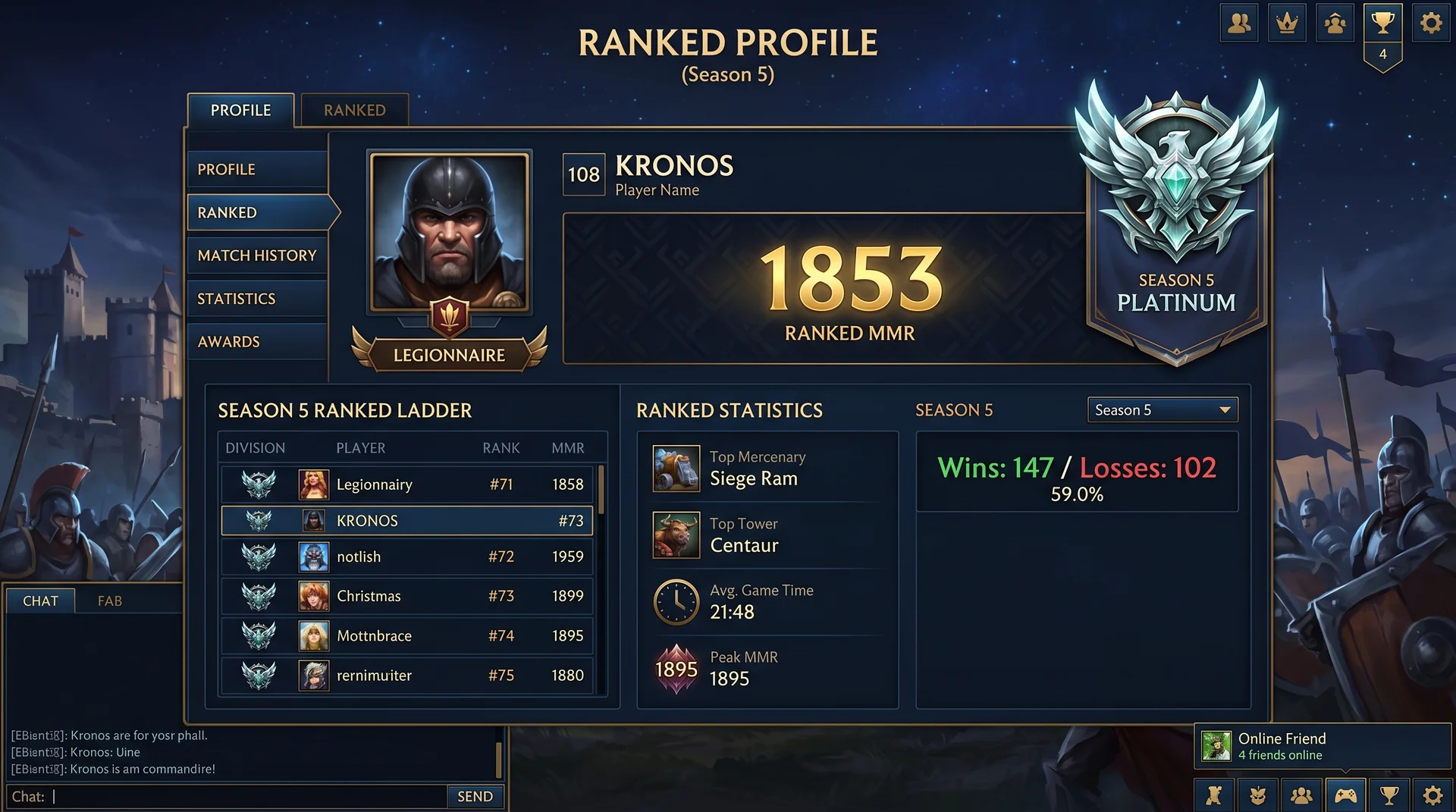
Most Legion TD 2 ranked players plateau at Gold — 1,400 rating — and can’t explain why. They know the wave types. They’ve read the economy guide. They can hold most builds through the first ten waves. But the rating doesn’t move.
The reason isn’t a missing build. It’s five habits that Master players run on autopilot every wave: specific decision loops that extract more information and more gold from the same mechanics Gold players are already using. The single most expensive habit to skip is the first one — upgrading before you scout — but all five compound. Already know the fundamentals? Our Legion TD 2 beginner’s guide covers units, waves, and co-op strategy. Come back here when you’re ready to climb.
Verified against Legion TD 2 official documentation, May 2026. Rank thresholds may adjust between seasons.
5 Habits at a Glance
- TAB before every upgrade — Scout your opponent’s build and mythium reserves before spending gold
- Count their mythium, not your health — Train workers based on what they spent last wave
- Think in 5-wave blocks — Plan your composition ahead of the weakness window, not into it
- Target Investment mid-game — Cash Out opens the game; Investment scales it
- Mix your send timing — Never spend mythium the same way two waves in a row
The Ranked Ladder: Where Each Tier Lives
The ladder runs from Bronze (1,000 rating) to Legend (2,800+), with a new rank every 200 points. New accounts start at 800 with a +40 bonus per win for their first 20 games, so fresh accounts converge to their real skill level quickly. The average player sits at Silver — 1,200 rating.
| Rank | Rating Range | What’s Typical |
|---|---|---|
| Bronze | 1,000–1,199 | Leaking early waves, inconsistent workers |
| Silver | 1,200–1,399 | Average skill — most players cluster here |
| Gold | 1,400–1,599 | Knows mechanics, gaps in scouting and timing |
| Platinum | 1,600–1,799 | Solid defense, economy mistakes persist |
| Diamond | 1,800–1,999 | Consistent play, weak on late-game pressure |
| Expert | 2,000–2,199 | Near-optimal economy, reads opponents |
| Master | 2,200–2,399 | All 5 habits running consistently |
| Senior Master+ | 2,400+ | Elite and leaderboard play |
One useful mechanic to know before you grind: season-end rewards are based on your peak rating, not your end-of-season position. If you reach Expert and slide back to Platinum chasing variance, you still earn Expert rewards. Climb aggressively early, then experiment.
Habit 1: Scout Before You Upgrade
This is the single habit responsible for most Gold plateaus. Every build phase, Gold players look at their strongest unit and reach for the upgrade button. Master players press TAB first.
TAB shows your opponent’s current build, their power score, how much they leaked last wave, and — most critically — their mythium reserves. That data tells you whether your existing value is enough to hold the next wave before you commit a single gold. The recommended value display already adjusts in real time based on your opponent’s saved mythium, meaning the UI is doing the math for you. You only benefit from it if you check before spending.
Here’s the specific trap Gold players fall into: you upgrade a 120g unit to its 225g form because it held wave 4 cleanly. Your opponent, meanwhile, has saved 160 mythium across two waves and is about to release a stacked send that your upgraded unit wasn’t built to handle. A 20g cheap unit repositioned to split aggro would have changed the outcome. Your 225g upgrade didn’t. You won’t know which scenario you’re in unless you look first.
The rule: Build phase opens → press TAB → check opponent power score and mythium bar → then spend gold.
This habit doesn’t require playing faster. It takes three seconds per wave. It’s the cheapest improvement available in ranked and almost no Gold player does it consistently.
Habit 2: Read the Mythium Bar, Not Your Health Bar
Gold players make decisions based on what just happened to them. They leaked, so they over-build next wave. They held cleanly, so they get greedy on workers. Both reactions are backwards — they’re responding to outcomes instead of signals.
The correct signal is your opponent’s mythium spend last wave. The official gameplay guide states the rule precisely: for every 40 mythium your opponent spent last wave, train approximately one worker. Workers cost 50g and generate 1 mythium per 10 seconds permanently — a missed worker in wave 3 creates an income gap every wave after it. The math compounds over a full game in ways that don’t look dramatic wave by wave but decide the result by wave 14.
Use this decision tree at the start of each build phase:
- Opponent spent 0 mythium last wave → Train no workers. They’re saving for a large send.
- Opponent spent 40–80 mythium → 1 worker if you’re at or above recommended value.
- Opponent spent 120+ mythium → 2–3 workers if you have gold after hitting value.
- Opponent has saved 3+ waves in a row → No workers. Add fighter value. A heavy coordinated send is coming.
Stop training workers roughly three waves before the game is likely to end — a worker that doesn’t generate enough mythium to pay back its 50g cost before the final wave is dead gold.
Habit 3: Plan Your Build in 5-Wave Blocks
Master players know by wave 4 what they need by wave 9. Gold players are still reacting wave by wave.
The mechanism: every strong opener carries a specific weakness window. Antler is a reliable front-liner from waves 1–6 but has a gap on waves 7–8. If you’re running Antler and haven’t thought about that gap by wave 5, you’ll scramble to plug it or leak through it. Planning ahead means you’re adding support during wave 5’s build phase — before the weakness arrives — rather than reacting to a leak.
The first 10 waves matter more than end-game combos. Structure your planning in three blocks:
- Block 1 (waves 1–5): Establish your opener, hit worker thresholds, identify your comp’s weak wave
- Block 2 (waves 6–10): Address the weakness window, reach your mid-game Mastermind target (see Habit 4)
- Block 3 (waves 11+): Legion Spell selection unlocks at wave 11 — you should already know your win condition before it triggers
Power spikes — waves where your unit generates more defense value than its gold cost because of ability optimization, positioning, or synergies — are plannable, not accidental. A 5-wave outlook lets you set them up deliberately. Running Yozora? It can’t leak waves 1–2 on its own. That means wave 1 and 2 are worker waves — plan block 2 around scaling from the safe early foundation, not rebuilding from a leak.
Habit 4: Pick Mastermind for Scaling, Not Survival
Cash Out (+22 gold) is the most popular opening Mastermind choice at Gold. It bumps your wave 1 gold immediately. It’s a valid opener — but it’s the first step, not the destination.
Investment (+34 income) is the mid-game target. High-level guides describe it as “almost mandatory” for scaling. The reason is mechanical: Investment raises your income permanently. In a 15-wave game, locking it in by wave 8 gives you 7 remaining waves of compounding advantage over an opponent who didn’t take it. That difference in total gold earned decides whether you complete your late-game comp or fall two upgrades short when it matters.
| Mastermind | When to Use | When NOT to Use |
|---|---|---|
| Cash Out | Opening — need early gold or first-unit safety net | Late game after you’ve already cleared your value threshold |
| Investment | Mid-game (waves 6–10) when the game is stable | When your king health is already critical — income won’t save you |
| Fiesta | Experienced players who understand the variance risk | Below Diamond — the random element will cost you rated games |
| YOLO | Specific high-risk push windows with your duo | Your default — it punishes hard and unpredictably when it misses |
Habit 5: Send as Information, Not Just Damage
A mercenary send doesn’t just damage your opponent — it forces a decision. When you send, they choose between training workers and adding fighter value. If they guess your next send wrong, they end up with either too little defense or too little income. Both outcomes benefit you.
The problem at Gold: players send whenever they have mythium. The pattern becomes readable within five waves. An experienced Platinum or Diamond opponent will learn your rhythm and optimize around it — staying safe while denying you the leverage sends are supposed to create.
The fix is deliberate unpredictability. Send light one wave, heavy two waves later, save three waves and release a stack. Your opponent can’t plan against a pattern that keeps changing. As the official guide puts it: “Consistently doing the same thing allows your opponent to exploit your tendencies.”
The two send types serve distinct goals:
- High-income mercenaries — Best when you’re uncertain about breaking them. Generates income whether they hold or not.
- Power mercenaries — Best when you’re confident in forcing a leak. Higher pressure, but they earn bounty gold if they hold it cleanly.
Decision framework: Opponent king above 80% HP and they’re ahead on workers → power mercenary, pressure a leak, claim the shutdown bounty. Game is income-even and you need to slow their scaling → high-income mercs. You’ve sent the same way three waves in a row → switch, regardless of outcome.
How Each Player Type Should Approach the Climb
| Player Type | Priority Habits | What to Focus on First |
|---|---|---|
| New to ranked | Habits 1 and 2 | Scout with TAB. Count mythium. Ignore everything else until these are automatic. |
| Casual climber | Habits 1, 2, and 4 | Three habits cover 80% of the Gold plateau for most players. Add Habit 4 once 1 and 2 are consistent. |
| Hardcore optimizer | All 5 | Add Habit 5 mixed sending to your lane reads and opponent scouting. This is where the Platinum-to-Master grind happens. |
| Duo queue | Habits 3 and 5 | Plan 5-wave blocks aloud with your partner every wave 4–5. Coordinate send timing together — duo communication is the advantage. |
Frequently Asked Questions
Does duo queue affect my rating?
Duo partners receive a +50 rating adjustment to their combined matchmaking calculation — the system accounts for the communication advantage and pairs you against stronger opponents accordingly. You’re not punished for playing duo, but you’re not getting a free ELO gift either. Playing with a consistent partner who runs Habit 3 with you is a genuine ranked tool, not a crutch.
Should I ever train workers when I’m leaking?
No. Consistent leaking means your fighter value is below where it needs to be. Training a worker mid-leak adds income you may not survive long enough to spend. Go back to the Habit 2 decision tree: if you’re leaking, your opponent is likely sending more than you accounted for. Fix the defense first.
Is there a shortcut for the Gold-to-Platinum jump specifically?
Habits 1 and 2 move most Gold players to Platinum within 30–50 games of consistent application. The Gold plateau isn’t a knowledge gap — it’s a decision-timing gap. Add Habit 4 (Investment target by wave 8) and the Platinum-to-Diamond window opens. The habits layer in a progression: 1 and 2 first, 4 second, 3 and 5 last.
Does the season reset wipe rating?
Seasonal rewards lock to your peak rating — if you reach Expert and slide back, you keep Expert rewards. After a season reset, ratings partially compress (exact values depend on the season). The implication for climbing: push your rating ceiling as early in the season as possible, then use the back half to experiment without fear of losing your reward floor.
Sources
[1] Legion TD 2 — Rating, Ranks, and Matchmaking Explained — AutoAttack Games (Official)
[2] Legion TD 2 Official Gameplay Guide — Steam Community
[3] A General “Essentials” Guideline to Ranked 2v2 (2200 ELO) — Steam Community
[4] Legion TD 2 Beginner Openings & Mastermind Lock-Ins Guide — SteamAH
[5] Legion TD 2 Game Manual — AutoAttack Games (Official)

I've been playing video games for over 20 years, spanning everything from early PC titles to modern open-world games. I started Switchblade Gaming to publish the kind of accurate, well-researched guides I always wanted to find — built on primary sources, tested in-game, and kept up to date after patches. I currently focus on Minecraft and Pokémon GO.