
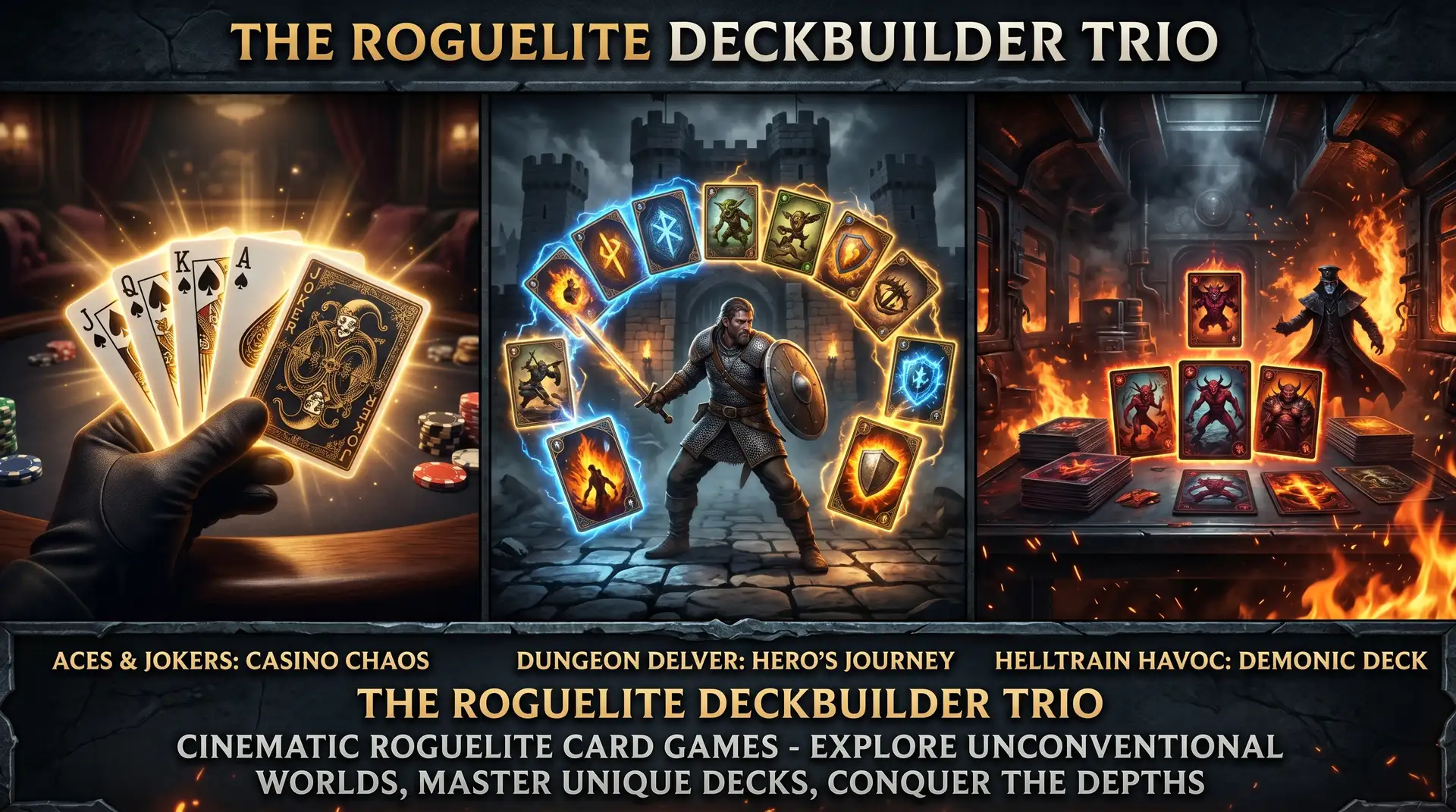
Balatro players don’t just want another deck builder. They want the specific feeling of a Joker combo turning a failing hand into ten million chips — the chip × mult explosion that makes you immediately restart for another run. Most lists recommend anything with cards and a roguelite structure, then leave you three hours into a session wondering why it doesn’t scratch the same itch.
The difference is risk-reward depth: how much a single in-run decision — push for a bigger hand, hold a risky Joker, spend coins now or save — shapes your run’s final score. Balatro maximises this. These 12 games get closest. If you’re still learning Balatro’s own systems, our Balatro guide for beginners covers Joker types, hand rankings, and the chip × mult formula before you jump to alternatives.
What Makes Balatro Hard to Replace
The chip × mult formula is the core. Your hand generates Chips; your Jokers multiply them. But multiplicative Jokers (×Mult) compound against each other — a ×3 Joker applied when your Mult is 50 gives 150. The same ×3 applied when you’ve stacked Mult to 200 gives 600: the same card doing four times the work. That exponential curve is the mechanic every alternative struggles to replicate.
On top of that, Glass Cards introduce explicit risk with exact numbers: each has a 1-in-4 chance of self-destructing when scored, and each destruction permanently boosts Glass Joker’s multiplier. Risk isn’t vague — it has a probability you can weigh against the upside. That precision is what makes pushing your luck feel like skill, not gambling. No alternative uses poker hand recognition as its core mechanic; the games below match the escalation feeling, not the poker frame.
How We Ranked These 12
Three factors determine placement: (1) exponential scaling — does a single modifier change the run’s outcome? (2) push-your-luck tension — does the game reward larger bets over safe plays? (3) number-explosion payoff — is the moment a build clicks as satisfying as Balatro’s? Games 1–4 deliver all three strongly. Games 5–8 hit two of three. Games 9–12 share Balatro’s roguelite DNA but scale more linearly. All entries verified against Steam release state as of May 2026.
All 12 at a Glance
| Game | Balatro DNA | Risk-Reward | Best For | Skip If |
|---|---|---|---|---|
| Luck Be a Landlord | Symbol synergy chains | ★★★★★ | Nearest alternative | Dislike slot aesthetics |
| Nubby’s Number Factory | Item-stack explosions | ★★★★★ | Big number payoffs | Luck-over-skill frustrates |
| Slay the Spire 2 | Deep card synergies | ★★★★☆ | Strategic depth seekers | Need instant gratification |
| Monster Train 2 | Lane combo escalation | ★★★★☆ | Campaign-mode players | Prefer pure run resets |
| Dungeons & Degenerate Gamblers | Blackjack bust mechanic | ★★★☆☆ | Direct gambling risk | Balance frustrates you |
| Inscryption | Card sacrifice stakes | ★★★☆☆ | Story + card mechanics | Want pure mechanical focus |
| Beyond Words | Word-score multipliers | ★★★☆☆ | Word game crossovers | Need consistent agency |
| Peglin | Physics push-your-luck | ★★★☆☆ | Tactile roguelite fans | Need deterministic results |
| Cobalt Core | Cascade card synergies | ★★☆☆☆ | FTL + deckbuilder fans | Need multiplier escalation |
| Griftlands | Dual-deck tension | ★★☆☆☆ | Narrative + mechanics | Want mechanical-only loop |
| Dicey Dungeons | Entry-level risk | ★★☆☆☆ | Genre newcomers | Want complex scaling |
| Fights in Tight Spaces | Tactical card combat | ★☆☆☆☆ | Grid strategy fans | Need Balatro-style escalation |
The 12 Best Games Like Balatro, Ranked
1. Luck Be a Landlord
Developer: TrampolineTales | Platforms: PC, Mobile, Console | Risk-Reward Depth: 5/5
The game that directly inspired Balatro. You spin a customisable slot machine where symbols interact to generate payout chains — a bee pollinating a flower watched by a cat produces a three-symbol cascade with the same logic as Joker combos. Escalation is faster than Balatro’s (spins replace hands) and more explosive, but less strategic: there’s no equivalent of the Ante pressure forcing you to commit to a score target each round. Symbol synergies compound to the same “this run just clicked” moment that defines Balatro’s best sessions.
Where it differs most: Luck Be a Landlord’s run structure is looser. Ante escalation in Balatro forces you to score a specific target each hand; the slot machine here is more forgiving early and punishing only when the floor system kicks in from floor 4 onward, adding locked rerolls and unremovable duds. If you want the closest mechanical sibling to Balatro’s Joker system, this is your first stop.
Play if: You want symbol-combo logic equivalent to Joker chains. Skip if: Structured ante-pressure is what keeps your sessions focused.
2. Nubby’s Number Factory
Developer: MogDogBlog Productions | Platform: PC | Price: $4.99 | Steam: 97% positive (10,000+ reviews) | Risk-Reward Depth: 5/5
The 2025 indie breakout. You launch Nubby — a living ball — down a peg board, and items stacked at the top trigger when Nubby hits specific pegs, stacking multipliers in real time. The result is the same “modest score becomes billions” payoff Balatro creates through Joker stacking, applied to a plinko-roguelite structure. Balatro’s developer LocalThunk publicly acknowledged the game on social media. At $4.99 it’s the lowest-barrier entry on this list and has an overwhelmingly positive Steam rating that rivals Balatro’s own launch reception.
The key difference from Balatro: you have full control over which poker hand to play; Nubby’s physics introduce genuine randomness each bounce. Players who rate Balatro’s strategic control above its luck elements will find this more chaotic — but the number payoff when a build fires is nearly identical to a Joker combo going off.
Play if: You want the newest game in Balatro’s spiritual family tree. Skip if: RNG you can’t mitigate through decisions kills your session.
3. Slay the Spire 2
Developer: Mega Crit | Platform: PC (Early Access March 2026) | Copies sold: 5.3 million by end of March 2026 | Risk-Reward Depth: 4/5
Five characters including two new additions — Necrobinder and Regent — plus a co-op multiplayer mode. The deck-building genre reference with early access polish still being added. Risk-reward depth operates on a different timescale than Balatro: the exponential payoff happens across an entire run as your deck compounds, not within a single hand. You won’t get Balatro’s one-per-twenty-minute payoff moment; you get the satisfaction of a 40-card deck becoming a 12-card engine that solves every encounter. A genuinely different relationship to escalation, not a lesser one.
Our Slay the Spire 2 beginner guide covers all five characters, key early-access mechanics, and how the Necrobinder differs from returning classes.
Play if: You want the deepest strategic challenge in the genre and a 100-hour ceiling. Skip if: Immediate score feedback per hand is what sustains your sessions.
4. Monster Train 2
Developer: Shiny Shoe | Platforms: PC, PS5, Switch, Xbox Series | Steam: 95% positive | Risk-Reward Depth: 4/5
A new pre-combat placement phase — you position units on three-tiered battle lanes before cards are played — creates risk-reward decisions Balatro doesn’t have. Five factions with interchangeable decks produce cascading synergies where a single unit placed in the right lane multiplies your entire board’s damage output. The shop decisions per fight echo Balatro’s Joker selection: commit to a build direction or keep options open?
Monster Train 2 rewards planning across 25+ encounters per run, not single-hand payoffs. That’s a feature if you want texture across a full campaign; a frustration if you want Balatro’s pure instant-feedback loop. The 95% positive rating reflects that Shiny Shoe nailed what they were building — it just isn’t a Balatro replacement, it’s a different kind of great.
Play if: You want the best campaign structure in the roguelite deckbuilder genre. Skip if: You prefer clean single-run resets without multi-encounter planning.
5. Dungeons & Degenerate Gamblers
Developer: Gambrinous | Platform: PC | Risk-Reward Depth: 3/5
Blackjack as the combat mechanic. You build a deck where cards add to or subtract from your hand total, and whoever scores closer to 21 deals the difference as damage. Some cards reward you for busting; others multiply existing values when you hit specific totals. The bust-or-not decision maps more directly to Balatro’s “play this risky hand or fold” tension than any other game on this list — you can see the exact numbers before committing.
Balance caveats: a small number of viable strategies emerge across runs, and a bad draw sequence can collapse a run through no fault of your decision-making. The wild cards have complex effects that take time to parse. Worth the price as a Balatro companion, but expect a handful of frustration runs before the mechanics click.
Play if: You want the most direct gambling risk mechanic of any deckbuilder. Skip if: Run-ending bad luck with no mitigation option is a dealbreaker.
6. Inscryption
Developer: Daniel Mullins Games | Platforms: PC, PS, Switch, Xbox | Risk-Reward Depth: 3/5
Card sacrifice creates the escalating stakes. Cards cost “blood” to play — you sacrifice weaker cards to summon stronger ones, and as the run progresses you’re forced to spend cards you’ve invested in upgrading. It’s risk-reward through attachment: the better you’ve built a card, the more it hurts and matters to spend it. No other game on this list replicates that specific emotional weight.
The meta-narrative changes the game’s mechanics radically mid-playthrough, making Inscryption unmissable but shorter as a pure deckbuilder than it appears. If you come from Balatro wanting 200 hours of pure mechanical escalation, this delivers about 15–20 hours of that alongside something else entirely.
Play if: You want the most original card game experience alongside mechanical depth. Skip if: Pure mechanical focus without narrative interruption is your priority.
7. Beyond Words
Developer: MindFuel Games | Platforms: PC, PS5, Xbox Series, Switch | Risk-Reward Depth: 3/5
Scrabble × Balatro, from the co-creators of TimeSplitters (Steve Ellis and David Doak). You spell words to generate points; between rounds you buy power cards that function identically to Jokers — some add to your multiplier, some re-trigger specific letters, some scale with word length. Score targets escalate from 500 to 250,000+ points across rounds, creating the same ante-pressure structure Balatro uses.
The gap: which power cards appear in the shop is more RNG-dependent than Balatro’s Joker selection, making runs without synergistic options feel harder to rescue. The “number explosion” moment when a word-score build clicks is genuinely Balatro-adjacent. Getting there consistently takes more runs than Balatro’s equivalent learning curve.
Play if: You enjoy word games and want Balatro’s structure applied to vocabulary. Skip if: You need consistent strategic agency across every run.
8. Peglin
Developer: PocketPair | Platforms: PC, Switch | Risk-Reward Depth: 3/5
Physics-based pachinko roguelite. Launch orbs down a peg board to deal damage, collecting new orbs and relics that modify trajectories, damage output, and healing. The push-your-luck element is spatial: aim for the highest-value pegs and risk a bad bounce sending your orb into the wrong board exit, or play it safe and chip away at enemy HP. Relic synergies create run-long scaling equivalent to Balatro’s mid-game engine building.
The core limitation for Balatro players: Balatro gives you full control over which hand to play; Peglin’s physics mean a correct aim can still produce a poor result from an unexpected bounce. Players who rate Balatro’s strategic control above its luck elements will find Peglin’s RNG more frustrating. Players who enjoy tactile “will it or won’t it” tension will find it compelling.
Play if: You want tactile roguelite number escalation with a physics twist. Skip if: Uncontrollable RNG breaks your session.
9. Cobalt Core
Developer: Rocket Rat Games | Platforms: PC, Switch | Steam: 96% positive | Risk-Reward Depth: 2/5
Sci-fi deckbuilder with a single-axis positioning system — you issue spaceship crew orders via cards to raise shields, dodge, or fire against enemy formations. Cascade synergies exist across card combinations, but risk-reward operates tactically rather than speculatively: the best play is usually the correct response to the enemy’s telegraphed action, not a gamble on whether your multiplier chain goes off. The 96% Steam rating reflects genuine quality in a different register than Balatro’s — FTL’s tactical tension rather than a casino’s escalating stakes.
Play if: You love FTL-style tactical thinking wrapped in roguelite card structure. Skip if: Multiplier escalation within individual encounters is your primary hook.
10. Griftlands
Developer: Klei Entertainment | Platforms: PC, PS, Switch, Xbox | Risk-Reward Depth: 2/5
Dual deckbuilding — one deck for combat, one for negotiation. The core tension is resource allocation: investing upgrades into your combat deck weakens your negotiation game and vice versa. Risk-reward operates across narrative arcs rather than within single encounters. Klei’s storytelling makes repeated runs feel fresh in ways purely mechanical roguelites can’t — but if you come from Balatro wanting multiplier payoffs, you’ll spend much of Griftlands’ runtime wishing the deckbuilding were simpler so you could focus on the story. It excels at what it does; it’s just doing something different.
Play if: You want narrative depth and dual-system deckbuilding in the same game. Skip if: Mechanical escalation needs to be the sole engagement loop.
11. Dicey Dungeons
Developer: Terry Cavanagh | Platforms: All major | Risk-Reward Depth: 2/5
Entry-level roguelite where dice replace cards. Six character classes each use different mechanics — the warrior builds up damage through dice combinations, the inventor crafts equipment from dice results — making this the most accessible game on the list. Risk comes from choosing which dice to commit versus re-roll. The ceiling is lower than Balatro’s by design: the most elaborate Dicey Dungeons combo produces modest scaling compared to Joker stacks reaching ×100 multipliers. That’s intentional — it’s a gentler, charming game. Use it as the starting point for anyone who wants to enter the genre before tackling Balatro’s learning curve.
Play if: You want a gentle introduction to risk-reward roguelite mechanics. Skip if: You need Balatro-level complexity and exponential scoring.
12. Fights in Tight Spaces
Developer: Ground Shatter | Platforms: PC, PS, Switch, Xbox | Risk-Reward Depth: 1/5
Card-based tactical combat on a 2D grid. Play cards to move, block, and attack, managing positioning and crowd control against enemies across procedural encounters. The link to Balatro is structural — roguelite + cards + run-based — not mechanical. There’s no equivalent of Joker stacking or multiplier escalation; risk comes from positioning within a fixed-damage system. Ranked 12th because it’s the least like Balatro’s specific loop. That said, Fights in Tight Spaces is a genuinely excellent tactical game with stylish cinematic presentation. It belongs on the same shelf as every game on this list — just not as a Balatro replacement.
Play if: You want card-based tactical grid strategy with clean production values. Skip if: Multiplier escalation is the specific mechanic you’re chasing.
Which Game Should You Play First?
| Your Balatro play style | Best first pick | Why |
|---|---|---|
| Joker combos + number explosions | Luck Be a Landlord | Same chain-combo logic, closest mechanical sibling |
| Pushing antes until the last moment | Dungeons & Degenerate Gamblers | Blackjack bust-risk is the most direct push-your-luck equivalent |
| Optimising 40-hour runs | Slay the Spire 2 | Deepest strategic ceiling in the genre |
| Short sessions, fast escalation | Nubby’s Number Factory | 15-minute run cycles with the same number-explosion payoff |
| Loving the shop economy per run | Monster Train 2 | Multi-faction shop decisions shape every run’s trajectory |
| Want something completely different | Inscryption | The most unique card game experience on this list |
FAQ
Is Slay the Spire 2 closer to Balatro than the original?
In one specific way, yes: co-op mode introduces a shared risk-reward layer where two players’ card synergies interact in real time, creating combo moments that feel closer to Balatro’s Joker chains than solo optimisation. The core loop is still run-long planning rather than single-hand payoffs. If you haven’t played either game, start with Slay the Spire 2 — there’s no mechanical reason to work through the original first, and the Early Access version already has more content than StS1’s launch build.
Does Luck Be a Landlord feel solved after 20 hours the way Balatro can?
Both games hit a familiarity ceiling at high play counts. Luck Be a Landlord addresses it through Endless Mode and a floor system that adds restrictive modifiers from floor 4 onward — locked rerolls, unremovable duds taking up precious reel space. Balatro uses Stake difficulty tiers. Neither is perfectly infinite, but both have 60+ hour ceilings before runs blur together. If post-100-hour freshness matters, Slay the Spire 2’s active Early Access content pipeline adds new variables faster than either game’s passive difficulty systems.
Are any of these games free to try before buying?
Dungeons & Degenerate Gamblers and Luck Be a Landlord both have Steam demos. Nubby’s Number Factory has no demo but at $4.99 the Steam refund window effectively functions as a trial. Monster Train 2 and Slay the Spire 2 both reached Game Pass shortly after launch — zero upfront cost with a subscription. Inscryption has no demo but regularly hits 75% off in Steam sales, bringing it under $5.
Sources
- Balatro Wiki — Mult mechanics and multiplicative scaling
- Wikipedia — Luck Be a Landlord
- PC Games N — Nubby’s Number Factory launch coverage
- Rogueliker — Best Roguelike Deckbuilders comprehensive guide
- WayTooManyGames — Beyond Words review

I've been playing video games for over 20 years, spanning everything from early PC titles to modern open-world games. I started Switchblade Gaming to publish the kind of accurate, well-researched guides I always wanted to find — built on primary sources, tested in-game, and kept up to date after patches. I currently focus on Minecraft and Pokémon GO.