
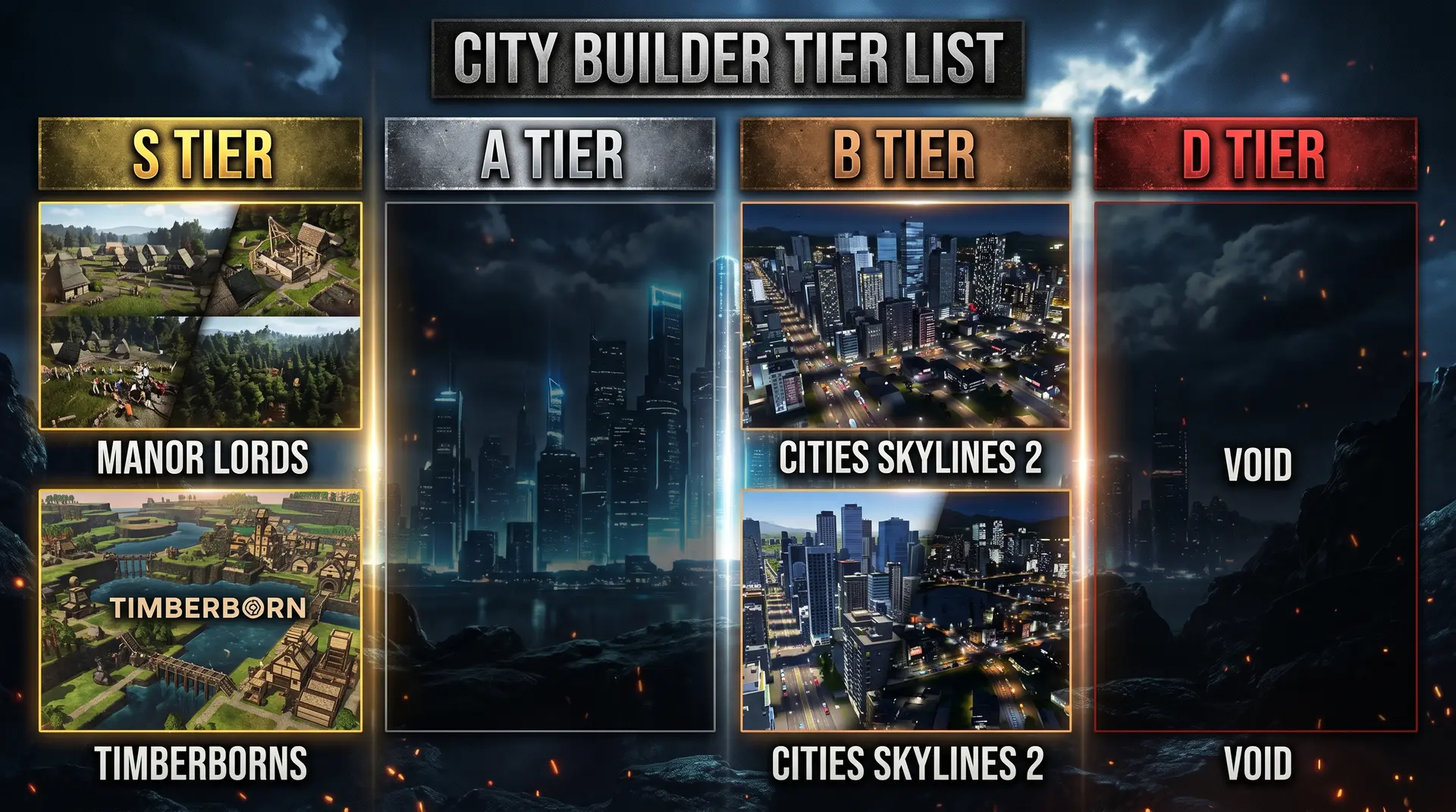
The city builder genre hit a new high-water mark in 2026. Timberborn launched out of Early Access in March to 37,000 reviews at 95% positive. Manor Lords’ December 2025 Update 5 reworked food and economic systems at a level that pushed a promising early access title into structurally coherent territory. Cities: Skylines 2 finally started recovering under new developer Iceflake Studios. There is more to play in this genre right now than any one person can test alone — which is exactly the problem this tier list solves.
Most city builder rankings tell you a game is good without explaining why it lands where it does. This list ranks 20 city builders using three specific criteria: settlement scale cap, survival mechanics depth, and replayability. Apply those consistently and the tiers sort themselves.
All rankings reflect the current state of each game as of May 2026.
How This Tier List Works
Every placement uses the same three axes:
- Settlement scale — how far can you grow before the game stops scaling with you? Village-scale games cap at a few hundred citizens; city-scale games support thousands. Neither is objectively better, but knowing the ceiling matters when choosing your next 80-hour project.
- Survival depth — does resource pressure create genuine decision-making, or just checkbox management? Games where food scarcity cascades into labor shortages, which cascade into military weakness, which cascade into trade disruption score high. Build-the-grain-silo-and-move-on games score low.
- Replayability — how many hours before the loop repeats? Procedural generation, asymmetric factions, and roguelite frameworks push this score up. Linear progression with a single solved city layout pushes it down.
| Game | Tier | Scale | Best For |
|---|---|---|---|
| Manor Lords | S | Town (500–2K citizens) | Medieval realism fans |
| Frostpunk 2 | S | City (2K+) | Political survival strategy |
| Timberborn | A | Town (500–2K) | Engineers and problem-solvers |
| Against the Storm | A | Settlement (variable) | Maximum replayability |
| Anno 1800 | A | City (2K+) | Economic strategy |
| Oxygen Not Included | A | Colony (small) | Systems thinkers |
| Cities: Skylines 2 | B | Metro (10K+) | Urban planning |
| Workers & Resources: SR | B | Country-scale | Logistics depth |
| Dwarf Fortress | B | Fortress | Depth over accessibility |
| Foundation | B | Town (500–2K) | Cozy medieval building |
| Surviving Mars | B | Colony (medium) | Sci-fi survival |
| Farthest Frontier | C | Town | Early-game survival pressure |
| Tropico 6 | C | Island chain | Comedy city management |
| The Wandering Village | C | Village (scale-capped) | Unique premise fans |
| Kingdoms and Castles | C | Town | Genre newcomers |
| Terra Nil | C | Region | Concept over depth |
| SimCity (2013) | D | City (capped) | Nostalgia only |
| Surviving the Aftermath | D | Camp/town | Genre completionists |
| Aven Colony | D | Colony (small) | Light sci-fi |
| Anno 2205 | D | Island chain | Not recommended |
S-Tier: These Set the Bar
Both S-tier games do something no other city builder in 2026 manages: they make you feel the weight of individual decisions at both the granular level — one family’s food supply — and the systemic level — your entire settlement’s survival. That emotional range is rare enough to define a tier of its own.
Manor Lords
Manor Lords earned 3 million sales in early access on a single foundational mechanic: the burgage plot system. You do not zone residential areas — you draw individual plot boundaries and watch families adapt their homes and backyard workshops to the available space. When grain runs short in February, you feel it as a cascade: the mill slows, the baker’s supply chain breaks, families go hungry while you scramble to rebalance crop rotations across fields arranged in the historical strip-farming patterns used in actual medieval agriculture.
December 2025’s Update 5 pushed the game past the “promising but incomplete” stage. The reworked food system now distinguishes between mutton, pork, chevon, beef, chicken, and small game — not for cosmetic variety but because each has a different production chain length and seasonal availability. New Duel and Fractured Realm modes give experienced players structured reasons to return to fresh maps. At 87% overall positive on Steam with 79% positive in recent reviews, Manor Lords is the benchmark for the genre. Its tactical battle system is still developing, but that does not affect the city builder score at all.
For year-by-year progression strategy and food system mechanics, our Manor Lords Beginner’s Guide 2026 covers the full settlement loop in detail.
Frostpunk 2
Where Manor Lords earns its tier through physical realism, Frostpunk 2 earns it through political and moral weight. Managing a heat colony in a post-apocalyptic ice age is not just a resource problem — it is a constant negotiation between factions with incompatible values, enforced by mechanics that make compromise feel genuinely costly rather than optional. The city builder layer — districts, infrastructure networks, resource pipelines — exists to feed the political simulation, not the other way around.
That inversion produces something no other city builder attempts: a game where the city itself is the argument you are making to your population. At 78% positive across 24,358 Steam reviews, Frostpunk 2’s divisive score reflects its deliberately uncomfortable design. Players who wanted a traditional survival builder pushed back; players who engaged with the factional layer stayed. Both reactions make sense — which is itself a signal of originality.
A-Tier: Strong on Two or More Criteria
A-tier games are excellent but narrower in appeal than S-tier. Each one excels on at least two of the three criteria and has a specific player type it serves better than anything else in the genre.
Timberborn
The standout launch story of 2026. Timberborn left Early Access on March 12, 2026 and immediately broke into Steam’s New & Trending and Top Sellers charts — 37,000 reviews at 95% positive within four days of launch. The premise (rebuild civilization as beaver engineers in a post-human world) delivers a city builder that is mechanically distinct from everything else on this list.
The core differentiator is the water simulation. Every colony lives or dies by its relationship with drought cycles and floodwaters. Damming, redirecting, and storing water is not checkbox survival — it is an engineering problem that scales in complexity as the colony grows. The 1.0 release added an automation layer with 20+ logic buildings including depth sensors, relays, timers, and HTTP integration, enabling players to build self-regulating water management systems. Two beaver factions — nature-loving Folktails and industrial Iron Teeth — offer meaningfully different playstyles on the same map. For water management fundamentals and colony survival strategy, see our Timberborn Beginner’s Guide 2026.
Against the Storm
Against the Storm solves city building’s most persistent problem: mid-game doldrums. Once you have cracked the food-wood-stone loops in most builders, the challenge disappears and you are executing a solved plan. The roguelite framework here forces you into a new, randomly-configured settlement on every run. Upgrades and unlocks carry forward between expeditions, keeping meta-game pressure alive without making individual runs feel pointless.
At 94% positive on 35,402 Steam reviews, it is the genre’s replayability benchmark. Note that it is not a traditional city builder — settlements stay small and the focus is adapting to randomized resource configurations rather than scaling to metropolis size. If your enjoyment comes from the growth arc from village to city, this is not your game. If it comes from solving a different resource problem each session, nothing else competes.
Anno 1800
Five years post-launch, Anno 1800 remains the gold standard for production chain complexity. The industrial revolution setting produces the most satisfying supply chain math in the genre: you are not building farms, you are constructing a vertically integrated economy where each island upgrade creates demand for three new goods from two other islands. At 82 out of 100 on OpenCritic with 95% critic recommendation and 81% positive across 31,000+ Steam reviews, this is the definitive choice for players who want economic strategy wrapped in city builder aesthetics. The DLC library is substantial — the base game frequently drops below $10 on sale, but a complete DLC collection changes the budget conversation.
Oxygen Not Included
Technically a colony sim rather than a pure city builder, but the spatial planning and resource management overlap is complete enough that excluding it would misrepresent the tier list. At 96% positive on 48,433 Steam reviews, it is the highest-rated game on this list by a meaningful margin. The gas, liquid, heat, and power systems all operate on consistent physical rules — when your colony suffocates, there is a diagnosable cause, and the fix requires actual engineering rather than guesswork. Plan for a learning curve. The depth on the other side is worth the investment.
B-Tier: One System Short
B-tier games are good to great with one structural weakness preventing an A placement. The tier is not a consolation prize — several of these are among the most actively played city builders in 2026.
Cities: Skylines 2 earns B through recovery rather than a strong start. The First Frost patch (February 2026) from Iceflake Studios fixed the citizen death wave bug, cut unrealistic bike traffic by 80%, and overhauled weather-dependent fog and snow accumulation. Steam reviews climbed to 67% positive recently, up from the 54% overall average that reflects the rough early months. It remains the best urban planning canvas on this list — road hierarchy, transit networks, and zoning systems unmatched in scope — and the trajectory is now clearly upward. Our Best City Builders 2026 guide includes CS2 alongside 14 other picks if you want a broader comparison at a glance.
Workers & Resources: Soviet Republic offers Factorio-level logistics complexity inside a city builder context. Building a Soviet republic from rural backwater to industrial superpower requires managing not just buildings but the rail, road, and pipeline networks connecting them — plus a citizen lifecycle from education to employment to retirement. At 91 out of 100 on Steambase with 89% positive recent reviews, it is the deepest logistics simulation in this genre. The UI and learning investment keep it from A-tier, but for players who want that depth, nothing else in the city builder space comes close.
Dwarf Fortress (Steam Edition) added accessible tilesets and a tutorial, but “more accessible than Dwarf Fortress” is still steep by any normal standard. The depth ceiling is unmatched — emergent stories here are genuinely novel in ways no purpose-built narrative game can replicate. B-tier because the payoff requires a commitment most players will not make without already understanding what they are committing to.
Foundation uses organic settlement growth — roads form from use patterns rather than grid placement — to produce the most visually coherent medieval builder on this list. It earns B for low-pressure cozy sessions rather than challenging play. The gentle systems rarely produce genuine crises, which limits replayability for players seeking sustained difficulty.
Surviving Mars delivers a solid terraforming loop and dome-building simulation that holds up well in 2026. Competition from newer titles and an aging UI keep it at B rather than A, but the core resource extraction and colony expansion gameplay remains the best sci-fi city builder option at its price point.
C-Tier: Good Concept, Structural Limit
C-tier games are worth playing with specific caveats. Each has a genuine hook and a clear target audience — but a structural weakness limits either depth or replayability enough to prevent a higher placement.
Farthest Frontier delivers the best early-game survival pressure on this list: winter is a genuine threat, wolves and bandit raids create constant tension, and the resource loops feel hand-crafted. The mid-game collapses into waiting for population to grow, and the loop does not evolve meaningfully once supply chains stabilize.
Tropico 6 — the El Presidente satire, political faction balancing, and inter-island logistics are genuinely charming. The city builder layer underneath those systems is thin enough that Tropico 6 functions better as a comedy political simulation than a city builder. Know which experience you are buying before you do.
The Wandering Village has the most original premise in this tier: build a settlement on the back of a giant creature roaming a post-apocalyptic landscape. The constraint that makes the premise compelling — finite space on the creature’s back — is also the design ceiling that kills replayability after a handful of runs.
Kingdoms and Castles is the best entry point for players who have never touched a city builder. Intentionally simplified systems, clear feedback loops, and a forgiving early game make it ideal as a genre introduction. The same simplicity that makes it accessible becomes a ceiling for players seeking depth past the first few hours.
Terra Nil is a reverse city builder: restore a barren wasteland to a thriving ecosystem, then evacuate without leaving a trace. Mechanically elegant, genuinely surprising, and short. Not meaningfully replayable, but worth one run for the design concept alone.
D-Tier: Outpaced or Broken
D-tier games either have unfixed design problems that define the experience, or have been so thoroughly outpaced by what is above them that there is no scenario where picking them over a higher-ranked alternative makes sense in 2026.
SimCity (2013) — the always-online requirement and server controversy were eventually resolved, but the underlying game’s city size caps and shallow simulation never matched what SimCity 4 delivered a decade earlier. The genre moved past it completely, and there is no reason to return.
Surviving the Aftermath — competent post-apocalyptic building that plateaus at medium complexity. The tech tree loops repeat without adding genuine challenge once mid-game stability is reached.
Aven Colony — a 2017 sci-fi builder that showed real ambition at launch but received minimal post-launch support. The building variety is too shallow to sustain play beyond the first campaign, and no updates have changed that calculation.
Anno 2205 — Ubisoft stripped the production chain complexity that defines the Anno series to broaden the audience. The result removed what makes Anno great without adding anything to compensate. Anno 1800 is available at a comparable sale price and is the better game in every dimension that matters to city builder players.
Player-Type Quick Pick
| If you want… | Play this | Skip this |
|---|---|---|
| Medieval realism | Manor Lords | Kingdoms and Castles (too gentle) |
| Maximum replayability | Against the Storm | Aven Colony (one-run loop) |
| Engineering challenge | Oxygen Not Included or Timberborn | Foundation (too low-pressure) |
| Big-city scale | Cities: Skylines 2 | The Wandering Village (scale-capped) |
| Economic depth | Anno 1800 | Anno 2205 (chains stripped) |
| Survival pressure | Frostpunk 2 | Surviving the Aftermath (shallow) |
| Genre introduction | Kingdoms and Castles | Dwarf Fortress (too steep) |
| Cozy building session | Foundation or Timberborn | Workers & Resources SR (too demanding) |
Frequently Asked Questions
What is the best city builder for beginners in 2026?
Kingdoms and Castles for players who want gentle pacing and clear feedback loops. Once the fundamentals click, Timberborn is the natural next step — it introduces genuine engineering challenges without punishing failure as hard as Manor Lords or Frostpunk 2.
Is Manor Lords worth buying in 2026?
Yes, with one caveat: it is still Early Access. December 2025’s Update 5 pushed the settlement building and food systems into genuinely finished territory, and the new game modes give experienced players structured goals to return to. The tactical battle system is still developing. Three million early access players already made this call — the core city builder loop is the reason.
Which city builder has the best replayability?
Against the Storm, by a clear margin. The roguelite framework guarantees a different resource configuration and faction combination on every expedition. Dwarf Fortress generates unique emergent stories, but the investment required to reach them makes it a harder recommendation for most players. For replayability within a single extended city, Timberborn’s procedural drought timing and faction-specific mechanics come closest.
Sources
- Manor Lords Review 2026 — Spawning Point
- Timberborn 1.0 Launch — NotebookCheck
- Cities: Skylines 2 First Frost Patch — Simulation Daily
- Against the Storm — Steam Store
- Frostpunk 2 — Steam Store
- Anno 1800 — OpenCritic
- Oxygen Not Included — Steam Store
- Workers & Resources: Soviet Republic — Steambase

I've been playing video games for over 20 years, spanning everything from early PC titles to modern open-world games. I started Switchblade Gaming to publish the kind of accurate, well-researched guides I always wanted to find — built on primary sources, tested in-game, and kept up to date after patches. I currently focus on Minecraft and Pokémon GO.