
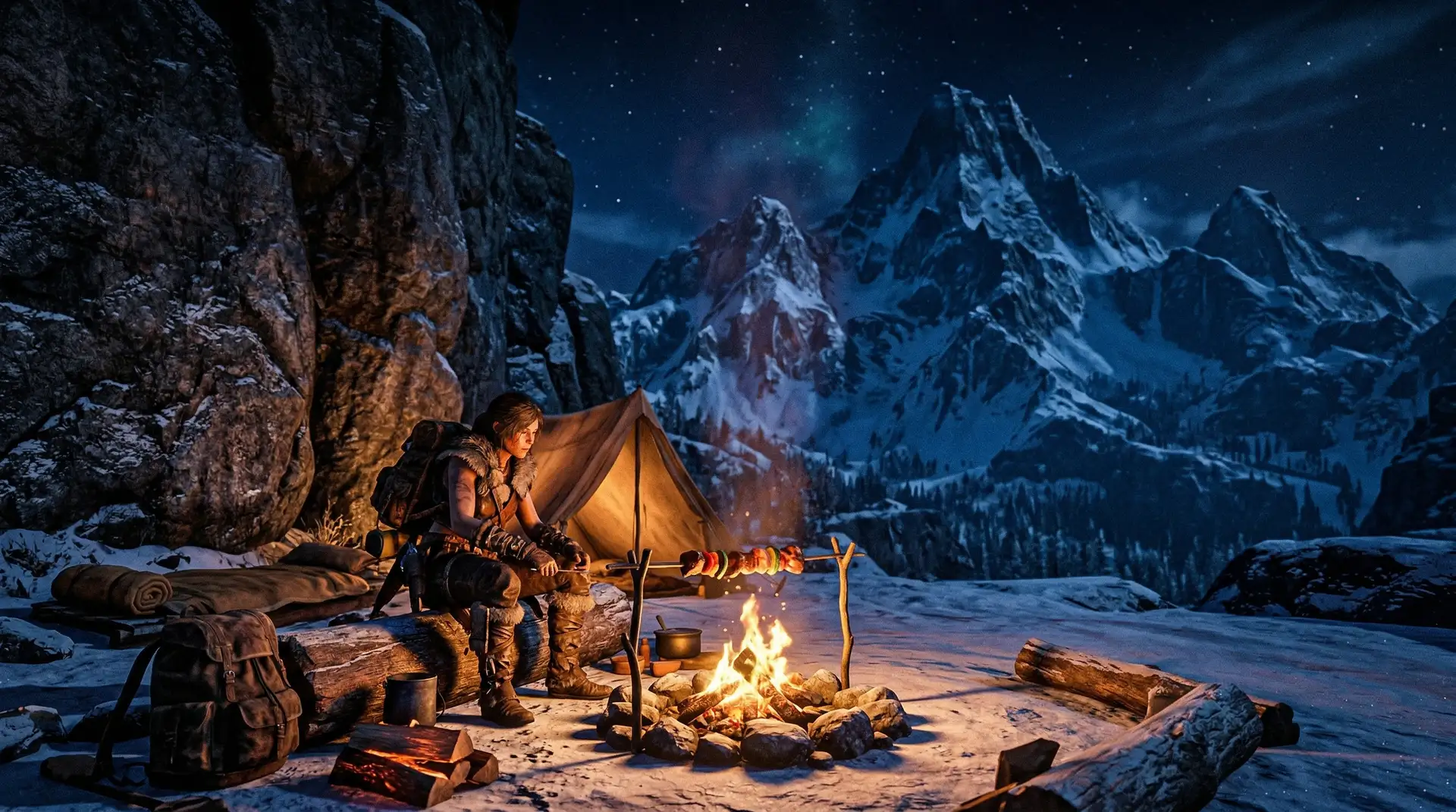
Stamina is the single most important resource in PEAK. Every handhold, every jump and every recovery after a fall draws from the same pool, and food is the only reliable way to refill it mid-climb. Run dry on an exposed traverse and your character loses grip strength, misses crucial catches and turns a recoverable slip into a full reset. This guide covers every food item currently in the game, explains how cooking works, and lays out the strategy that keeps your stamina topped up from the first slope to the summit push.
If you are still learning the ropes, start with our PEAK Beginner Guide for a full overview of movement, gear and early-game survival. For the deeper mechanics behind stamina drain rates and rest points, the PEAK Stamina Guide breaks down exactly how exertion, weight and altitude interact.
Why Food Matters More Than Any Other Item
Stamina in PEAK is not a passive regeneration bar. It only recovers at rest points or when you eat. That makes food the only portable stamina source available while you are hanging on a wall, traversing a ridge or recovering from a fall. Climbing speed scales directly with remaining stamina: below 30 percent your character moves noticeably slower, grip windows shorten and recovery animations after a fall take longer. A single cooked steak eaten before a technical section can be the difference between clearing it in one attempt and burning three minutes on retries.
Food also matters because of the cascading failure loop. One missed meal leads to slower climbing, which drains more stamina per move, which forces another rest, which costs time. In timed challenges and competitive runs, this spiral is what separates clean summits from DNFs.
All Food Items and Their Stamina Values
The table below lists every food item currently available in PEAK, sorted by stamina restored per unit of weight. Raw values are what you get if you eat the item without cooking it first. Cooked values apply after processing at a campfire.

| Food Item | Weight (kg) | Raw Stamina | Cooked Stamina | Stamina/kg | Best Use Case |
|---|---|---|---|---|---|
| Trail Mix | 0.2 | 15 | N/A | 75.0 | Quick top-up during traversals |
| Energy Bar | 0.3 | 20 | N/A | 66.7 | Emergency stamina on technical walls |
| Berries | 0.2 | 8 | 12 | 60.0 | Lightweight filler early zones |
| Dried Meat | 0.4 | 25 | N/A | 62.5 | No-cook reliable stamina |
| Bread Roll | 0.3 | 18 | N/A | 60.0 | Solid carb source, no cooking needed |
| Raw Fish | 0.5 | 12 | 30 | 60.0 | Cook for best value, poor raw |
| Raw Steak | 0.6 | 10 | 35 | 58.3 | Highest single-item restore when cooked |
| Canned Beans | 0.5 | 22 | 28 | 56.0 | Decent raw, slightly better cooked |
| Tinned Soup | 0.6 | 20 | 30 | 50.0 | Warming bonus in cold zones |
| Cheese Wheel | 0.8 | 30 | N/A | 37.5 | High restore, heavy; base camp stock |
Two patterns stand out immediately. Lightweight items like trail mix and energy bars offer the best stamina-to-weight ratio and require no cooking, making them ideal for summit pushes where every gram counts. Heavier items like raw steak and fish give far more total stamina but only after cooking, so they belong in the early and mid zones where campfires are available. For a full breakdown of every item and its carry weight impact, see our PEAK All Items Guide.
How Cooking Works
Cooking in PEAK requires a campfire. You cannot cook at rest points, in tents or anywhere else. To cook, approach a campfire, open your inventory and drag a cookable item onto the fire icon. A progress ring appears and the item converts after approximately 8 seconds. You can cook multiple items sequentially but not simultaneously.
The raw-to-cooked stamina bonus ranges from 40 to 250 percent depending on the item. Raw steak jumps from 10 to 35, making it nearly useless uncooked but the single strongest restore in the game once processed. Fish follows a similar pattern. Canned goods show a smaller improvement because they are already partially processed. Items labelled N/A for cooking (trail mix, energy bars, dried meat, bread, cheese) are ready-to-eat and their values do not change.
Campfires are fixed locations, not placeable items. They appear at roughly every other rest point in the lower zones and become scarcer above the treeline. Plan your cooking around the campfire locations you can see on the route, not on the assumption that one will appear where you need it.
Best Food Combinations for Sustained Climbs
There is no single best loadout because the answer depends on which zone you are tackling and whether campfires are accessible. However, two general strategies cover most situations.
Carb-Heavy Loadout (Lightweight, No Cooking)
Pack trail mix, energy bars, bread rolls and dried meat. Total weight stays low, nothing needs cooking and you get frequent small top-ups. This is the default for summit attempts and any zone above the treeline where campfires are rare. The downside is lower total stamina capacity per trip. You will burn through these items faster on long technical sections.
Protein-Heavy Loadout (Maximum Stamina, Requires Campfires)
Pack raw steak, raw fish and canned beans alongside a small reserve of trail mix. Cook the steak and fish at every available campfire. This loadout delivers more total stamina per slot but demands planning around fire locations and adds 1 to 2 kg of extra weight. Best suited for the mid-mountain zones where campfires still appear regularly and technical difficulty is ramping up.
Food Weight Versus Benefit Tradeoff
Every kilogram you carry increases stamina drain per move. Packing five cooked steaks gives you a massive stamina reserve but the extra 3 kg slows your base climbing speed and increases the drain rate on every action. The community consensus from testing is that the sweet spot sits around 1.5 to 2 kg of food total, mixing lightweight no-cook items with one or two high-value cooked pieces.
Above the exposed ridge zone, shed any remaining heavy food and switch entirely to trail mix and energy bars. The weight penalty on near-vertical faces and ice walls outweighs the extra restore. Our PEAK Tips and Tricks guide covers other weight-saving techniques that stack well with a lighter food loadout. For the climbing lines and movement tricks that let you conserve stamina on top of smart eating, see the PEAK Advanced Techniques guide.
When to Eat
Timing matters almost as much as what you carry. Three rules cover 90 percent of situations:
- Pre-hard section top-up. Eat before entering any section you recognise as technical (overhangs, ice walls, long traversals). Starting at full stamina gives you the full margin to make mistakes without falling.
- Post-fall recovery. After any significant fall, eat immediately before reclimbing. Falls drain stamina on impact and the recovery animation eats into your remaining pool. Reclimbing on a depleted bar guarantees a slower, sloppier second attempt.
- Never mid-rope traverse. Eating triggers a brief animation that pauses your grip. On a rope traverse or narrow ledge, this animation can cause you to lose your position. Eat on stable ground or at a rest point.
Food Priority by Mountain Zone
The mountain in PEAK has distinct zones and each one demands a different food approach.
| Zone | Campfires | Recommended Food | Strategy |
|---|---|---|---|
| Early Slopes | Frequent | Raw steak, fish, canned beans | Cook everything; build stamina reserves before difficulty ramps |
| Mid Mountain | Occasional | Mix of cookable and ready-to-eat | Cook at every fire you pass; switch to no-cook items between fires |
| Exposed Ridge | Rare | Energy bars, trail mix, dried meat | Drop heavy food; every gram matters on vertical faces |
| Summit Approach | None | Trail mix, energy bars only | Lightest possible loadout; eat sparingly, ration for the final push |
Co-op Food Sharing
In multiplayer, any player can drop food items from their inventory for teammates to pick up. This creates a team strategy layer that does not exist in solo. The most effective co-op approach is to designate one player as the pack mule who carries the bulk of the heavy food and cooks it at campfires while the lead climber runs light. The lead burns less stamina because they carry less weight, and the support player distributes cooked food at rest points.
You cannot feed another player directly. The item must be dropped on the ground and the receiving player must pick it up manually, so do your food transfers at rest points rather than on a cliff face. For more multiplayer strategies, check our PEAK Co-op Guide.
Solo Food Management
Without a teammate to share the load, solo climbers need stricter discipline. The key principle is front-load your carrying capacity. In the early and mid zones, carry more food than you think you need and cook aggressively at every campfire. The weight penalty matters less on gentle slopes where stamina drain is low.
Once you pass the halfway point, start rationing. Eat only when stamina drops below 40 percent rather than topping up constantly. Drop any raw food you did not manage to cook as dead weight. By the exposed ridge, your pack should contain nothing but lightweight no-cook items and essential gear. Our PEAK Solo Guide covers the full solo strategy including route selection and gear priorities that complement these food decisions.
FAQ
What is the best food item in PEAK?
Cooked steak restores the most stamina per item at 35 points, but trail mix offers the best stamina-to-weight ratio at 75 per kg. For summit attempts, trail mix wins. For mid-mountain grinding, cooked steak is more efficient when campfires are available.
Can you cook without a campfire?
No. Cooking requires a campfire and these are fixed locations on the mountain, not craftable items. If you cannot reach a campfire, stick to ready-to-eat items like trail mix, energy bars, dried meat and bread rolls.
Does food expire or spoil?
No. Food items in PEAK do not have a freshness timer or spoilage mechanic. Raw items stay raw and cooked items stay cooked for the entire run regardless of how long you hold them.
Should I prioritise food or rope in my weight budget?
Rope is non-negotiable for safety on technical sections, so it always takes priority. Build your food loadout around whatever weight budget remains after rope and essential gear. In practice, this means carrying lighter food items and fewer of them rather than cutting rope to fit an extra steak.
Sources
- Normal Studio. PEAK on Steam. Valve Corporation
- r/PEAKgame Community. PEAK Subreddit Discussions. Reddit
- PEAK Wiki Contributors. PEAK Wiki. Fandom

I've been playing video games for over 20 years, spanning everything from early PC titles to modern open-world games. I started Switchblade Gaming to publish the kind of accurate, well-researched guides I always wanted to find — built on primary sources, tested in-game, and kept up to date after patches. I currently focus on Minecraft and Pokémon GO.