
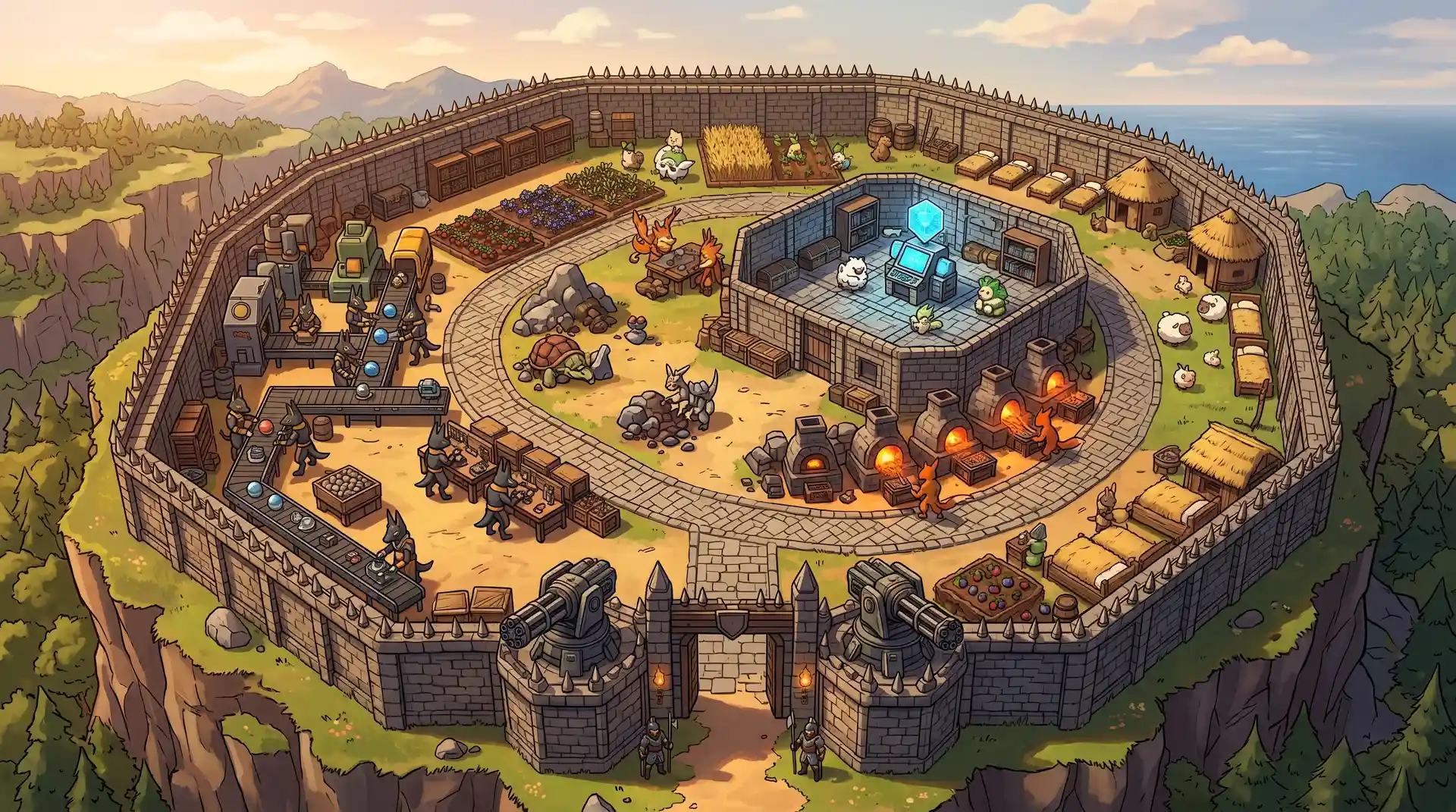
Most Palworld base guides tell you to build walls, assign Pals to stations, and unlock conveyor belts. That’s all correct — and completely insufficient for understanding why your base with 20 assigned Pals feels slower than a streamer’s running 8.
The answer: Pal level and passive skills determine output, not headcount. A single Anubis with the Artisan passive (+50% work speed) and a maxed Statue of Power boost (+30%) clears Giga Sphere production faster than four generic Handiwork Pals on the same assembly line. This guide explains the mechanism with real numbers, gives you a working 3-zone layout template, and shows you how to build a base that defends itself while you explore.
New to Palworld entirely? Start with our Palworld Beginners Guide 2026 before reading this — this guide assumes you’ve placed your first Palbox and cleared the early crafting tiers.
Verified April 2026. Stat values may shift with future patches.
Quick Start: First 10 Things to Build and Assign
If you’ve just unlocked your first base, run through these in order before optimizing anything else:
- Place your Palbox on flat terrain with resource nodes visible within two screen lengths
- Build a wooden chest and a Feed Box immediately — Pals that can’t eat stop working
- Assign one high-level Transporting Pal to handle resource movement between stations
- Build a Sphere Workbench (upgrades to the Assembly Line at Technology Tier 27)
- Capture or breed an Anubis as early as possible — desert region spawn or egg incubation
- Unlock and build the Monitoring Stand to enable Hard Working and Super Hard Working modes
- Upgrade your Palbox to Level 2 to unlock 10 worker slots minimum
- Build the Statue of Power and start spending Pal Souls on your core crafting Pals
- Designate zone boundaries with foundations before adding more structures
- Add defensive walls after production is running — not before
Best Base Locations by Game Stage
Location determines your resource pressure for the next 10 hours of play. The most important terrain rule: always choose flat ground. Building on slopes wastes foundation materials and breaks Pal pathfinding — workers spend more time routing around elevation changes than completing tasks.
Early game (under Level 20):
- Small Settlement (8, −528): Abundant Ore and Wood nodes, fast travel point nearby. Best starter location for most players.
- Plateau of Beginnings (264, −548): Paldium Fragments for Pal Spheres plus dungeon access for early Pal captures. Flat terrain makes zoning straightforward.
Mid-game (Levels 20–40):
- Cinnamoth Forest (−77, −310): Dense Ore nodes paired with Sulfur access for Gunpowder crafting. Core mid-game resource combination.
- Sealed Realm of the Guardian (180, −39): Coal farming — critical for unlocking Electric Furnaces and Assembly Lines on the Tech Tree.
Late game / second base:
- Sakurajima Island (−646, 270): Crude Oil for Flamethrower Fuel, Missile Ammo, and Frag Grenade Mk2. Only worth a dedicated base once the relevant weapon tiers are unlocked.
The 3-Zone Layout Template
Your base should operate as three distinct zones radiating outward from the Palbox. Most players build reactively — dropping stations wherever there’s space — and then wonder why Pals idle constantly. Zone planning eliminates that problem before it starts.
Zone 1 — Production core (closest to Palbox)
Your Sphere Assembly Line, Production Assembly Line, and all crafting stations live here. Pal pathfinding is the real constraint: every extra second a Pal spends walking between stations is a second it’s not crafting. Keep station-to-station distance under 5 foundation tiles wherever possible. A compact Zone 1 with three stations runs faster than a spread-out one with six.
Zone 2 — Resource processing (mid-ring)
Furnaces, Stone Pits, Logging Sites, and the Feed Box sit here. Resources flow inward to Zone 1 if you have a Transporting Pal assigned. One Level 3+ Transporting Pal handles an 8-station base without bottlenecking. Add a second only if you’re running a dedicated ore or coal farm at full capacity.
Zone 3 — Defense perimeter (outer ring)
Walls, turret emplacements, and Pal beds live here. Keep the Feed Box in Zone 2 so all Pals can reach it. The single most common base mistake is placing the Palbox near the edge for convenience — you’re handing raiders a direct path to your base’s off switch. Palbox belongs deepest in Zone 1, ringed by Zone 3 infrastructure.
Worker Pals: Level Over Quantity (With the Numbers)
Work Speed is the stat that determines how fast a Pal completes each action cycle at a crafting station. A Pal with Work Speed 70 finishes the same cycle roughly twice as fast as one with Work Speed 35. This is why headcount misleads.
Anubis has a base Work Speed of 70 and the highest Handiwork level available — Level 4, upgradeable to Level 5 via the Pal Essence Condenser. Most other Handiwork options — Wixen, Lunaris, Verdash — cap at Level 3 with lower base Work Speed. A single Anubis on a Sphere Assembly Line produces Giga and Mega Spheres in seconds; Screen Rant’s testing confirmed this against Level 3 alternatives. Three Wixen filling the same three-slot Assembly Line will not match two Artisan-bred Anubis in throughput.
The Sphere Assembly Line (Tech Tier 27, 3 points) accepts up to 3 simultaneous workers. The earlier Sphere Workbench accepts only 1. Unlocking the Assembly Line is the single biggest production jump available — prioritize Tech Tier 27 before expanding your worker count.
The stacking formula:
- Anubis base Work Speed: 70
- Artisan passive: +50% → 105 effective
- Statue of Power maxed (Pal Souls): +30% → ~136 effective
- Monitoring Stand (Hard Working): additional speed at sanity cost
- Food buff (Mozzarina Hamburger or Dumud Chowder): +50% temporary
Stack all four and a single Anubis functions at nearly double its default output. Breeding Artisan into your Anubis via passive skill inheritance should be your first serious base optimization goal — it outperforms adding three more generic workers.
For every other station, the same principle applies: one Level 4 specialist beats two Level 2 generalists. Game8’s work suitability guide confirms the best-in-slot options:
| Job | Best Pal | Suitability Level | Notes |
|---|---|---|---|
| Handiwork / Crafting | Anubis | 4 (→5 with Condenser) | Highest Work Speed in game; breed Artisan passive in |
| Mining | Astegon, Blazamut Ryu | 4 | Blazamut Ryu also handles Kindling — dual-utility |
| Kindling / Furnace | Jormuntide Ignis | 4 | Accessible early via volcanic egg incubation |
| Lumbering | Celesdir, Prixter | 4 | Prixter has lower food consumption |
| Transporting | Knocklem | 4 | Also mines — assign where both roles are needed |
| Medicine Production | Lyleen | 4 | Best-in-slot with no close alternative |
Work speed boosts to apply to every key worker:
- Artisan passive (+50%): Breed this into all core production Pals
- Statue of Power (Pal Souls): Up to +30% Work Speed — spend on Anubis and Lyleen first
- Monitoring Stand: Hard Working for steady bursts; Super Hard Working only with active sanity management
- Food buffs: Mozzarina Hamburger and Dumud Chowder add +50% work speed; Fried Chikipi and Grilled Lamball add +30% plus sanity recovery — batch cook both once your kitchen is operational
One passive to actively avoid: Slacker (−30% work speed) and Musclehead (−50%) appear on otherwise strong Pals. Check every Pal’s passives before assigning them to a production station — a Musclehead Anubis runs slower than a clean Wixen.
Defense: Palbox-First Architecture
Raids scale with your character level and base level. Higher-level bases attract harder raid waves that include flying Pals — enemies that bypass ground-level walls entirely. Your defense plan needs to account for both ground and air vectors.
Five rules that cover 90% of raid scenarios:
- Palbox must be ringed. Minimum two layers of stone walls between it and any exterior wall. Palbox is the primary raid target — destroying it ends the base. Wooden walls collapse too fast under raid fire to serve as anything other than a temporary placeholder.
- Build walls 2–3 blocks high, 2 blocks thick at entry points. This forces ground units to route around rather than through, funneling them into turret fire lanes.
- Turrets need ammo runners. Turret emplacements require Pals with Transporting suitability to keep them resupplied. An empty turret is decoration. Assign at least one Transporting Pal per turret cluster, or position turrets close enough that workers can reach them during combat.
- Combat Pals for aerial threats. Fixed turrets cover the ground vector. Flying raid Pals need combat-assigned Pals patrolling the perimeter to intercept them. A mixed defense — turrets at entry points plus 2–3 combat Pals on guard duty — handles both threat types.
- Choke the entrance. One entry point with a turret covering it is stronger than four gap-filled walls. Natural terrain features — ridges, water edges, elevation — are free chokepoints. This is another reason location selection matters: flat terrain with a natural bottleneck beats an open plateau every time.
Player Type Quick Reference
| Player Type | Priority | Skip |
|---|---|---|
| New player | Flat terrain, Sphere Workbench, early Anubis capture, Feed Box central placement | Multi-base expansion until Level 20+ |
| Casual | Anubis + Artisan passive, Monitoring Stand, batch-cook food buffs | Breeding theory — just catch a decent Anubis and enhance at the Statue of Power |
| Optimizer | Artisan + Statue of Power + food buff stack on 2–3 Anubis; Pal Essence Condenser to push Handiwork to Level 5 | Filling every Pal slot — over-assignment causes pathfinding congestion and idle time |
| Completionist | Separate specialized bases: ore farm, production hub, resource conversion base | Trying to run all functions from one base at endgame |
When to Add a Second Base
A second base is sometimes the right answer, but often it’s the expensive solution to a problem that a Transporting Pal or passive skill upgrade would solve for free.
- Ore/coal nodes depleted before workers finish cycles → dedicated mining base near the relevant deposit
- Crude Oil demand unlocked → secondary base at Sakurajima Island only
- Production Pals idling while waiting on raw materials → bottleneck is transport, not workers; add a high-level Transporting Pal first
- Palbox at Level 5 (15 worker slots filled) → expansion is no longer possible from one base; second base required
- Defense failing repeatedly → reassess layout before relocating; the problem is almost always Palbox exposure or missing combat Pals, not base location
FAQ
Does adding more Pals to a station always increase output?
No. The Sphere Assembly Line supports 3 Pals simultaneously; adding a fourth does nothing. The Sphere Workbench supports only 1. Filling slots beyond the station maximum produces zero additional output — those Pals stand idle next to the station. Stack level and passives on the Pals that fit, rather than adding more bodies.
What happens when a Pal’s sanity drops to zero?
Zero-sanity Pals stop working and may temporarily leave the base. Monitoring Stand’s Super Hard Working mode drains sanity significantly faster than normal. Counter with food that includes sanity bonuses — Fried Chikipi and Grilled Lamball give +30% work speed plus sanity recovery, making them the better default food versus the pure work speed options if you’re running hard working modes.
Stone or wood walls?
Stone at the earliest opportunity. Wood is a placeholder only — it collapses quickly under raid fire and provides no meaningful delay time for turrets to engage. Stone walls 2 blocks thick at entry points are the minimum viable defense layer.
Does base shape (circle, grid, L-shape) matter?
Grid is the most practical. It aligns with the foundation-tile system, keeps zone boundaries readable, and minimizes station-to-station travel distances. Irregular shapes look creative but introduce Pal pathfinding failures — workers get blocked at corners and idle rather than routing to their station.
My Pals keep stopping work randomly. What’s causing it?
Check in order: (1) Feed Box is accessible and stocked — move it to the center of Zone 2 if Pals can’t reach it; (2) Pal sanity level via the status screen; (3) station-to-station clipping — structures placed too close block Pal movement; (4) work assignment has reset — Pals sometimes reassign themselves after raids or base upgrades. Rebuilding the Feed Box in an open central location resolves the majority of idle Pal reports.
Sources
- Game8 — “Work Speed Explained | Palworld” — passive skill values, food buff percentages, Monitoring Stand mode data
- Screen Rant — “This Palworld Pal Trick Is A Great Solution To Production Bottlenecks” — Anubis Work Speed 70, Handiwork Level 4 confirmation
- The Palworld Wiki — “Sphere Assembly Line” — 3-worker simultaneous limit, Tech Tier 27 unlock
- The Palworld Wiki — “Working” — Work Suitability levels 1–4, best-in-slot Pals by work type
- BisectHosting — “Palworld Base Building Guide” — base location coordinates

I've been playing video games for over 20 years, spanning everything from early PC titles to modern open-world games. I started Switchblade Gaming to publish the kind of accurate, well-researched guides I always wanted to find — built on primary sources, tested in-game, and kept up to date after patches. I currently focus on Minecraft and Pokémon GO.