

Picking your first weapon in Monster Hunter Wilds is one of the most paralyzing decisions for new players. Fourteen weapon types, each with its own moveset, resource system, and learning curve — and none of the in-game tooltips tell you which one will make your first 10 hours enjoyable rather than frustrating.
The short answer: Sword and Shield, Long Sword, and Hammer are the three best starting weapons for most new hunters in 2026. Each is approachable for different reasons, and which one suits you depends on whether you prefer fast and flexible, mobile and rewarding, or simple and powerful.
This guide ranks all 14 weapons by difficulty, walks through the top 3 beginner picks in detail, and helps you match a weapon to how you actually want to fight. And yes — you can change weapons freely, so nothing is permanent. More on that below.
What Makes a Weapon Beginner-Friendly?
Not all weapons are created equal for players new to Monster Hunter. The beginner-friendly ones share a few traits:
- Short combo chains — you get results from simple inputs rather than memorising 8-button sequences
- Forgiving positioning — large hitboxes or fast attack speed means you land hits even if your positioning isn’t perfect
- Low resource overhead — no phials to charge, no ammo types to manage, no note-sequences to build
- Recovery options — either a guard (block), a fast dodge, or the speed to get out of danger quickly
- Clear feedback loop — you can tell when you’re doing well and when you’ve made a mistake
Weapons that fail these criteria for beginners — like Charge Blade (complex phial charging and guard point timing) or Insect Glaive (Kinsect management plus aerial combat) — aren’t bad weapons. They’re just weapons that demand investment before they feel good. As a new hunter, you want to be learning Monster Hunter, not learning a subsystem.
All 14 Weapons Ranked by Beginner Difficulty
Here is how every weapon in Monster Hunter Wilds stacks up for new players. Easy means effective from day one with minimal reading required; Hard means you will spend significant time learning the weapon itself before you can focus on the monster.
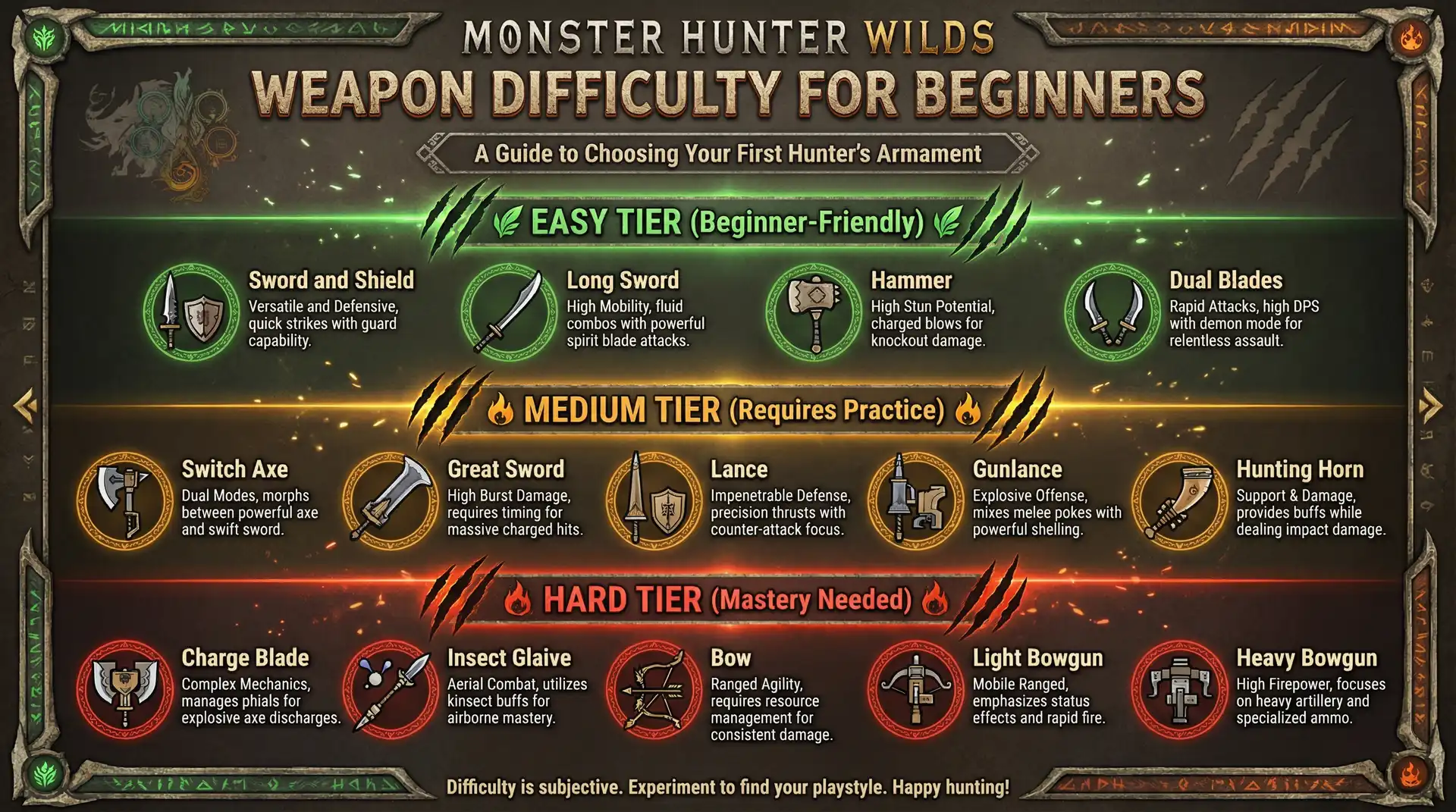
| Difficulty | Weapons | Why |
|---|---|---|
| Easy | Sword and Shield, Long Sword, Hammer, Dual Blades | Simple inputs, fast feedback, minimal resource management |
| Medium | Switch Axe, Great Sword, Lance, Gunlance, Hunting Horn | One extra mechanic to learn (morphing, charged hits, shells, notes) but core loop is readable |
| Hard | Charge Blade, Insect Glaive, Bow, Light Bowgun, Heavy Bowgun | Resource systems (phials, Kinsect, stamina+coatings, ammo types) require homework before the weapon performs |
Great Sword sits in Medium rather than Hard because Wilds’ version is significantly more accessible than older entries — the charged slash system is intuitive even if not mastered, and the raw damage output means partial success still feels rewarding.
Bow is Hard for beginners specifically because of the stamina management and coating system. Once learned, it is one of the most satisfying weapons in the game. But the learning tax is real.
Top 3 Beginner Weapons — Detailed Breakdown
1. Sword and Shield — The All-Rounder
Sword and Shield (SnS) is the most complete beginner weapon in Monster Hunter Wilds. It has a guard, fast attack speed, good reach for its size, and — crucially — you can use items with your weapon drawn. Every other melee weapon requires you to sheathe before consuming a potion. SnS doesn’t. In your first hunts, when you’re still learning monster patterns and will be taking more damage than you’d like, being able to heal without the sheathing animation is a significant safety net.
The core combo is straightforward: Triangle (slash) chains into circle (shield bash) into triangle again. Wilds adds the Offset Attack — a counter that triggers when you time your shield bash against an incoming monster attack. You don’t need to use it to be effective, but it’s intuitive enough that most new players discover it naturally and feel rewarded when it lands.
Core combo: Triangle × 3 → Circle → Triangle × 3 (loop). Sprint-cancel into Perfect Rush for burst damage windows.
Best for: Players who want flexibility and don’t want to commit to a specific playstyle yet. SnS rewards good fundamentals more than weapon-specific mechanics, so the skills you build with it transfer to every weapon you pick up later.
Limitations: Individual hits deal modest damage. You need to land a lot of attacks to see big numbers, which can feel slow against high-health late-game monsters if you don’t have good armor skills backing you up.
2. Long Sword — Mobile and Rewarding
Long Sword is statistically the most popular weapon in Monster Hunter Wilds, and for good reason. It has massive reach, excellent mobility, and a built-in counter — the Foresight Slash — that punishes monster attacks and fills your Spirit Gauge at the same time.
The Spirit Gauge is the weapon’s resource system, but it’s simpler than it sounds. Land attacks to fill a gauge (white → yellow → red). At each tier, you can spend the gauge on a Spirit Blade combo that resets the gauge at a higher tier. Hitting maximum red gauge and staying there increases all your damage. It’s a positive feedback loop: hit the monster more, deal more damage, hit the monster more efficiently. New players don’t need to optimise this — you’ll naturally learn it as you play.
Core combo: Triangle × 3 → R2 (Foresight Slash on a monster attack to counter) → Spirit Roundslash (R2 while gauge is active) → Spirit Blade combo (R2 × 3). Wilds adds Sakura Slash as a gap-closer finisher.
Best for: Players who like fluid, rhythmic combat and want a weapon that feels increasingly powerful as they improve. The counter mechanic gives you a goal to work toward rather than just ‘hit the monster more’.
Limitations: The Long Sword’s sweeping attacks can knock teammates out of their combos in multiplayer — the ‘Long Sword main’ reputation exists for a reason. In co-op, position yourself to avoid overlapping your swings with other hunters. The Monster Hunter Wilds monster weaknesses chart will help you identify which part of the monster to target for maximum effect.
3. Hammer — Simple Power
Hammer has the simplest moveset of any weapon in Monster Hunter Wilds and delivers some of the most satisfying results. Charge an attack by holding the attack button, release at the right moment to trigger a Brutal Strike, and aim for the monster’s head. Landing head hits deals Stun (KO) damage — fill the stun bar and the monster collapses, giving your whole team a free opening for maximum damage.
There is no gauge to manage, no phials to charge, no counter timing to execute. The complexity comes from reading the monster’s movement to stay near its head, which is genuinely hard against faster monsters. But the weapon itself is mechanically transparent.
Core combo: Hold R2 to charge (three charge levels: Charged Pound, Spinning Bludgeon, Overhead Smash). Big Bang (R2 + Triangle at max charge) is the primary burst tool. Wilds adds the Impact Crater as a Focus Strike finisher when a wound opens on the head.
Best for: Players who want to focus on learning monster patterns without weapon mechanics getting in the way. Also excellent for players who enjoy support-adjacent roles — landing consistent KOs benefits every hunter in the party.
Limitations: The Hammer has no block. You need to roll or position to avoid damage, which punishes players who haven’t learned a monster’s attack patterns. It also rewards head hits specifically, so learning the monster’s anatomy matters more than with weapons that deal good damage to the body.
What Weapon Should You Choose for Your Playstyle?
Beyond the top 3, the right weapon depends on what kind of hunter you want to be. Here is a direct mapping:
| If you like… | Try this weapon | Why |
|---|---|---|
| Fast, aggressive melee | Dual Blades | Rapid hits, high DPS ceiling, simple button combo — Stamina management is the only learning curve |
| Big single hits and positioning puzzles | Great Sword | Charged slashes reward patient, well-timed swings — satisfying when you land the True Charge Slash. See our Monster Hunter Wilds Great Sword build guide for optimised setups |
| Tanking hits and controlling space | Lance | Best guard in the game, counter-thrust punishes monster attacks, methodical poke-poke-poke rhythm |
| Range and safety | Light Bowgun | Distance from the monster reduces panic, but you’ll need to learn ammo types — medium-term investment |
| Team support + unique combat | Hunting Horn | Wilds made the note system far more accessible; songs buff your entire party and the self-improvement echo attacks hit hard |
One rule that applies regardless of weapon choice: always check the best armor sets in Monster Hunter Wilds before heading into tougher hunts. Even the best weapon underperforms if your armor skills don’t support it.
Can You Change Weapons After Picking One?
Yes — freely and at any point. Monster Hunter Wilds is deliberately designed to encourage weapon experimentation. You are never locked into a weapon choice.
Every camp has a Weapon Box where you can swap to any weapon in your collection before a hunt. Your character’s progression (Hunter Rank, story progress, armor upgrades) is entirely independent of which weapon you use. Each weapon has its own upgrade tree through the smithy, so switching weapons means starting a new upgrade path — but it does not reset anything else.
The practical recommendation: start with Sword and Shield, Long Sword, or Hammer for your first 5–10 hunts. Learn monster patterns, understand the wound and Focus Strike system, and get comfortable with item management. Then experiment. Most hunters find their ‘main’ weapon somewhere between their second and fourth attempt, not their first.
There is no wrong answer in the early game. Damage thresholds don’t punish weapon-switching in Low Rank content, and High Rank is where you’ll want a proper upgrade path established. By then, you’ll know what you like.
Frequently Asked Questions
What is the easiest weapon to learn in Monster Hunter Wilds?
Sword and Shield is generally considered the easiest weapon to be effective with from day one. It has a guard, lets you use items while drawn, and delivers consistent damage with simple inputs. Long Sword is a close second due to its large hitboxes and intuitive Spirit Gauge loop.
Is Dual Blades good for beginners?
Dual Blades is effective for beginners who prioritise speed over power. The combo chain is simple and the constant hits feel rewarding. The Stamina management (Archdemon Mode drains stamina) adds a learning layer, but it is less complex than Charge Blade or Bow. A solid choice if the top 3 don’t appeal to you.
Should beginners avoid Charge Blade?
Charge Blade is one of the most powerful weapons in the game but has the steepest learning curve. The phial charging system, guard points, and the SAED burst require deliberate study before the weapon performs. There is no reason you can’t start on Charge Blade, but expect to spend 10+ hours learning the weapon rather than the monsters. Most guides recommend getting familiar with Monster Hunter’s core combat loop on a simpler weapon first.
How many weapons should I try as a beginner?
Try at least two or three in the first 10 hunts. Many players fall in love with one weapon immediately, but the weapon that feels intuitive in the training area sometimes feels awkward against a real monster’s movement patterns. Give yourself permission to experiment before committing to an upgrade path.
Does weapon type affect story progression?
No. Every weapon can clear every piece of story content in Monster Hunter Wilds. Some weapons make specific fights easier (Hammer against monsters with punishable heads, Bow against flying monsters with accessible weak points), but no weapon gates your progress.
Sources
- Game8 Editorial Team. Monster Hunter Wilds Complete Guide Hub — weapon types, builds, and progression. Game8.
- IGN. Monster Hunter Wilds Review — weapon systems and combat depth evaluated. IGN.
- GamesRadar. Monster Hunter Wilds Review — beginner impressions and weapon accessibility. GamesRadar.
- Eurogamer. Monster Hunter Wilds Review — combat mechanics and weapon variety analysis. Eurogamer.

I've been playing video games for over 20 years, spanning everything from early PC titles to modern open-world games. I started Switchblade Gaming to publish the kind of accurate, well-researched guides I always wanted to find — built on primary sources, tested in-game, and kept up to date after patches. I currently focus on Minecraft and Pokémon GO.