
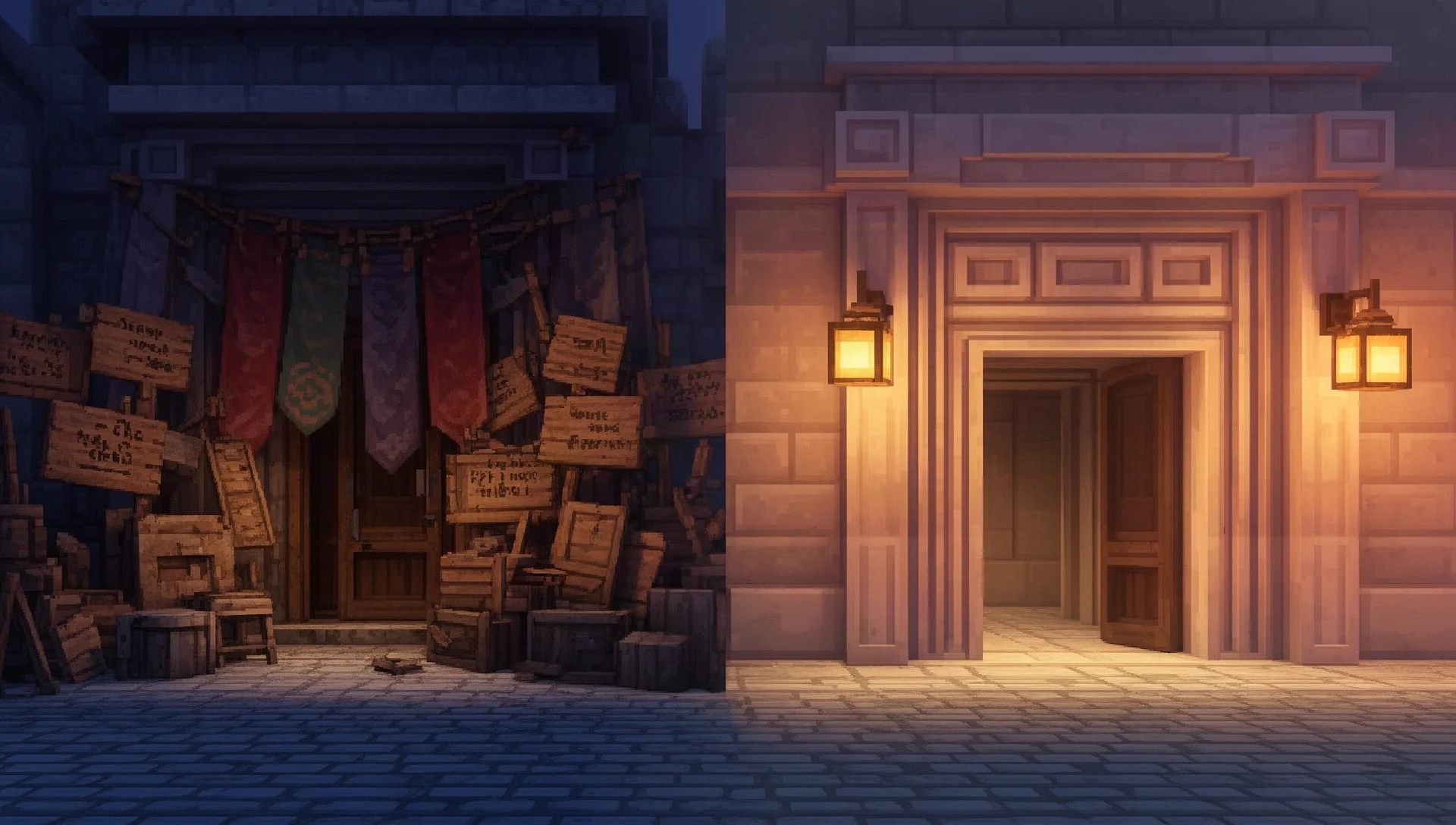
CurseForge holds roughly twice as many mod projects as Modrinth, according to third-party trackers [9]. Modrinth is the platform that tells you exactly what cut creators get — 75% of ad revenue [1] — while CurseForge won’t say what percentage of its reward pool actually reaches authors [2]. Neither fact makes one platform simply “better.” They point to two different products built on two different priorities, and which one fits you depends on whether you’re chasing a 2018 modpack or checking what shipped for 1.21.6 this morning.
Quick Verdict: Which Platform Fits Your Setup
If you’re new to modding, start with Modrinth — the App’s cleaner interface and human-reviewed listings mean fewer ways to install something you’ll regret. If you’re a hardcore optimiser chasing day-one mod updates, Modrinth again, for a different reason: new 1.21.x releases land there first, and its lighter launcher leaves more RAM for the game itself. Everyone else’s answer depends on what they’re actually trying to do.
| Player type | Pick | Why |
|---|---|---|
| New player | Modrinth | Every listing passes human review before it’s downloadable [5] — fewer ways to grab something malicious by accident |
| Casual player | CurseForge | Bigger curated modpack library, including packs like RLCraft and All The Mods that stay CurseForge-exclusive |
| Hardcore / optimiser | Modrinth | Current-version mods post there first, and the ~150MB launcher [4] leaves more headroom than CurseForge’s Overwolf-based app |
| Completionist | CurseForge | The only platform with deep pre-2019 coverage — most 1.7.10 and 1.12.2-era mods never made it to Modrinth |

Mod Catalog and Coverage: Legacy Depth vs Current-Version Speed
CurseForge has been collecting Minecraft mods since 2007, and it shows — comparison trackers put its catalog north of 226,000 projects against Modrinth’s 100,000-plus [9]. Treat those exact figures as directional rather than official; neither platform publishes a live public count, and third-party numbers drift depending on when they were pulled. What’s consistent across every source checked for this piece is the shape of the gap: CurseForge’s advantage is almost entirely in older content. Mods built for 1.7.10 or 1.12.2 frequently exist only on CurseForge, because their authors uploaded once and never migrated [8]. Modpacks compound the effect: because CurseForge’s client had years of head start as the default modpack-install path, big packs get built and maintained there first, and some — RLCraft and the All The Mods series among them — have stayed CurseForge-exclusive rather than getting mirrored across.
Modrinth’s smaller number skews the other way. It launched in 2020 as a Minecraft-focused alternative, and active developers increasingly treat it as the primary upload target — for a fresh 1.21.6 release, checking Modrinth first has become the default habit for a lot of modders [9]. Both platforms host mods for every major loader (Forge, Fabric, NeoForge, and Quilt), so loader choice doesn’t decide platform choice on its own; if you’re still weighing which loader to run, our Forge vs Fabric vs NeoForge comparison covers that separately. For a curated starting point instead of browsing either catalog cold, see our best Minecraft mods for 2026.
Launcher Speed, RAM Use and Ads
Modrinth’s own app page claims roughly 150MB of RAM at idle [4] — a self-reported number, but one that lines up directionally with independent estimates putting it in the 50–100MB range against CurseForge’s 200–300MB [10]. None of those third-party figures come with disclosed test hardware or methodology, so treat the specific numbers as rough community benchmarks rather than lab results. The direction they agree on matters more than the exact digits: CurseForge’s launcher runs on the Overwolf framework with an embedded browser for ads, and that architecture costs more memory at idle than Modrinth’s lighter, ad-free app. On an 8GB machine trying to also run a modded instance, that gap is the difference between a smooth session and stutter before you’ve even loaded a world.

If you haven’t set up either launcher yet, our guide to installing Minecraft mods walks through both from scratch.
API Access: Open vs Gated
Modrinth’s API is fully open — any launcher, tool, or script can query it without applying for anything, which is exactly why alternatives like Prism Launcher and GDLauncher can pull from it natively. CurseForge’s API works differently: third-party developers have to apply for a key, and Overwolf reviews every application against three criteria — the impact on author earnings, the load on CurseForge’s servers and CDN, and whether mod authors have consented to third-party distribution of their work [3]. That gate isn’t arbitrary bureaucracy; it exists because CurseForge lets individual authors restrict their mods from being redistributed outside its own ecosystem [3][8], something Modrinth’s open-by-default model doesn’t need to police. In practice, that gate is visible in the tooling: command-line managers like ferium and packwiz support both platforms, but their CurseForge side runs through the same API-key-gated process described above, while their Modrinth side needs no key or application at all.
Creator Monetization: What Authors Actually Get Paid
This is where the two platforms diverge most sharply on transparency. Modrinth publishes its formula in plain terms: ad revenue from the whole site and app splits 75% to creators, 25% to the platform, weighted by downloads and page views, with earnings released 60 days after month-end under standard ad-network payment terms [1]. Half of every Modrinth+ subscription gets redistributed to creators the same way.

CurseForge’s Reward Program pays a fixed $0.05 per point, and points come from a monthly pool “based on a percentage of revenues” — but the FAQ never states what that percentage actually is, and the point-to-download conversion rate changes month to month based on an internal algorithm authors can’t see [2]. That’s not necessarily a worse deal for any individual author — a popular mod on a much larger platform can out-earn the same mod on a smaller one even at a lower disclosed rate. But it’s a real difference in how each platform treats its creators: one shows its math, one doesn’t. Take community claims that Modrinth “pays more per download” [9] as anecdotal rather than verified — nobody outside CurseForge can check the comparison against a number CurseForge itself won’t publish.
Trust and Safety: What the 2023 Malware Incident Actually Revealed
In June 2023, compromised CurseForge and Bukkit accounts uploaded credential-stealing malware — later named Fractureiser — into popular mods and modpacks, including entries in the Better MC series and packs like Dungeons Arise and Sky Villages [6]. Some infected files had reportedly been live since April or May before detection [6]. CurseForge’s own account of the incident says it banned the responsible accounts and released a detection tool for affected users [7], but the support article never describes any new pre-publish scanning system added as a result [7]. Modrinth, by contrast, confirmed it was unaffected [6].
The mechanism explains the outcome better than luck does. Every new Modrinth listing goes through mandatory human moderator review before it’s publicly downloadable, typically within 24–48 hours, with an in-house scanner that can flag a project for deeper manual inspection [5]. CurseForge’s workflow has historically leaned on post-upload detection and after-the-fact bans rather than blocking a file before it goes live. That’s the real, checkable difference behind “is CurseForge safe” discourse — not vague reputation, but two different points in the pipeline where a bad file can be caught.
Which One Should You Actually Use?
Use CurseForge if: you need a specific legacy pack that only lives there (RLCraft, All The Mods), you’re chasing an old 1.7.10 or 1.12.2 mod, or ads and a heavier launcher genuinely don’t bother you.
Skip CurseForge if: your PC is RAM-constrained, you want a creator payout system you can actually audit, or you’re modding on a version that shipped in the last few weeks.
Use Modrinth if: you want the lightest launcher footprint, an ad-free browsing experience, or the reassurance that a human looked at a mod before you could install it.
Skip Modrinth if: the specific mod or pack you need was never uploaded there — which, for anything built before roughly 2019, is still common.
FAQ
Is CurseForge actually less safe than Modrinth?
Not inherently less safe in general use, but the 2023 Fractureiser incident exposed a structural gap: CurseForge’s pipeline let malware go live and spread before anyone caught it, while Modrinth’s mandatory pre-publish human review would have blocked the same files before download [5][6][7]. That’s a process difference worth weighing, not a verdict that CurseForge is unsafe to use today.
Can I use CurseForge and Modrinth mods in the same launcher?
Yes — independent launchers like Prism Launcher pull from both platforms’ APIs, so you’re not locked into one ecosystem. The trade-off is you lose each platform’s native one-click install polish in exchange for that flexibility.
Does Modrinth really pay creators more than CurseForge?
Unverifiable as stated. Modrinth’s 75/25 split is public and checkable [1]; CurseForge’s reward-pool percentage isn’t [2]. Community claims that Modrinth pays more per download are plausible but come from creators comparing notes, not from audited numbers on both sides [9].
Will a mod I download from CurseForge work if I install it through Modrinth’s launcher, or vice versa?
Yes, in most cases — a mod’s underlying JAR file works with whichever Forge, Fabric, NeoForge, or Quilt instance you point it at, regardless of which platform you downloaded it from. Platform and mod loader are separate layers; only an author’s explicit distribution restriction [3] would block a CurseForge-exclusive mod from working elsewhere, and that’s a listing policy, not a technical one.
As a new modder, which platform should I publish to first?
Modrinth, if reach isn’t your only concern — the open API means your mod is instantly available to every third-party launcher and tool without waiting on anyone’s approval, and the transparent payout split means you know what you’re actually earning. CurseForge still commands the larger existing audience, so cross-posting once you’re established is the standard move, not an either/or choice.
Sources
- Modrinth. “Rewards Program Information.” modrinth.com/legal/cmp-info
- CurseForge Support. “Reward Program FAQ.” support.curseforge.com
- CurseForge Support. “About the CurseForge API and How to Apply for a Key.” support.curseforge.com
- Modrinth. “Download Modrinth App.” modrinth.com/app
- Modrinth Support. “Modrinth project review times.” support.modrinth.com
- Prism Launcher. “Fractureiser malware alert.” prismlauncher.org
- CurseForge Support. “June 2023 – Infected mods detection tool.” support.curseforge.com
- GDLauncher. “CurseForge vs Modrinth – Platform Comparison.” gdlauncher.com
- TopModdedServers. “CurseForge vs Modrinth: Which One Should You Use?” topmoddedservers.com
- Astroworld Guides. “Best Minecraft Launchers: CurseForge vs Modrinth vs Prism.” guide.astroworldmc.com
Verified against platform documentation and community benchmarks current as of August 2026. RAM figures and project counts drift over time — check each platform directly for current numbers.

I've been playing video games for over 20 years, spanning everything from early PC titles to modern open-world games. I started Switchblade Gaming to publish the kind of accurate, well-researched guides I always wanted to find — built on primary sources, tested in-game, and kept up to date after patches. I currently focus on Minecraft and Pokémon GO.