

After Season 8’s full six-division rank reset, every player in Marvel Rivals starts from scratch. The ladder is volatile, communication is chaos, and the heroes that carry you in uncoordinated solo queue are not the heroes that dominate coordinated premade lobbies. That split is wider than any tier list currently shows — because most tier lists publish one ranking and call it done.
This guide publishes two: a win-rate tier (the best proxy for solo-queue viability) and an editorial meta tier (what coordinated teams actually run). The data is cross-referenced from Counterwatch.gg win rates as of May 23, 2026, against community meta consensus heading into Season 8: Sins of Alchemax, which launched May 15, 2026 with 16 hero balance changes, a new Vanguard in Devil Dinosaur, and mid-season Duelist Cyclops arriving June 12.
Verified: Season 8.0 patch (May 15, 2026). Win-rate data: May 23, 2026. Values shift with patches — check Counterwatch for live updates.
Master Tier Table: Solo-Queue vs. Premade Meta
The Solo-Queue Tier uses win-rate data across all ranks as the primary signal. The Premade Meta Tier reflects editorial consensus from high-level competitive play, where team-up synergies and communication unlock hero potential that win-rate data misses.
| Hero | Role | Solo-Queue Tier | Premade Meta Tier | Note |
|---|---|---|---|---|
| Peni Parker | Vanguard | S | A | Best solo carry tank; mines are passive value |
| Magik | Duelist | S | A | Portal escape = self-sufficient dive |
| Ultron | Strategist | S | A | Flight + shields reduce coordination dependency |
| Devil Dinosaur | Vanguard | S* | A | *Early data (53.7% WR); limited sample size |
| Daredevil | Duelist | S | A | Radar sense gives self-gathered intel |
| Hulk | Vanguard | A | S | Brawl enabler; ult wasted without follow |
| Groot | Vanguard | A | S | Wall placement rewards coordination |
| Hela | Duelist | A | S | Best pure hitscan; solo carry ceiling |
| Invisible Woman | Strategist | A | S | Shields reactive in solo; game-changing premade |
| Cloak & Dagger | Strategist | A | S | Dual damage+heal; lowest coordination floor |
| Rocket Raccoon | Strategist | A | S | Triple-buffed Season 8; best poke support |
| Emma Frost | Vanguard | A | A | Major Season 8 buff; frontline anchor |
| Magneto | Vanguard | A | A | Shield + ult scatter; reliable in both modes |
| Captain America | Vanguard | A | A | Consistent engage tool |
| Rogue | Vanguard | A | A | Ability steal adds chaos-friendly upside |
| Wolverine | Duelist | A | A | Self-heal sustain; dive carry in either mode |
| Psylocke | Duelist | A | A | Lone assassin; high solo ceiling |
| Elsa Bloodstone | Duelist | A | A | Safe backline; reliable output |
| Black Cat | Duelist | A | A | Season 7+8 synergy trio with White Fox+Cap |
| Venom | Duelist | A | A | Dive initiation; reliable in both modes |
| Moon Knight | Duelist | B | A | Area denial; stronger in structured comps |
| Phoenix | Duelist | B | A | Spread damage rewards grouped enemies; premade setup |
| Loki | Strategist | A | A | Clone deception rewards game sense; viable solo |
| Jeff the Land Shark | Strategist | A | A | Ultimate removes enemies from fights; disruptive |
| White Fox | Strategist | A | A | Season 7 addition; flexible kit |
| Mantis | Strategist | A | B | Strong overall; better with known teammates |
| Iron Man | Duelist | A | C | Solo mobility carry; drops in coordinated meta |
| Gambit | Duelist | S | S | Best mid-range burst; reliable in either mode |
| Luna Snow | Strategist | C | B | Ult wasted in PUGs; coordinated-team payoff |
| Namor | Duelist | D | A* | *S-tier below Diamond; drops at high rank |
| Doctor Strange | Vanguard | B | B | Portal coordination rewards comm; decent solo |
| The Thing | Vanguard | B | B | Refuses to die; rarely the best option |
| Thor | Vanguard | B | B | Hit-or-miss depending on rank |
| Deadpool | Vanguard | A | B | Self-heal sustain; less useful premade than dive tanks |
| Black Panther | Duelist | A | B | High mobility; skill-gated |
| Star-Lord | Duelist | B | B | Escape tools; consistent if not focused |
| Blade | Duelist | B | B | Added Season 3.5; solid but not meta-dominant |
| Winter Soldier | Duelist | B | B | Range + burst; team-up dependent for peak output |
| Scarlet Witch | Duelist | C | B | CC scales with communication |
| Spider-Man | Duelist | B | C | High skill floor; mobility does not scale with team |
| Squirrel Girl | Duelist | C | C | Best point defender; niche pick |
| Adam Warlock | Strategist | B | B | Rez mechanic requires positioning awareness |
| Hawkeye | Duelist | F | C | F-tier WR (46.7%); viable only with exceptional aim |
| Human Torch | Duelist | F | C | Among lowest win rates; very punishable |
| Black Widow | Duelist | F | D | Lowest overall win rate (42.5%) |
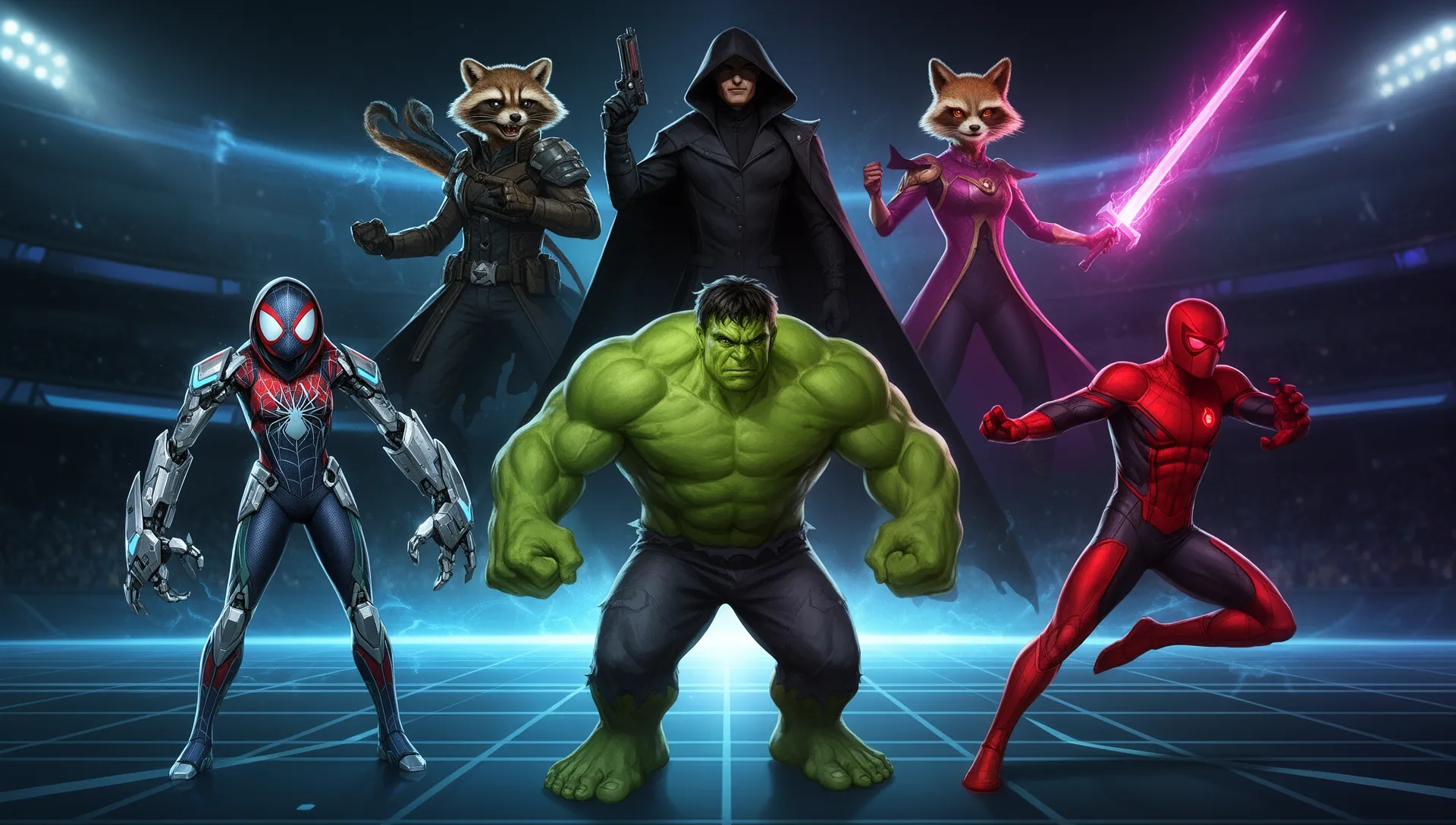
Why Solo-Queue and Premade Meta Tiers Diverge
The split comes down to one thing: who provides the conditions for your abilities to matter.
In solo queue, you are the condition. Peni Parker’s mines activate whether your team groups with you or not. Daredevil’s radar sense gives him wall-vision without a teammate calling enemy positions. Magik’s portals create a personal escape route she controls entirely. These heroes have built-in coordination.
In premade, your teammates become the condition — and that changes the value proposition entirely. Hulk’s crowd control chain becomes S-tier because your DPS player has already agreed to burst the target Hulk staggers. Luna Snow’s Absolute Zero ultimate multiplies when teammates time their own cooldowns into its 50% damage window. These are heroes whose ceiling requires external input.
Season 8’s full rank reset amplifies the gap. When everyone re-sorts through divisions simultaneously, early-season lobbies mix players across a wider skill band than any mid-season point. Coordination is worse, callouts are absent, and heroes who depend on teammate follow-up (Namor’s turrets, Hulk’s engage chain, Luna Snow’s ult window) drop dramatically in effective tier.
S-Tier Solo Queue Picks: These Heroes Carry Themselves
Peni Parker — Vanguard (55.3% Win Rate, 25% Pick Rate)
Peni Parker leads all heroes in win rate and pick rate as of May 23, 2026. Her dominance in solo queue traces directly to Arachno-Mine — mines she deploys that deal damage and slow any enemy who walks through them, regardless of what her team is doing. Other tanks need teammates to capitalize on their disruption; Peni’s disruption works passively.
Her ultimate, SP//dr, summons a mech suit that gives her burst melee power and displacement. Critically, the mech’s value is not team-dependent: you activate it, you swing, you reset. The highest-skill version (setting mines in a ring before ulting so fleeing enemies walk into them) is optional — the base version still produces value in a PUG.
In premade, she drops to A-tier not because she is worse but because coordinated teams have better tank options for enabling their DPS carries. Her passive space denial is less impactful when the team already controls positioning through communication.
Magik — Duelist (54.8% Win Rate, 24% Pick Rate)
Magik’s solo dominance runs through Limbo Shards and her portal kit. Her Darkchylde portals create personal escape routes she controls independently — no teammate needs to peel for her when she can reposition through a portal she placed two seconds ago. Limbo Shards persist after deployment, dealing damage and controlling space even during repositioning windows where a less mobile Duelist would be idle.
The comparison that matters: Psylocke is a similarly high-damage Duelist but relies on finding isolated targets and requires a clean escape window. Magik creates her own window. In a lobby where teammates are not guarding your flanks, that self-sufficiency is the difference between two and four kills a fight.
Daredevil — Duelist (53.2% Win Rate, 14% Pick Rate)
Daredevil’s Radar Sense passive detects enemies through walls — a mechanic that eliminates his reliance on teammate callouts. Most heroes in solo queue operate with incomplete information. Daredevil does not. He knows when the support is isolated, when the tank has turned, when the dive window opens.
His combo of Billy Club — which roots targets — into melee burst can delete supports before their team has time to react, and his mobility lets him reset before being traded. The low pick rate (14%) relative to his S-tier win rate signals skill-gating: he underperforms in low-rank hands but breaks lobbies for players who can execute his kit consistently.
Gambit — Duelist (S-Tier Both Solo and Premade)
Gambit occupies the rare position of S-tier in both solo and premade contexts. His mid-range burst through charged kinetic cards deals reliable damage at the distance most fights occur in ranked play, without requiring point-blank commitment. His ultimate creates a mid-fight displacement that works whether teammates follow or not.
He is the closest Marvel Rivals has to a “universal carry” — a hero whose power does not scale dramatically with team coordination because his damage is self-contained. This also makes him the most frequently banned pick at higher ranks, where opponents know his consistency is opponent-agnostic.
S-Tier Premade Picks: Why They Drop Solo
Hulk — Vanguard (A-Tier Solo / S-Tier Premade)
Hulk is the clearest example of a hero whose editorial rank is more honest than his win rate. His brawl-meta role is to absorb damage, apply crowd control with Gamma Charge, and create the moment for DPS to burst the staggered target. In premade, your DPS player has agreed to watch for that signal. In solo queue, they are usually watching the other side of the map.
His ultimate, Gamma Tsunami, sends a wave of radiation that displaces and damages multiple enemies — but it requires two or three teammates to capitalize on the chaos before enemies re-stabilize. PUG teammates average one delayed follow-up per fight. The result: Hulk goes from a game-winning brawl anchor in premade to a durable frontliner with wasted ultimate value in solo. He still clocks 52.2% win rate (A-tier), meaning he is far from bad — just not the carry tank he becomes with coordinated backup.
When to pick Hulk solo: When you are duo-queued with at least one DPS who confirms they will follow your engage signal.
Namor — Duelist (D-Tier Overall Win Rate / S-Tier Below Diamond)
No hero in Season 8 illustrates rank-dependent tier more starkly than Namor. His D-tier win rate (48.1% overall) sits alongside an S-tier placement below Diamond rank — a gap explained entirely by Monstro Spawn mechanics and whether opponents know how to handle them.
Namor’s Monstro Spawns are turrets that create chokepoint control when placed on a flank. In coordinated play, teammates hold positions around the turrets, forcing opponents to either break them (burning cooldowns) or fight through them. In solo queue below Diamond, most opponents simply do not know the counter: focus the turrets with splash AoE and re-engage. So Namor’s turrets become unclearable walls at lower ranks.
Above Diamond, opponents coordinate the clear in four seconds and then focus Namor directly — who has minimal mobility compared to Daredevil or Magik. His Blessing of the Deep invulnerability window buys repositioning time, but without teammates providing peel, he absorbs four players’ attention after the turrets are gone. His Horn of Proteus ultimate devastates chokepoints but only when teammates are grouped and ready to push the displaced enemies — which PUG teams rarely do.
Solo queue verdict: Pick Namor below Diamond for map-control dominance. Swap to Magik or Daredevil in Diamond+.
Luna Snow — Strategist (C-Tier Solo Win Rate / B-Tier Premade)
Luna Snow’s Absolute Zero ultimate grants nearby allies both a 50% healing boost and a 50% damage boost simultaneously — one of the highest team-fight swing abilities in the game, in theory. The operative phrase is nearby allies who are actively using their own cooldowns during the window. In a premade, your team times their pushes into Absolute Zero. In a PUG, half your team is in the wrong building when it activates.
Her regular healing also rewards knowing teammate positioning in advance — her ice projectile heals the nearest ally in range, which means healers who understand their team’s movement patterns heal efficiently, while those reacting to chaos heal the wrong target at the wrong time. Dualshockers ranks her at #9 for solo queue — not unviable, but conditional. The gap between her C-tier win rate and her workable solo ranking reflects exactly this: she delivers for players who can read positioning, and fails for those who cannot.
Solo queue verdict: Main-able if you have strong game sense. Otherwise, Cloak & Dagger gives you healing plus damage with a lower skill floor and a more forgiving delivery mechanic.
Team Compositions: 2-2-2 vs. Triple Support
2-2-2 (Two Vanguards, Two Duelists, Two Strategists) — Recommended for Ranked Climbing
The standard competitive format because it balances engage tools, damage output, and healing sustain. Two strong Season 8 builds:
- Dive 2-2-2: Peni Parker + Hulk | Hela + Daredevil | Cloak & Dagger + Ultron. Peni controls space passively; Hulk enables Hela and Daredevil’s burst by creating chaos the supports cannot heal through fast enough.
- Brawl 2-2-2: Groot + Emma Frost | Wolverine + Magik | Invisible Woman + Rocket Raccoon. Emma Frost anchors the frontline post-buff; Rocket’s triple Season 8 buff (damage + healing + reduced ultimate cost) makes him the best poke support for sustained brawl fights.
Triple Support (Three Strategists, Two Duelists, One Vanguard) — High Coordination Required
The dominant meta composition heading into Season 8 has outperformed the 3-2-1 format in organized play: Invisible Woman + Cloak & Dagger + Luna Snow (triple support) + Wolverine + Magik (Duelists) + Magneto (solo Vanguard). The three healers run shielding and sustained healing that counters dive compositions, while Wolverine and Magik create the dive pressure the triple-support shell protects.
For solo queue: run 2-2-2. The triple-support shell only works when your Vanguard and Duelists understand their roles without callouts — a coordination level that solo lobbies rarely reach consistently.
Season 8 New Hero: Devil Dinosaur

Devil Dinosaur is the 50th hero added to Marvel Rivals and the first new Vanguard since Season 7. His kit centers on bleed damage applied through bite attacks and a charge disruption ability that displaces enemies through tight defensive formations — useful for breaking clusters around objectives.
Current ranking: A-tier on Counterwatch (53.7% win rate) with the caveat that Season 8 data is still accumulating. The immortalboost Season 8 guide describes him as “an A-tier brawler but not meta-defining at launch,” which aligns with a hero who fills the Hulk brawl role with more sustained damage output but less single-stagger crowd control value.
Who should play him: Players who enjoy Hulk’s engage role but want more sustained attrition through bleed rather than a single-impact stagger. His bleed application creates pressure that does not require immediate teammate follow-up, making him somewhat more solo-queue viable than Hulk — though his team-fight ceiling is lower without the Gamma Charge stagger chain.
Watch for mid-season: Cyclops (Duelist) arrives June 12, 2026. No competitive data yet, but his profile as a ranged Duelist suggests he will compete with Hela and Elsa Bloodstone for the backline damage role.
Player-Type Tier Guide
| Player Type | Best Solo Pick | Best Premade Pick | Why |
|---|---|---|---|
| New player | Cloak & Dagger (Strategist) | Invisible Woman (Strategist) | Auto-tracking attacks and heals; lowest execution floor in either mode |
| Casual | Peni Parker (Vanguard) | Hulk (Vanguard) | Peni’s mines are passive value; Hulk’s role is clear once you have a coordinated DPS |
| Hardcore | Daredevil (Duelist) | Luna Snow (Strategist) | Both have high ceilings that pay off proportionally to skill and positioning reads |
| Completionist | Magik (Duelist) | Namor (Duelist) | Most mechanically complex kits; highest unique upside when fully mastered |
Frequently Asked Questions
Is Marvel Rivals free to play?
Yes — completely free on PC and consoles. The game peaked at 644,000 concurrent players on Steam at launch and maintains around 340,000 daily players. All heroes are unlockable through gameplay; the battle pass and cosmetics are the only paid elements.
Which hero is best for beginners?
Peni Parker if you want to tank, Cloak & Dagger if you want to support. Both have low failure states: Peni’s mines produce value even when played passively, and Cloak & Dagger’s auto-tracking attacks mean your aim does not have to be precise to deal damage and heal simultaneously. Avoid Hawkeye and Black Widow at the start — both are F-tier by win rate because they require mechanics most new players have not built yet.
Does the tier list change with each patch?
Yes, and Season 8 already proved it. Emma Frost and Rocket Raccoon jumped tiers after major buffs at season launch. Namor’s D-tier win rate is a direct response to the brawl meta that elevated dive-capable tanks over turret-control Duelists. Check Counterwatch for live win-rate shifts after any balance patch.
Is 2-2-2 or triple support better in ranked?
2-2-2 for solo ranked — the triple-support variation only performs when all six players understand their role, which requires coordination that most solo lobbies do not reach. If you are in a premade of four or more, the triple-support shell (Invisible Woman + Cloak & Dagger + Luna Snow) with Wolverine and Magik plus Magneto is the highest-ceiling Season 8 composition.
What does the Season 8 rank reset mean for climbing?
Every player started from a base rank when Season 8 launched May 15, 2026. The early-season ladder is volatile — you will face players who are genuinely out of rank in both directions. During this window, heroes with high solo-queue win rates (Peni, Magik, Daredevil, Gambit) are safer climbers because they do not depend on opponents being placed correctly to win. Expect the tier list to stabilize around weeks four to six as the ladder sorts.
Individual hero tiers only tell half the story — for full six-hero compositions built around Season 10’s Team-Up ability pairings, see our Marvel Rivals best team comps guide.
Marvel Rivals is one of the most team-driven hero shooters available in 2026 — for other free-to-play multiplayer options with a similar competitive spirit, see our 20 Best Co-op Games 2026 hub, and for a broader look at where competitive gaming is heading this year, our Best Competitive Games 2026 guide covers the full landscape.
Sources
- Marvel Rivals Hero Tier List — Counterwatch.gg (May 23, 2026)
- Marvel Rivals Season 8 Tier List — Beebom
- Best Heroes for Solo Queue in Competitive — Dualshockers
- Marvel Rivals Season 8 Guide — Immortalboost
- Marvel Rivals Version 20260521 Patch Notes — Official marvelrivals.com

I've been playing video games for over 20 years, spanning everything from early PC titles to modern open-world games. I started Switchblade Gaming to publish the kind of accurate, well-researched guides I always wanted to find — built on primary sources, tested in-game, and kept up to date after patches. I currently focus on Minecraft and Pokémon GO.