
Nook Miles are Animal Crossing: New Horizons’ second currency — and most players underestimate them. While Bells pay the mortgage and stock the shop, Nook Miles unlock the tools that actually shape your island. Master this system and you’ll get your dreamie villagers faster, terraform more efficiently, and stretch every daily play session further.
This guide covers everything: what Nook Miles are, how to earn them reliably, and exactly what to spend them on in priority order. Whether you’re a week-one islander or returning after a long break, the system works the same way.
Nook Miles vs. Bells: Two Currencies, Two Purposes
Nook Miles and Bells look similar on the surface — both are numbers on your screen — but they serve completely different roles and cannot be exchanged for each other.
Bells are your day-to-day money. You earn them by selling fish, bugs, fossils, and items at Nook’s Cranny. Bells pay off your home loans, buy furniture, fund Nook Shopping orders, and pay for terraforming once the Island Designer app is unlocked.
Nook Miles are an achievement-based reward currency. You earn them by completing tasks and milestones — not by selling items. They’re redeemed exclusively at the Nook Stop terminal inside Resident Services.
The key distinction: Nook Miles fund access and progression, not decoration. Nook Miles Tickets, terraforming permits, and app unlocks are things Bells simply cannot buy. That’s why managing your Nook Miles balance matters almost as much as your Bell count.
How to Earn Nook Miles
Permanent Nook Miles Achievements
These are the backbone of the system. Permanent achievements are one-time milestone rewards for actions like catching your 10th fish, selling 50 items, or talking to five villagers. Each milestone has five escalating tiers — complete tier one and you unlock tier two, which pays out more for a harder target.
Early-game achievements pay out the most relative to effort. Milestones like “Island Togetherness” (talking to all your villagers daily), “Angling for Perfection” (catch X fish), and “Flower Power” (plant/pick X flowers) will roll in naturally as you play. Don’t grind them — just keep playing and they accumulate.
The five-tier structure means even familiar activities have long-term payoff. By the time you’ve completed all tiers of an achievement, you’ll have earned hundreds to thousands of Nook Miles from that single category alone.
Nook Miles+ Daily Challenges
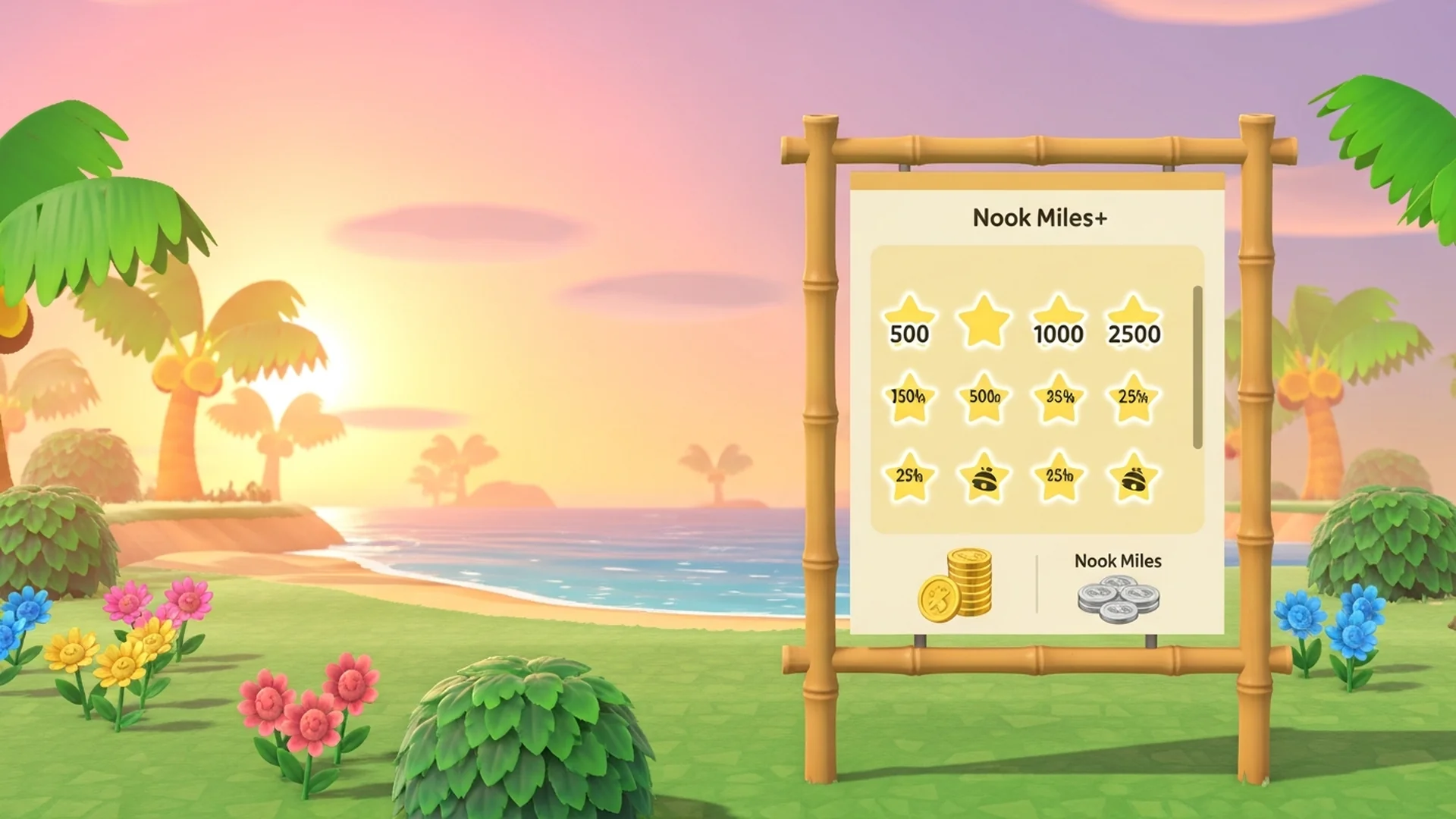
Nook Miles+ is the rotating daily layer of the system, unlocked after your first full day on the island. Every day, five mini-tasks appear at the Nook Stop, each worth between 100–300 Nook Miles. Complete all five and you earn a 2× bonus stamp, doubling the payout for your remaining tasks that day.
Typical Nook Miles+ tasks include:
- Catch a bug or fish
- Pick a flower or plant one
- Find a fossil
- Send a letter
- Water a plant
- Hit a rock
- Chop wood from a tree
All of these take under two minutes each. A full five-task clear daily takes 10–15 minutes and nets you 1,000–2,500 Nook Miles depending on task values and the bonus multiplier. Tasks reset at midnight, so always clear them before the day turns over.
Nook Mileage Tiers
Your total lifetime Nook Miles accumulation determines your Nook Mileage tier — a prestige ranking displayed on your Nook Passport. There are five tiers: Bronze, Silver, Gold, Platinum, and finally the top tier unlocked at extremely high totals. Higher tiers cosmetically upgrade your Nook Passport but have no functional gameplay effect. Treat them as a long-term marker of island progress, not something to chase directly.
The Fastest Daily Nook Miles Methods
For players wanting to accumulate Nook Miles efficiently:
- Complete all five Nook Miles+ tasks before midnight — this should be non-negotiable. 10 minutes, done. Miss even one and you lose the bonus multiplier window.
- Don’t ignore fossils — “Fossil Finder” achievements tier up faster than most players expect. Digging four fossils daily is already on the board; donate or sell them after.
- Talk to every villager — “Island Togetherness” pays out for greeting all residents daily. If you have 10 villagers, a quick lap around the island checks this off.
- Sell consistently at Nook’s Cranny — “Stalk Market” and “Bell Ringer” achievements both have five tiers and accumulate fast from normal play.
- Craft daily — DIY-related achievements (“DIY Furniture” series) tick up every time you craft at a workbench. Use your daily recipe cards from balloon presents.
There is no efficient exploit for Nook Miles — the system is designed to reward consistent daily play rather than grinding sessions. 15–20 minutes per day is better than a two-hour marathon once a week.
Best Things to Spend Nook Miles On (Priority Ranking)
Not all Nook Miles redemptions are equal. Here’s the priority order from most to least valuable:
1. Nook Miles Tickets (2,000 NM each) — Highest Priority
Nook Miles Tickets (NMTs) are the single most valuable item in the Nook Stop. Each ticket takes you to a random mystery island via Dodo Airlines, and mystery islands are the primary method for hunting specific villagers, collecting non-native fruit, and finding rare DIY recipe bottles washed up on shore.
Every NMT costs 2,000 NM. At 10–15 daily Nook Miles+ tasks alone, you’ll accumulate enough for one ticket every two to three days of consistent play. Prioritise building a stockpile before you need them — having 20+ tickets before starting a dreamie hunt prevents frustration.
2. Island Designer App Permits (6,000 NM each) — High Priority
Once Tom Nook awards the Island Designer app, individual terraforming tools — cliff construction and waterway permits — each cost 6,000 Nook Miles. These are essential for anyone planning a serious island layout. Buy them as soon as they’re available.
The custom path permit (also 3,000 NM) lets you design and place custom patterns as paths, which is one of the most impactful visual changes you can make to an island. If you’re working on terraforming, see the Animal Crossing island design guide for layout strategies.
3. Pro Designs App (800 NM) — Medium Priority
The Pro Designs expansion for the Custom Designs app unlocks additional design slots and the ability to create full clothing patterns (hats, dresses, socks, shoes). At only 800 NM it’s cheap relative to its impact. Buy it in your first week.
4. Hairstyle and Reaction Packs (1,800–3,300 NM) — Low–Medium Priority
Several cosmetic upgrades are available at the Nook Stop: new hairstyle sets (1,800 NM each), reaction packs like “Nook Inc. Reaction Set” (2,700 NM), and the “Hip Reactions Collection” (2,700 NM). These are quality-of-life additions but purely cosmetic. Buy them after you have a comfortable NMT stockpile.
5. Bag and Umbrella Upgrades — Lowest Priority
Nook-branded bags and umbrellas appear in the Nook Miles shop for 800–1,200 NM. Purely aesthetic. Buy only if you’ve met all higher-priority needs.
What NOT to Spend Nook Miles On
A few Nook Stop items look appealing but represent poor value against your NMT budget:
- Bell Vouchers (500 NM → 3,000 Bells) — the exchange rate is terrible. You can earn 3,000 Bells in two minutes by selling common fish. Never buy these unless you have surplus NM and a Bell emergency.
- Furniture items available via normal gameplay — some Nook Stop items are also giftable or craftable. Check before spending.
- Cosmetics when you’re low on NMTs — if your NMT supply is under 10 and you’re actively hunting a dreamie, freeze all cosmetic purchases until the hunt is complete.
Nook Miles Ticket Strategy: When and How to Use Them
NMTs are the engine of long-term island development. The three main use cases:
Villager Hunting
Mystery islands occasionally spawn a random villager camping. If it’s your target dreamie, invite them. If not, leave without interacting — the island regenerates on your next NMT trip. This is the primary villager acquisition method outside of campsite visits.
Expect to use 20–50 NMTs to find a specific villager. Popular dreamies with limited spawn pools (Raymond, Marshal, Sherb, Coco) can require significantly more. Build your stockpile before you start — hunting with fewer than 15 tickets creates unnecessary pressure.
Non-Native Fruit Farming
Mystery islands grow fruit based on your island’s native fruit — but one in five trips will spawn a different native island type, offering non-native fruit trees. Non-native fruit sells for 500 Bells each (vs. 100 Bells for your native fruit). Plant a full orchard early and non-native fruit becomes a reliable Bell source for Nook loan repayments.
DIY Bottle Hunting
Mystery islands always have a DIY recipe bottle washed up on the beach. If you’re completing your DIY collection or hunting specific seasonal recipes, NMT trips are a reliable source. Secondary benefit that pays off passively during villager hunts.
How Many NMTs Should You Stockpile?
A practical guide by play stage:
| Play Stage | Target NMT Stockpile | Reasoning |
|---|---|---|
| First month | 5–10 | Island not ready for terraforming; focus on app permits first |
| Pre-dreamie hunt | 20–30 | Minimum comfortable buffer for most villagers |
| Active dreamie hunt | 30–50+ | Popular dreamies can take 40+ tickets |
| Terraforming phase | 10–15 maintenance | NM better spent on permits; NMTs only for specific needs |
| Endgame | 5–10 passive | Island complete; accumulate for future updates |
Frequently Asked Questions
What is the fastest way to earn Nook Miles?
Complete all five Nook Miles+ daily tasks before midnight — this is consistently the best time-to-NM ratio. The 2× bonus multiplier for completing all five tasks means a clean daily clear pays far more than partial completion. Combine with natural milestone achievements from normal play.
Should I spend Nook Miles on furniture or tickets?
Tickets first, every time. Furniture can be sourced via Nook Shopping, balloons, villager gifts, and Nook’s Cranny. Nook Miles Tickets are the only reliable villager-hunting tool, and mystery islands also yield non-native fruit and DIY recipes as secondary rewards.
Can you run out of Nook Miles achievements?
Technically yes — all permanent achievements have a final tier, and once completed, that category stops generating NM. However, the total number of achievements across all categories is large enough that most players complete them gradually over hundreds of hours. Nook Miles+ daily tasks continue indefinitely regardless.
What happens when you complete all achievements?
You retain your existing Nook Miles balance and continue earning via Nook Miles+ daily tasks. The daily system has no endpoint, so your NM income never fully stops — it just reduces compared to early-game when permanent achievements were firing constantly.
Are Nook Miles Tickets worth it if I don’t care about villagers?
Yes. Even without villager hunting as a goal, mystery islands provide non-native fruit (reliable Bells source), DIY recipe bottles, and occasionally rare fish and bugs not spawning on your island. NMTs are useful at every stage of play.
Getting the Most from Animal Crossing: New Horizons
Nook Miles sit at the centre of ACNH’s long-term progression loop. Daily Nook Miles+ challenges give you a reason to log in every day; permanent achievements reward natural play; and the Nook Stop redemption list makes sure every NM has a clear, useful destination.
The players who feel stuck — who’ve been on their island for months but haven’t found their dreamies or finished terraforming — are often the ones sitting on idle Nook Miles or spending them on cosmetics too early. Use this guide as your spending priority checklist: tickets first, permits second, everything else after.
For your next steps, check the full Animal Crossing: New Horizons beginner’s guide for the complete island progression roadmap, and the best life sim games guide if you’re looking for what to play alongside ACNH.
Sources
- Animal Crossing Wiki — Nook Miles system documentation
- Polygon — ACNH complete guide
- Nintendo Life — Nook Miles+ tips and strategies

I've been playing video games for over 20 years, spanning everything from early PC titles to modern open-world games. I started Switchblade Gaming to publish the kind of accurate, well-researched guides I always wanted to find — built on primary sources, tested in-game, and kept up to date after patches. I currently focus on Minecraft and Pokémon GO.