
In short
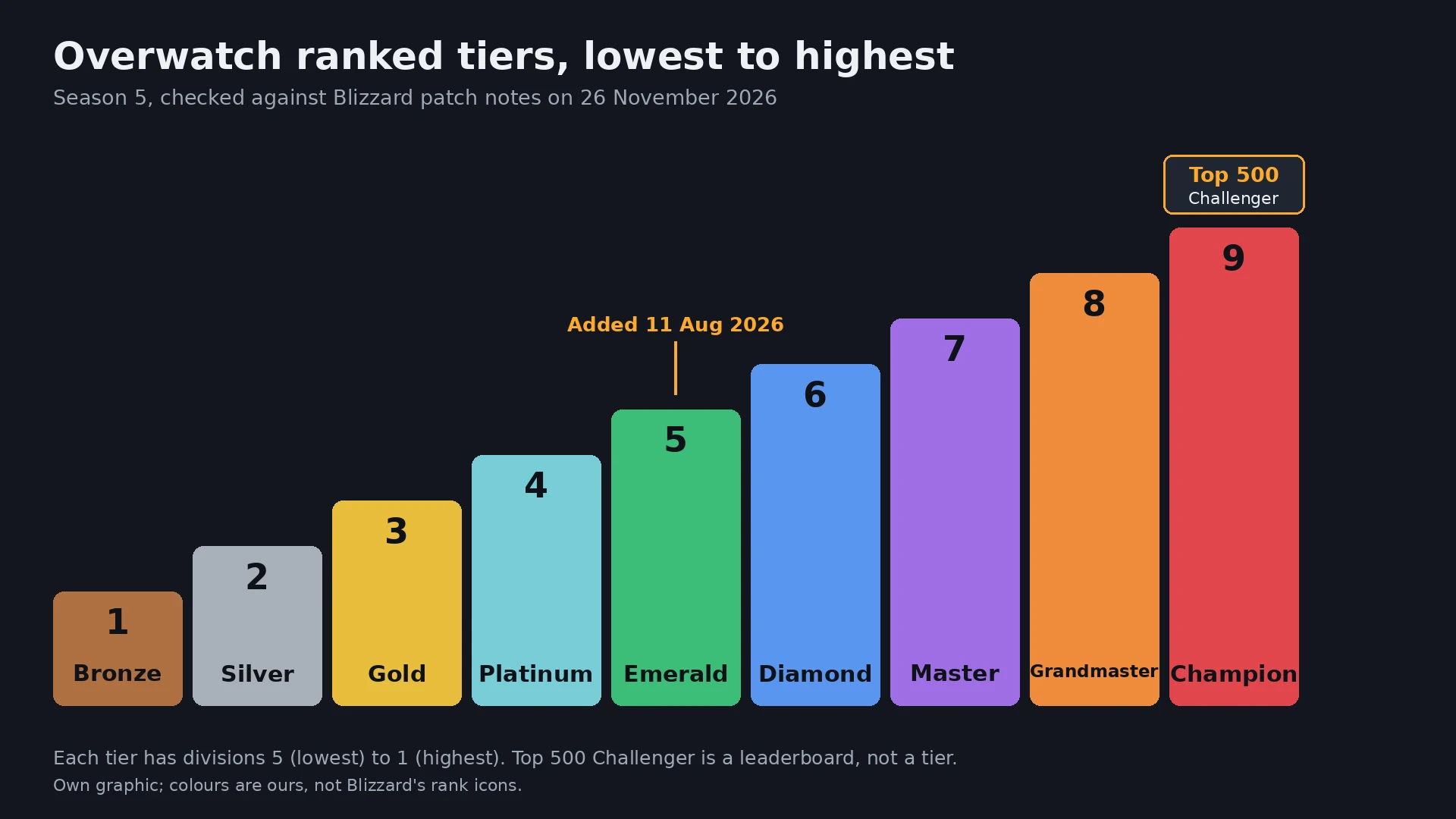
- Overwatch ranks run through nine tiers since Emerald joined between Platinum and Diamond on 11 August 2026.
- You need 10 placement matches in each role to get a rank, and your rank updates after every match.
- Top 500 Challenger is a leaderboard above Champion, not a tenth tier.
- Checked against: Blizzard patch notes and developer posts, 2022 to 16 November 2026.
Any Overwatch rank guide written before August 2026 is missing a tier. Blizzard’s 11 August 2026 patch notes added Emerald between Platinum and Diamond, which makes nine tiers, and the same patch moved players who had been Platinum and Diamond into it. Other rules have moved too. A guide that says you get a rank update every “seven wins or 20 losses”, or that Top 500 needs 750 wins, is repeating rules Blizzard has since retired.
This guide uses only what Blizzard’s patch notes and developer posts say, up to the 16 November 2026 update (Season 5), and says so where they stop short. One question comes up more than any other: is the badge on your profile your hidden matchmaking rating? Blizzard answered it in its February 2026 notes, and the answer differs from what older guides say. It is in the MMR section below, in Blizzard’s own words.
Verified on 26 November 2026 against the patch notes; values may change with updates. Nothing here was play-tested: we did not run placements for this piece, so every number is Blizzard’s or is labelled as the community wiki’s.
Quick Start: How to Get Your First Overwatch Rank
You need 50 wins before Competitive Play opens, then 10 placement matches in the queue and role you choose. The steps:
- Win 50 matches. Blizzard’s 12 May 2026 notes raised the unlock requirement from 20 wins to 50 wins; the Overwatch community wiki counts wins in Quick Play or Stadium, with Stadium wins counting double.
- Open Competitive Play and choose Role Queue or Open Queue. Each queue keeps its own rank.
- Pick the role you want ranked first. Blizzard says you must complete 10 matches in a role to receive your rank for that role.
- Play the 10 placement matches. A predicted rank shows after each one.
- After placements, your rank updates after every match.
- Open the Competitive Overview and read the Rank Distribution Indicator, added on 11 August 2026, to see where your rank sits among players in that queue.
One practical note before you start: placements are the first ten games a new rank is built from, so sort your graphics first. Our best Overwatch 2 PC settings guide covers the high-frame-rate config, and the low-end PC settings guide covers weaker hardware. We do not repeat them here.
Overwatch Ranks in Order: Nine Tiers From Bronze to Champion
From lowest to highest the tiers are Bronze, Silver, Gold, Platinum, Emerald, Diamond, Master, Grandmaster and Champion. Blizzard’s 2022 competitive post says each tier has five divisions ranking from 5 (lowest) to 1 (highest), and that your division counts down until you rank up to the next tier. Blizzard’s August 2026 list of Challenger Score values names Champion 5 through Champion 1, so the five-division pattern still holds at the top. The five divisions of Emerald come from the community wiki only; Blizzard’s Emerald note does not give a number.
| Tier | Divisions | What Blizzard’s notes say about it | Share of players |
|---|---|---|---|
| Champion | 5 to 1 | Added above Grandmaster in February 2024 (Season 9 notes). The August 2026 patch made its highest divisions “more exclusive”. | Not published |
| Grandmaster | 5 to 1 | Challenger Score values are listed for Grandmaster 2 and 1 (August 2026). | Not published |
| Master | 5 to 1 | Master, Grandmaster and Champion were tuned in August 2025 to hold a higher share of players once ranks settled. | Not published |
| Diamond | 5 to 1 | Many former Diamond players moved into Emerald in August 2026. Diamond no longer qualifies for Top 500 Challenger (February 2026). | Not published |
| Emerald | 5 to 1 (wiki) | New on 11 August 2026, between Platinum and Diamond, with its own titles and weapon charms. | Not published |
| Gold and Platinum | 5 to 1 | Blizzard wrote that the majority of its players are in Gold and Platinum, which is why it added a rank near the middle of the skill curve. | Not published since Emerald |
| Bronze and Silver | 5 to 1 | Part of the 2022 “Bronze through Grand Master” ladder. No tier-specific rule in the notes read. | Not published |
The pattern in the table: Blizzard widened the top in August 2025 (Master to Champion tuned to hold more players), added a tier in the middle in August 2026 (Emerald), and then tightened only the very top (the highest Champion divisions). The share column says “Not published” because Blizzard has not published a per-tier share since it added Emerald, and we will not invent one. Blizzard did say its February 2026 reset “did not change the Rank Distribution”, and it put the Rank Distribution Indicator into the game so you can read your own standing in a queue.
Stadium has a separate ranked ladder with its own leagues, from Novice up to Legend, according to the Stadium section of Blizzard’s April 2026 notes. Everything below is about Role Queue and Open Queue.
What Your Overwatch Rank Means, by Player Type
The same ladder asks different things of different players. The advice in the right-hand column is sourced to Blizzard where it can be, and marked as ours where it is a judgement.
| Player type | Your situation | What to do |
|---|---|---|
| New to ranked | You have not unlocked Competitive Play yet | Win 50 matches first. Then place the role you play most; each role takes its own 10 placement matches (our advice on order). |
| Returning after a break | You last played ranked months ago | An early Overwatch 2 matchmaker post from Blizzard said both tier and rating can decay for players who stay away a long time, and that returners may see dramatic shifts. Blizzard has not restated that since Season 9, so treat it as a possibility, not a rule. |
| Mid-ladder climber (Bronze to Diamond) | Your tier label changed after 11 August | That patch moved many Platinum and Diamond players into Emerald, so a changed badge is not proof your skill changed. Check the Rank Distribution Indicator. |
| High-rank grinder (Master and up) | You want Top 500 Challenger | Rank decides the order now, but you still need enough Challenger Score to appear. See the Top 500 section below. |
Notice what the table cannot tell you: how fast any one match moves you. Blizzard publishes the modifiers (below) but not the size of a win in rank points.
Role Queue and Open Queue: Separate Ranks, Separate Placements
Each role in Role Queue has its own rank, and Open Queue has one more. Blizzard’s April 2024 notes made the titles show it: Champion Tank, Champion Support, Champion Damage and Open Queue Champion. That is why one account can be Platinum on tank and Diamond on damage, and why the February 2026 reset sent everyone to Unranked in both queues, with “their respective 10 placement matches for each role.”
The queue formats are changing. Blizzard’s Director’s Take on 5v5 and 6v6 says Season 6 will offer three Competitive options on day one: standard 5v5, Open Queue 6v6, and a Role Queue 6v6 test with a 2-2-2 setup. The Role Queue test is a four-week mini season that starts at season launch. The post gives no calendar date, and the Overwatch wiki’s season list puts Season 6 at 8 December 2026. It also does not say whether the test keeps a rank separate from your 5v5 Role Queue rank, so check the in-game Competitive Overview on day one.
Do not confuse any of this with Hero Skill Rating, which has nothing to do with your tier. Blizzard’s August 2025 notes describe it as a number from 0 to 5,000, with 5,000 equal to the top of Champion 1, earned per hero after 5 placement matches on that hero, and “not used in Matchmaking in any way.” It is a practice scoreboard, not a second rank that moves your lobbies.
Rewards follow the same logic as the ladder. Since August 2025, Competitive rewards are based on your highest rank in a season, not your final rank, with Top 500 as the exception: it needs your final rank.
What the 10 Placement Matches Really Set
The 10 matches set your starting rank in that role, and Blizzard says winning them has “a significant impact on your final rank.” The February 2024 notes rebuilt placements “from the ground up”: you complete 10 matches in a role, and a predicted rank displays after each one. Blizzard gives no formula for how a result turns into a tier. The community wiki adds that a loss still counts toward your ten. For how placements work in another new ranked mode, see our Gears of War: E-Day ranked placements explainer.
What placements do not do is lock you in. The same notes switched Competitive Updates from waiting for five wins or 15 losses to an update after every match, so a weak start can be corrected. Blizzard shows no figure for how quickly, so treat any claim about “games to climb back” as unsourced.
When a season reset sends everyone back to placements
The notes record five full rank resets in two years, each followed by 10 placement matches per role: Season 9 on 13 February 2024, Season 12 on 20 August 2024 (when Blizzard wrote “our plan is to reset ranks every 6 months”), Season 15 on 18 February 2025, Season 18 on 26 August 2025, and the 10 February 2026 patch. Blizzard calls the last two soft resets, though every rank went to Unranked, and the August 2025 reset also reset Hero Skill Ratings for the first time. The February 2026 notes put the cadence differently, as a Rank Reset “every 3 seasons” with a new Top 500 player icon at each, “meaning that a new icon becomes available to earn every 3 seasons.” Both describe the same rhythm, since a season now lasts about two months.
One conflict to flag: Season 4’s August 2026 notes describe a “Ranks Redistributed” change for Emerald and do not mention a reset to Unranked, while the Overwatch wiki’s season list lists a competitive reset for that season. If your rank moved after 11 August, the notes explain it as a redistribution; if it went to Unranked, that would be the reset the wiki records, and the in-game Competitive Overview is the place to confirm which you got. Nothing in the Blizzard posts we read announces a reset for Season 6, and Blizzard’s Director’s Take mentions no rank reset, only the 6v6 Role Queue mini season, a 6v6 balance patch and some matchmaking changes.
How Promotion and Demotion Work Now: An Update After Every Match
Your rank updates after every match, and each loss can cost progress but does not always cost a division. That is the single rule that has changed most, and old guides get it wrong, as the table shows:
| Period | When your rank updates | Source |
|---|---|---|
| 2022 launch of Overwatch 2 | After 7 wins or 20 losses | Blizzard’s 2022 competitive post |
| Season 3 | After 5 wins or 15 losses | Blizzard’s matchmaker developer blog, part 2 (early Overwatch 2 era) |
| Season 9 (13 February 2024) to now | After every match | Blizzard’s February 2024 notes |
Blizzard’s February 2024 notes say modifiers appear after each match and explain how much progress a result gives or takes, including win or loss streaks, rank instability and match favorability. Its April 2024 notes added Demotion Protection: the bar shows it when a loss did not drop you a division, and if you lose the next match you drop to the previous division. In practice one loss at the bottom of a division is survivable; a second loss in a row is not.
Grouping also affects who you face. Blizzard’s April 2024 notes define a Narrow group, for Bronze to Diamond, as one where every member is within five divisions of each other; any other group is Wide, with longer queue times and lower match quality. Those notes barred Grandmaster and Champion players from Narrow groups, but the 16 November 2026 hotfix refers to “Narrow groups containing Champion players” in 5v5 Role Queue and cut the maximum width of groups with Champion players in 6v6 Open Queue from 4 to 3. The top-end rules have clearly changed since 2024 and we could not find the current full list. If you duo with a much higher-ranked friend, expect longer queues and less even lobbies.
Hidden MMR Versus Visible Rank: Linked Since Season 9, According to Blizzard

Since Season 9, Blizzard says your rank and your MMR are linked, so the badge is meant to be an accurate picture of the number that builds your lobbies. Before that, they could drift far apart. Blizzard’s February 2026 Top 500 notes put it this way: “Before Season 9 of Overwatch 2, Rank and MMR were not directly linked and could diverge considerably. After Season 9, we committed to Rank and MMR being linked in the Core game because we believe showing you the most accurate representation of your skill is important to the competitive integrity of the system.” “Linked” is Blizzard’s word; it does not say the two numbers are identical.
That is why older guides disagree with this one. Blizzard’s 2022 competitive post said tier and division “aren’t completely aligned with the matchmaking rating we use to determine matches,” and its early matchmaker blog said “we only create matches based on players’ MMR, not the visible competitive rank,” with the visible rank moving “towards their rating over time.” Both describe the system before Season 9. A guide that tells you your badge lags a hidden number is quoting them.
The same February 2026 notes explain why Blizzard will not decay ranks at the start of each season. It rejects that old “pseudo-Rank decay” because, with rank and MMR linked, “we’d be lowering the MMR of all of the highest ranked players every season,” which would be “effectively creating more severe versions of the Rank Resets we do every 3 seasons.” Blizzard does not call the reset a decay mechanism; it says decay would act like a harsher, more frequent reset for top players.
Hidden MMR has not vanished from Blizzard’s vocabulary. The June 2026 notes still speak of “hidden MMRs” when explaining why Stadium Ranked dropped its grouping restrictions, and the April 2026 Stadium notes say starting-rank changes should “bring player’s visual ranks more in line with their actual MMR.” Stadium Ranked is a separate system from the Role Queue and Open Queue ranks this guide covers.
What Blizzard has not published, in the pages we read, is how many rank points a win or loss is worth, or how the modifiers change MMR as opposed to the visible bar. Our practical reading, which is an inference and not a Blizzard statement: in Role Queue and Open Queue, treat your badge as your matchmaking level, and expect it to be least reliable during placements and just after a reset, when Blizzard’s own predicted rank is still settling.
Top 500 Challenger: A Leaderboard, Not a Tier
Top 500 Challenger sits above Champion as a leaderboard, and since 6 October 2026 it is sorted by rank. Blizzard’s October notes changed the default sort from Challenger Score to Rank, based end-of-season title rewards on Rank, and removed the Heat Bonus. Challenger Score now remains “only as a requirement to be on the leaderboard,” and Blizzard says it is possible to be Rank 1 with the lowest Challenger Score of the 500 players if you have the highest actual rank (October 2026 notes).
The entry rules came from the February 2026 patch: Diamond was removed from eligibility, the required challenge changed from Seasoned Competitor to Adept Competitor, and the total wins needed dropped from 750 to 250. Challenger Score is now always awarded from your own rank, and the deduction for a loss rose from 33% to 40%. The same notes cut the Challenger Score needed to appear to 2,000 for Combined Role and Open Queue (from 5,000) and 1,500 for each individual role (from 4,000); later notes do not restate those minimums, so they may have changed. The wiki lists a Master-or-higher rank requirement and Endorsement Level 2. Blizzard’s February payout table starts at Master 5 and drops Diamond, which fits Master or higher, but we did not find either requirement stated outright in the notes we read, so check the in-game requirements.
The February notes set Challenger Score per rank and division, from Master 5 at 20 up to Champion 1 at 700. In August 2026 Blizzard raised the values for the highest divisions. The list is headed “Challenger Score Tuning” and says the change “makes winning at our highest ranks more rewarding,” so read the numbers as the score tied to winning at that rank; Blizzard does not spell out the unit.
| Rank | Before 11 August 2026 | After |
|---|---|---|
| Grandmaster 2 | 175 | 200 |
| Grandmaster 1 | 200 | 250 |
| Champion 5 | 250 | 350 |
| Champion 4 | 300 | 450 |
| Champion 3 | 400 | 550 |
| Champion 2 | 550 | 700 |
| Champion 1 | 700 | 900 |
The takeaway is the slope: Champion 1 is now 900 against Grandmaster 2’s 200, a 4.5x gap. Blizzard said in February 2026 that the larger payouts at the top account for both the difficulty of holding these ranks and the longer queue times that come with them. The August list carried a warning too: the Challenger System has “more foundational problems that can’t be addressed by tuning,” and in October Blizzard switched the default sort to rank.
Overwatch Ranks FAQ
How many ranks are there in Overwatch?
Nine tiers: Bronze, Silver, Gold, Platinum, Emerald, Diamond, Master, Grandmaster and Champion, each split into divisions 5 to 1 (Emerald’s five come from the community wiki). Top 500 Challenger is a leaderboard above them, not a tenth tier. Guides that list eight tiers predate Emerald’s arrival on 11 August 2026.
How many placement matches do you need in Overwatch?
Ten per role in Role Queue, according to Blizzard’s February 2024 and February 2026 notes. The February 2026 notes also reset Open Queue and say players needed to complete “their respective 10 placement matches”, so plan on ten there too. Hero placements are different: 5 matches per hero, and they do not feed matchmaking, so ignore them when your goal is your tier.
Why did my rank change after 11 August 2026?
Blizzard’s notes say the Emerald redistribution mainly moved players who had been Platinum and Diamond into Emerald, and made the highest Champion divisions more exclusive. A new badge after that patch is therefore expected for many players and is not evidence of a skill change. The Rank Distribution Indicator shows where you stand now.
How do you get into Top 500 Challenger?
You need the Adept Competitor challenge, 250 total wins, and enough Challenger Score to be among the 500 highest, with rank deciding the order. Blizzard’s notes cover the wins and the challenge; the community wiki also lists Master or higher and Endorsement Level 2, which we did not find stated outright in the Blizzard notes we read (the payout table starting at Master 5 fits Master or higher).
By name, yes, for Stadium Ranked (June 2026 notes). For Role Queue and Open Queue, Blizzard’s February 2026 notes say Rank and MMR have been linked since Season 9, so the badge is meant to track the matchmaking number. The picture of a hidden rating running ahead of your badge belongs to the earlier system.
Sources
- Blizzard Entertainment. Overwatch Retail Patch Notes, August 2026 (11 August entry: New Skill Tier – Emerald, Rank Distribution Indicator, Challenger Score Tuning). Overwatch patch notes
- Blizzard Entertainment. Overwatch Retail Patch Notes, February 2026 (10 February entry: Rank Reset, Top 500 Challenger Updates). Overwatch patch notes
- Blizzard Entertainment. Overwatch Retail Patch Notes, October 2026 (6 October entry: Top 500 Challenger System Updates). Overwatch patch notes
- Blizzard Entertainment. Overwatch Retail Patch Notes, November 2026 (16 November entry: Competitive Play Updates). Overwatch patch notes
- Blizzard Entertainment. Overwatch Retail Patch Notes, May 2026 (12 May entry: Competitive Play unlock requirement). Overwatch patch notes
- Blizzard Entertainment. Overwatch Retail Patch Notes, April 2026 (Stadium Updates: ranked progress at season start). Overwatch patch notes
- Blizzard Entertainment. Overwatch Retail Patch Notes, June 2026 (Stadium Ranked grouping restrictions and hidden MMRs). Overwatch patch notes
- Blizzard Entertainment. Overwatch 2 Retail Patch Notes, February 2025 (18 February entry: Season 15 Skill Rank Reset). Overwatch patch notes
- Blizzard Entertainment. Overwatch 2 Retail Patch Notes, August 2024 (20 August entry: Mid-Year Rank Reset for Season 12). Overwatch patch notes
- Blizzard Entertainment. Overwatch 2 Retail Patch Notes, August 2025 (26 August entry: Season 18 Skill Rank Reset, Hero Skill Rating, Competitive Rewards). Overwatch patch notes
- Blizzard Entertainment. Overwatch 2 Retail Patch Notes, April 2024 (16 April entry: Grouping Restrictions, Demotion Protection, role titles). Overwatch patch notes
- Blizzard Entertainment. Overwatch 2 Retail Patch Notes, February 2024 (13 February entry: Season 9 Skill Rank Reset, Placement Matches, Competitive Updates, Champion). Overwatch patch notes
- Blizzard Entertainment. Initializing systems! Updating Competitive play for Overwatch 2 (2022). Overwatch news
- Blizzard Entertainment. Overwatch 2 Developer Blog: Explaining matchmaker goals and plans, part 2. Overwatch news
- Blizzard Entertainment. Director’s Take: 5v5 and 6v6, Better Together. Blizzard News
- Overwatch Wiki. Competitive Play (page last edited 22 November 2026). Overwatch Wiki
- Overwatch Wiki. Season/2026 (season dates and competitive changes). Overwatch Wiki

I've been playing video games for over 20 years, spanning everything from early PC titles to modern open-world games. I started Switchblade Gaming to publish the kind of accurate, well-researched guides I always wanted to find — built on primary sources, tested in-game, and kept up to date after patches. I currently focus on Minecraft and Pokémon GO.